Event submissions
Published
This submission belongs to the session B. Genetic Diagnosis and Targeted Therapy in Cancer of the event The 2nd International Electronic Conference on Genes
Published date
09 Dec, 2024
Academic Editor
'%3e%3cpath%20d='M12.6657%2010.9104C12.4185%2010.325%2012.0599%209.79327%2011.6097%209.34482C11.1609%208.89508%2010.6293%208.5365%2010.0442%208.28888C10.0389%208.28626%2010.0337%208.28495%2010.0285%208.28233C10.8446%207.69279%2011.3752%206.73249%2011.3752%205.64904C11.3752%203.8542%209.92103%202.39999%208.1262%202.39999C6.33136%202.39999%204.87715%203.8542%204.87715%205.64904C4.87715%206.73249%205.40774%207.69279%206.22393%208.28364C6.21869%208.28626%206.21345%208.28757%206.20821%208.29019C5.62129%208.5378%205.09463%208.89284%204.64265%209.34613C4.1929%209.79493%203.83432%2010.3266%203.58671%2010.9117C3.34345%2011.4845%203.21226%2012.0987%203.20023%2012.7209C3.19988%2012.7349%203.20233%2012.7488%203.20744%2012.7619C3.21255%2012.7749%203.22022%2012.7867%203.22998%2012.7968C3.23975%2012.8068%203.25142%2012.8147%203.26431%2012.8202C3.2772%2012.8256%203.29105%2012.8284%203.30504%2012.8284H4.09109C4.14874%2012.8284%204.19459%2012.7825%204.1959%2012.7262C4.2221%2011.7148%204.62823%2010.7676%205.34617%2010.0497C6.08899%209.30683%207.0755%208.89808%208.1262%208.89808C9.17689%208.89808%2010.1634%209.30683%2010.9062%2010.0497C11.6242%2010.7676%2012.0303%2011.7148%2012.0565%2012.7262C12.0578%2012.7838%2012.1037%2012.8284%2012.1613%2012.8284H12.9474C12.9613%2012.8284%2012.9752%2012.8256%2012.9881%2012.8202C13.001%2012.8147%2013.0126%2012.8068%2013.0224%2012.7968C13.0322%2012.7867%2013.0398%2012.7749%2013.0449%2012.7619C13.0501%2012.7488%2013.0525%2012.7349%2013.0522%2012.7209C13.0391%2012.0947%2012.9094%2011.4855%2012.6657%2010.9104ZM8.1262%207.9024C7.52486%207.9024%206.9589%207.6679%206.53312%207.24211C6.10733%206.81633%205.87283%206.25037%205.87283%205.64904C5.87283%205.0477%206.10733%204.48174%206.53312%204.05596C6.9589%203.63018%207.52486%203.39567%208.1262%203.39567C8.72753%203.39567%209.29349%203.63018%209.71927%204.05596C10.1451%204.48174%2010.3796%205.0477%2010.3796%205.64904C10.3796%206.25037%2010.1451%206.81633%209.71927%207.24211C9.29349%207.6679%208.72753%207.9024%208.1262%207.9024Z'%20fill='%235D1EE1'/%3e%3c/g%3e%3c/svg%3e) Christos Kontos
Christos KontosCitation
Milena M. Jovanović, Dragana Šeklić, UNSATURATED QUEEN BEE ACID FROM ROYAL JELLY 10H2DA MODULATES THE EPITHELIAL-TO-MESENCHYMAL TRANSITION IN SW-480 COLORECTAL CANCER CELLS, in Proceedings of The 2nd International Electronic Conference on Genes, 11 December–13 December 2024, MDPI: Basel, Switzerland
Share
Email
Facebook
Twitter
LinkedIn
UNSATURATED QUEEN BEE ACID FROM ROYAL JELLY 10H2DA MODULATES THE EPITHELIAL-TO-MESENCHYMAL TRANSITION IN SW-480 COLORECTAL CANCER CELLS
'%3e%3cpath%20d='M12.6647%2010.9104C12.4176%2010.325%2012.0589%209.7933%2011.6088%209.34485C11.16%208.89511%2010.6283%208.53653%2010.0432%208.28891C10.038%208.28629%2010.0327%208.28498%2010.0275%208.28236C10.8437%207.69282%2011.3743%206.73252%2011.3743%205.64907C11.3743%203.85423%209.92005%202.40002%208.12522%202.40002C6.33038%202.40002%204.87618%203.85423%204.87618%205.64907C4.87618%206.73252%205.40677%207.69282%206.22296%208.28367C6.21772%208.28629%206.21248%208.2876%206.20724%208.29022C5.62031%208.53783%205.09365%208.89287%204.64167%209.34616C4.19192%209.79496%203.83334%2010.3266%203.58573%2010.9117C3.34247%2011.4846%203.21128%2012.0987%203.19925%2012.721C3.1989%2012.735%203.20135%2012.7489%203.20646%2012.7619C3.21157%2012.7749%203.21924%2012.7868%203.22901%2012.7968C3.23877%2012.8068%203.25045%2012.8148%203.26334%2012.8202C3.27623%2012.8256%203.29007%2012.8284%203.30406%2012.8284H4.09012C4.14776%2012.8284%204.19362%2012.7825%204.19493%2012.7262C4.22113%2011.7148%204.62726%2010.7676%205.34519%2010.0497C6.08802%209.30686%207.07452%208.89811%208.12522%208.89811C9.17592%208.89811%2010.1624%209.30686%2010.9052%2010.0497C11.6232%2010.7676%2012.0293%2011.7148%2012.0555%2012.7262C12.0568%2012.7839%2012.1027%2012.8284%2012.1603%2012.8284H12.9464C12.9604%2012.8284%2012.9742%2012.8256%2012.9871%2012.8202C13%2012.8148%2013.0117%2012.8068%2013.0214%2012.7968C13.0312%2012.7868%2013.0389%2012.7749%2013.044%2012.7619C13.0491%2012.7489%2013.0515%2012.735%2013.0512%2012.721C13.0381%2012.0947%2012.9084%2011.4856%2012.6647%2010.9104ZM8.12522%207.90243C7.52388%207.90243%206.95792%207.66793%206.53214%207.24215C6.10636%206.81636%205.87185%206.2504%205.87185%205.64907C5.87185%205.04773%206.10636%204.48177%206.53214%204.05599C6.95792%203.63021%207.52388%203.3957%208.12522%203.3957C8.72655%203.3957%209.29252%203.63021%209.7183%204.05599C10.1441%204.48177%2010.3786%205.04773%2010.3786%205.64907C10.3786%206.2504%2010.1441%206.81636%209.7183%207.24215C9.29252%207.66793%208.72655%207.90243%208.12522%207.90243Z'%20fill='%235D1EE1'/%3e%3c/g%3e%3c/svg%3e)
Milena M. Jovanović 1
Dragana Šeklić 2
1. Department for biology and ecology, Faculty of Science, University of Kragujevac, Kragujevac, 34000, Serbia
2. Institute for Information Technologies Kragujevac, University of Kragujevac, 34 000 Kragujevac, Serbia
Abstract
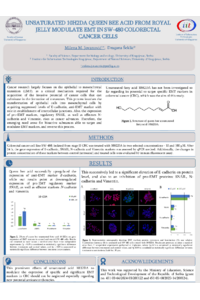
Cancer research largely focuses on the epithelial-to-mesenchymal transition (EMT) as a critical mechanism required for the acquisition of the invasive potential of cancer cells, which can culminate in the formation of metastases. This process involves the transformation of epithelial cells into mesenchymal cells by acquiring suppressed levels of E-cadherin, an anti-EMT marker with a role in the establishment of intercellular junctions. Also, the expression of pro-EMT markers, such as the regulatory marker SNAIL, as well as the effectors N-cadherin and Vimentin, rises as cancer advances. Therefore, there is an emerging need for bioactive substances able to target and modulate EMT markers and reverse this process. The unsaturated fatty acid 10H2DA has not been investigated so far regarding its potential to target specific EMT markers in colorectal cancer (CRC), which was the aim of this study.
Colorectal cancer cell line SW-480 isolated from stage II CRC was treated with 10H2DA in two selected concentrations of 10 and 100 μM. After 24 h, the gene expression of E-cadherin, SNAIL, N-cadherin, and Vimentin markers was assessed by the qPCR method. Additionally, changes in the protein concentration of these markers between control (untreated) and treated cells were evaluated by immunofluorescent assay.
Queen bee acid successfully upregulated the expression of the anti-EMT marker E-cadherin. Our results also point towards a downregulated expression of the pro-EMT regulatory marker SNAIL, as well as the effector markers N-cadherin and Vimentin. This successively led to a significant elevation in E-cadherin on the protein level, and also to an inhibition of pro-EMT proteins, namely, SNAIL, N-cadherin, and Vimentin.
The potential of the unsaturated acid 10H2DA to modulate the expression of specific and significant EMT markers in CRC is obvious and prominent, and it should not be neglected in future studies regarding anticancer therapeutic approaches.
Keywords
E-cadherin
immunofluorescence
N-cadherin
qPCR
SNAIL
Vimentin
Poster
Jovanovic et al. - Poster.pdf
Elucidation of the molecular basis of phenotypes in Seri-genetic resources (Bombyx mori L. and Morus spp.) using repository RNA-Seq datasets: A self-service data-mining approach
Recurrent clinically significant mutations in acute myeloid leukemia: analysis of the cancer genomics database and proprietary data on the CBio portal