Event submissions
Published
This submission belongs to the session B. Animal genetics and genomics of the event The 3rd International Electronic Conference on Animals
Published date
07 Mar, 2025
Academic Editor
'%3e%3cpath%20d='M12.6657%2010.9104C12.4185%2010.325%2012.0599%209.79327%2011.6097%209.34482C11.1609%208.89508%2010.6293%208.5365%2010.0442%208.28888C10.0389%208.28626%2010.0337%208.28495%2010.0285%208.28233C10.8446%207.69279%2011.3752%206.73249%2011.3752%205.64904C11.3752%203.8542%209.92103%202.39999%208.1262%202.39999C6.33136%202.39999%204.87715%203.8542%204.87715%205.64904C4.87715%206.73249%205.40774%207.69279%206.22393%208.28364C6.21869%208.28626%206.21345%208.28757%206.20821%208.29019C5.62129%208.5378%205.09463%208.89284%204.64265%209.34613C4.1929%209.79493%203.83432%2010.3266%203.58671%2010.9117C3.34345%2011.4845%203.21226%2012.0987%203.20023%2012.7209C3.19988%2012.7349%203.20233%2012.7488%203.20744%2012.7619C3.21255%2012.7749%203.22022%2012.7867%203.22998%2012.7968C3.23975%2012.8068%203.25142%2012.8147%203.26431%2012.8202C3.2772%2012.8256%203.29105%2012.8284%203.30504%2012.8284H4.09109C4.14874%2012.8284%204.19459%2012.7825%204.1959%2012.7262C4.2221%2011.7148%204.62823%2010.7676%205.34617%2010.0497C6.08899%209.30683%207.0755%208.89808%208.1262%208.89808C9.17689%208.89808%2010.1634%209.30683%2010.9062%2010.0497C11.6242%2010.7676%2012.0303%2011.7148%2012.0565%2012.7262C12.0578%2012.7838%2012.1037%2012.8284%2012.1613%2012.8284H12.9474C12.9613%2012.8284%2012.9752%2012.8256%2012.9881%2012.8202C13.001%2012.8147%2013.0126%2012.8068%2013.0224%2012.7968C13.0322%2012.7867%2013.0398%2012.7749%2013.0449%2012.7619C13.0501%2012.7488%2013.0525%2012.7349%2013.0522%2012.7209C13.0391%2012.0947%2012.9094%2011.4855%2012.6657%2010.9104ZM8.1262%207.9024C7.52486%207.9024%206.9589%207.6679%206.53312%207.24211C6.10733%206.81633%205.87283%206.25037%205.87283%205.64904C5.87283%205.0477%206.10733%204.48174%206.53312%204.05596C6.9589%203.63018%207.52486%203.39567%208.1262%203.39567C8.72753%203.39567%209.29349%203.63018%209.71927%204.05596C10.1451%204.48174%2010.3796%205.0477%2010.3796%205.64904C10.3796%206.25037%2010.1451%206.81633%209.71927%207.24211C9.29349%207.6679%208.72753%207.9024%208.1262%207.9024Z'%20fill='%235D1EE1'/%3e%3c/g%3e%3c/svg%3e) Clive Julian Phillips
Clive Julian PhillipsCitation
Luis F. Cartuche-Macas, Edilberto Chacón, Miguel M. Gutiérrez-Reinoso, Manuel García-Herreros, Assessing inbreeding and genetic diversity in South American Brown Swiss cattle: The Ecuadorian experience, in Proceedings of The 3rd International Electronic Conference on Animals, 12 March–14 March 2025, MDPI: Basel, Switzerland
Share
Email
Facebook
Twitter
LinkedIn
Assessing inbreeding and genetic diversity in South American Brown Swiss cattle: The Ecuadorian experience

Luis F. Cartuche-Macas 1

Edilberto Chacón 2
'%3e%3cpath%20d='M12.6647%2010.9104C12.4176%2010.325%2012.0589%209.7933%2011.6088%209.34485C11.16%208.89511%2010.6283%208.53653%2010.0432%208.28891C10.038%208.28629%2010.0327%208.28498%2010.0275%208.28236C10.8437%207.69282%2011.3743%206.73252%2011.3743%205.64907C11.3743%203.85423%209.92005%202.40002%208.12522%202.40002C6.33038%202.40002%204.87618%203.85423%204.87618%205.64907C4.87618%206.73252%205.40677%207.69282%206.22296%208.28367C6.21772%208.28629%206.21248%208.2876%206.20724%208.29022C5.62031%208.53783%205.09365%208.89287%204.64167%209.34616C4.19192%209.79496%203.83334%2010.3266%203.58573%2010.9117C3.34247%2011.4846%203.21128%2012.0987%203.19925%2012.721C3.1989%2012.735%203.20135%2012.7489%203.20646%2012.7619C3.21157%2012.7749%203.21924%2012.7868%203.22901%2012.7968C3.23877%2012.8068%203.25045%2012.8148%203.26334%2012.8202C3.27623%2012.8256%203.29007%2012.8284%203.30406%2012.8284H4.09012C4.14776%2012.8284%204.19362%2012.7825%204.19493%2012.7262C4.22113%2011.7148%204.62726%2010.7676%205.34519%2010.0497C6.08802%209.30686%207.07452%208.89811%208.12522%208.89811C9.17592%208.89811%2010.1624%209.30686%2010.9052%2010.0497C11.6232%2010.7676%2012.0293%2011.7148%2012.0555%2012.7262C12.0568%2012.7839%2012.1027%2012.8284%2012.1603%2012.8284H12.9464C12.9604%2012.8284%2012.9742%2012.8256%2012.9871%2012.8202C13%2012.8148%2013.0117%2012.8068%2013.0214%2012.7968C13.0312%2012.7868%2013.0389%2012.7749%2013.044%2012.7619C13.0491%2012.7489%2013.0515%2012.735%2013.0512%2012.721C13.0381%2012.0947%2012.9084%2011.4856%2012.6647%2010.9104ZM8.12522%207.90243C7.52388%207.90243%206.95792%207.66793%206.53214%207.24215C6.10636%206.81636%205.87185%206.2504%205.87185%205.64907C5.87185%205.04773%206.10636%204.48177%206.53214%204.05599C6.95792%203.63021%207.52388%203.3957%208.12522%203.3957C8.72655%203.3957%209.29252%203.63021%209.7183%204.05599C10.1441%204.48177%2010.3786%205.04773%2010.3786%205.64907C10.3786%206.2504%2010.1441%206.81636%209.7183%207.24215C9.29252%207.66793%208.72655%207.90243%208.12522%207.90243Z'%20fill='%235D1EE1'/%3e%3c/g%3e%3c/svg%3e)
Miguel M. Gutiérrez-Reinoso 2

Manuel García-Herreros 3,4
1. Asociación Holstein Friesian del Ecuador, Quito, Ecuador
2. Medicina Veterinaria, Universidad Técnica de Cotopaxi (UTC), Latacunga, Ecuador
3. Instituto Nacional de Investigação Agrária e Veterinária (INIAV), Santarém, Portugal
4. CIISA-AL4AnimalS, Faculty of Veterinary Medicine, University of Lisbon, Lisbon, Portugal
Abstract
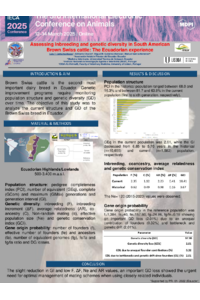
The Brown Swiss cattle is the second most important dairy breed in Ecuador. Genetic improvement programs require monitoring population structure and genetic diversity (GD) over time. The objective was to analyze the current structure and GD of the Brown Swiss breed in Ecuador. The genealogical database of the Ecuadorian Brown Swiss Association, with 30,332 females and 5,846 males was used. Three databases were designed: historical (all individuals= 36,178), current (individuals born between 2014-2023= 3,698) and reference (individuals with known sire and dam within the current population= 3,016). Population variables: pedigree completeness index (PCI), number of equivalent (GEq), complete (GCom) and maximum (GMax) generations and generation interval (GI). DG variables: inbreeding (F), inbreeding increment (ΔF), average relatedness (AR), co-ancestry (C), Non-random mating (α), effective population size (Ne) and genetic conservation index (GCI). The gene origin probability variables: number of founders (f), effective number of founders (fe) and ancestors (fa), number of equivalent genomes (fg), fe/fa and fg/fa ratio and DG losses. The databases were analyzed by ENDOG and POPREP software. PCI in the historical population ranged between 68.0-16.3% and between 81.7-63.9% in the current population (1st to 6th generation, respectively). GEq in the current population was 2.61 while the GI decreased from 6.85 to 5.70 years in the historical (n=10,655) and current (n=1,582) population, respectively. In addition, F=2.35%, AR=2.23%, ΔF= 0.41%, C= 1.12%, α=0.0125; GCI=10.41, and Ne= 120 (2015-2020) values were observed. Gene origin probability in the reference population was f=1,384, fa=40, fe=157.60, fg=24.86, fg/fe=0.16 showing an important GD loss (2.01%) due to unequal contribution of founders (0.32%) and bottleneck and genetic drift (2.01%). In conclusion, despite the slight reduction of GI and low F, ΔF, Ne and AR values, an important GD loss showed the urgent need for optimal management of mating schemes when using closely related individuals.
Keywords
Pedigree
inbreeding
population structure
genetic diversity
Brown Swiss cattle
Poster
IECA2025Poster-110752.pdf
Analysis of Ecuadorian Montbeliarde dairy cattle population revealed an increased inbreeding rate and genetic diversity loss
Estimation of Genetic Parameters and Weighted Single-Step Genome-Wide Association Studies for Fertility Traits in Holstein Cattle Using Liquid Chip