Event submissions
Published
This submission belongs to the session B. Animal genetics and genomics of the event The 3rd International Electronic Conference on Animals
Published date
07 Mar, 2025
Academic Editor
'%3e%3cpath%20d='M12.6657%2010.9104C12.4185%2010.325%2012.0599%209.79327%2011.6097%209.34482C11.1609%208.89508%2010.6293%208.5365%2010.0442%208.28888C10.0389%208.28626%2010.0337%208.28495%2010.0285%208.28233C10.8446%207.69279%2011.3752%206.73249%2011.3752%205.64904C11.3752%203.8542%209.92103%202.39999%208.1262%202.39999C6.33136%202.39999%204.87715%203.8542%204.87715%205.64904C4.87715%206.73249%205.40774%207.69279%206.22393%208.28364C6.21869%208.28626%206.21345%208.28757%206.20821%208.29019C5.62129%208.5378%205.09463%208.89284%204.64265%209.34613C4.1929%209.79493%203.83432%2010.3266%203.58671%2010.9117C3.34345%2011.4845%203.21226%2012.0987%203.20023%2012.7209C3.19988%2012.7349%203.20233%2012.7488%203.20744%2012.7619C3.21255%2012.7749%203.22022%2012.7867%203.22998%2012.7968C3.23975%2012.8068%203.25142%2012.8147%203.26431%2012.8202C3.2772%2012.8256%203.29105%2012.8284%203.30504%2012.8284H4.09109C4.14874%2012.8284%204.19459%2012.7825%204.1959%2012.7262C4.2221%2011.7148%204.62823%2010.7676%205.34617%2010.0497C6.08899%209.30683%207.0755%208.89808%208.1262%208.89808C9.17689%208.89808%2010.1634%209.30683%2010.9062%2010.0497C11.6242%2010.7676%2012.0303%2011.7148%2012.0565%2012.7262C12.0578%2012.7838%2012.1037%2012.8284%2012.1613%2012.8284H12.9474C12.9613%2012.8284%2012.9752%2012.8256%2012.9881%2012.8202C13.001%2012.8147%2013.0126%2012.8068%2013.0224%2012.7968C13.0322%2012.7867%2013.0398%2012.7749%2013.0449%2012.7619C13.0501%2012.7488%2013.0525%2012.7349%2013.0522%2012.7209C13.0391%2012.0947%2012.9094%2011.4855%2012.6657%2010.9104ZM8.1262%207.9024C7.52486%207.9024%206.9589%207.6679%206.53312%207.24211C6.10733%206.81633%205.87283%206.25037%205.87283%205.64904C5.87283%205.0477%206.10733%204.48174%206.53312%204.05596C6.9589%203.63018%207.52486%203.39567%208.1262%203.39567C8.72753%203.39567%209.29349%203.63018%209.71927%204.05596C10.1451%204.48174%2010.3796%205.0477%2010.3796%205.64904C10.3796%206.25037%2010.1451%206.81633%209.71927%207.24211C9.29349%207.6679%208.72753%207.9024%208.1262%207.9024Z'%20fill='%235D1EE1'/%3e%3c/g%3e%3c/svg%3e) Zissis Mamuris
Zissis MamurisCitation
Sarra Farjallah Amor, Emel Aboubekrine, The first insight into the genetic structure of the Monogenean Sparicotyle chrysophrii from Gilthead Sea Bream (Sparus aurata) Along the Tunisian Coasts, in Proceedings of The 3rd International Electronic Conference on Animals, 12 March–14 March 2025, MDPI: Basel, Switzerland
Share
Email
Facebook
Twitter
LinkedIn
The first insight into the genetic structure of the Monogenean Sparicotyle chrysophrii from Gilthead Sea Bream (Sparus aurata) Along the Tunisian Coasts
'%3e%3cpath%20d='M12.6647%2010.9104C12.4176%2010.325%2012.0589%209.7933%2011.6088%209.34485C11.16%208.89511%2010.6283%208.53653%2010.0432%208.28891C10.038%208.28629%2010.0327%208.28498%2010.0275%208.28236C10.8437%207.69282%2011.3743%206.73252%2011.3743%205.64907C11.3743%203.85423%209.92005%202.40002%208.12522%202.40002C6.33038%202.40002%204.87618%203.85423%204.87618%205.64907C4.87618%206.73252%205.40677%207.69282%206.22296%208.28367C6.21772%208.28629%206.21248%208.2876%206.20724%208.29022C5.62031%208.53783%205.09365%208.89287%204.64167%209.34616C4.19192%209.79496%203.83334%2010.3266%203.58573%2010.9117C3.34247%2011.4846%203.21128%2012.0987%203.19925%2012.721C3.1989%2012.735%203.20135%2012.7489%203.20646%2012.7619C3.21157%2012.7749%203.21924%2012.7868%203.22901%2012.7968C3.23877%2012.8068%203.25045%2012.8148%203.26334%2012.8202C3.27623%2012.8256%203.29007%2012.8284%203.30406%2012.8284H4.09012C4.14776%2012.8284%204.19362%2012.7825%204.19493%2012.7262C4.22113%2011.7148%204.62726%2010.7676%205.34519%2010.0497C6.08802%209.30686%207.07452%208.89811%208.12522%208.89811C9.17592%208.89811%2010.1624%209.30686%2010.9052%2010.0497C11.6232%2010.7676%2012.0293%2011.7148%2012.0555%2012.7262C12.0568%2012.7839%2012.1027%2012.8284%2012.1603%2012.8284H12.9464C12.9604%2012.8284%2012.9742%2012.8256%2012.9871%2012.8202C13%2012.8148%2013.0117%2012.8068%2013.0214%2012.7968C13.0312%2012.7868%2013.0389%2012.7749%2013.044%2012.7619C13.0491%2012.7489%2013.0515%2012.735%2013.0512%2012.721C13.0381%2012.0947%2012.9084%2011.4856%2012.6647%2010.9104ZM8.12522%207.90243C7.52388%207.90243%206.95792%207.66793%206.53214%207.24215C6.10636%206.81636%205.87185%206.2504%205.87185%205.64907C5.87185%205.04773%206.10636%204.48177%206.53214%204.05599C6.95792%203.63021%207.52388%203.3957%208.12522%203.3957C8.72655%203.3957%209.29252%203.63021%209.7183%204.05599C10.1441%204.48177%2010.3786%205.04773%2010.3786%205.64907C10.3786%206.2504%2010.1441%206.81636%209.7183%207.24215C9.29252%207.66793%208.72655%207.90243%208.12522%207.90243Z'%20fill='%235D1EE1'/%3e%3c/g%3e%3c/svg%3e)
Sarra Farjallah Amor 1
Emel Aboubekrine 1
1. Laboratory of Ecology, Biology and Physiology of Aquatic organisms LR18ES41, Faculty of Sciences of Tunis, University of Tunis El Manar, 2092, Tunis, Tunisia
Abstract
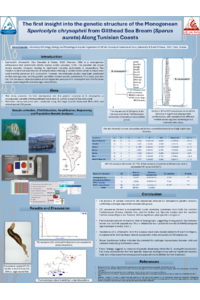
Sparicotyle chrysophrii (Van Beneden & Hesse, 1863) Mamaev, 1984 is a monogenean ectoparasite that specifically infects Sparus aurata Linnaeus, 1758. This parasite can cause parasitic diseases, leading to significant mortality, especially in aquaculture. The examination of the morpho-anatomical characteristics of ectoparasites infesting S. aurata across seven Tunisian sites confirmed the presence of S. chrysophrii. However, few molecular studies have been conducted on this monogenean, and its genetic variability remains poorly understood. This work provides the first molecular characterisation and phylogenetic analysis of S. chrysophrii from the Tunisian coasts, examining both wild and cage-reared hosts using two molecular markers: the large subunit ribosomal RNA (28S) and mitochondrial COI genes. The analysis of nuclear ribosomal 28S sequences revealed no intraspecific genetic variation, resulting in a strongly supported monophyletic group. The COI sequences were grouped into a monophyletic clade clustering specimens from both the northern Mediterranean (France, Adriatic Sea, Italian and Spanish coasts) and the southern Mediterranean (Algeria), showing no significant phylogenetic ramification. The haplotype network showed no distinct haplogroups, implying strong genetic flow between farmed and wild fish populations, as reflected by low nucleotide diversity (0.00445) relative to high haplotype diversity (0.821). Shared haplotypes indicated the potential for pathogen transmission between wild and cultured hosts along the Tunisian coasts. The AMOVA across the three regions (north, central, and south of Tunisia) showed that 0% of the total variation was attributed to differences among the groups, 7.62% to differences among populations within groups, and 92.77% to differences within populations. These findings indicate the absence of genetic structuring within the S. chrysophrii population. This study demonstrates that the species disperses homogenously and does not face significant barriers, likely due to the high gene flow occurring among parasite populations, facilitated by the dispersion potential of the host.
Keywords
Sparicotyle chrysophrii/Sparus aurata/ 28S/ COI/ Genetic structure/ Genetic flow/ Transfer of pathogenetic agents
Poster
03Monogenea-Int Con on Sustainable Agri-II-Turquie_sample_poster - Copy - Copy - Copy.pdf
Genetic Insights into Thermotolerance: Identifying miRNA Variants Linked to Heat Stress Resilience in Dairy Cows
Isolation and Molecular Characterization of Class II novel genotype of Newcastle disease virus from field outbreaks in Mizoram, NER, India