Event submissions
Published
This submission belongs to the session C. Sustainable animal physiology and reproduction of the event The 3rd International Electronic Conference on Animals
Published date
07 Mar, 2025
Academic Editor
'%3e%3cpath%20d='M12.6657%2010.9104C12.4185%2010.325%2012.0599%209.79327%2011.6097%209.34482C11.1609%208.89508%2010.6293%208.5365%2010.0442%208.28888C10.0389%208.28626%2010.0337%208.28495%2010.0285%208.28233C10.8446%207.69279%2011.3752%206.73249%2011.3752%205.64904C11.3752%203.8542%209.92103%202.39999%208.1262%202.39999C6.33136%202.39999%204.87715%203.8542%204.87715%205.64904C4.87715%206.73249%205.40774%207.69279%206.22393%208.28364C6.21869%208.28626%206.21345%208.28757%206.20821%208.29019C5.62129%208.5378%205.09463%208.89284%204.64265%209.34613C4.1929%209.79493%203.83432%2010.3266%203.58671%2010.9117C3.34345%2011.4845%203.21226%2012.0987%203.20023%2012.7209C3.19988%2012.7349%203.20233%2012.7488%203.20744%2012.7619C3.21255%2012.7749%203.22022%2012.7867%203.22998%2012.7968C3.23975%2012.8068%203.25142%2012.8147%203.26431%2012.8202C3.2772%2012.8256%203.29105%2012.8284%203.30504%2012.8284H4.09109C4.14874%2012.8284%204.19459%2012.7825%204.1959%2012.7262C4.2221%2011.7148%204.62823%2010.7676%205.34617%2010.0497C6.08899%209.30683%207.0755%208.89808%208.1262%208.89808C9.17689%208.89808%2010.1634%209.30683%2010.9062%2010.0497C11.6242%2010.7676%2012.0303%2011.7148%2012.0565%2012.7262C12.0578%2012.7838%2012.1037%2012.8284%2012.1613%2012.8284H12.9474C12.9613%2012.8284%2012.9752%2012.8256%2012.9881%2012.8202C13.001%2012.8147%2013.0126%2012.8068%2013.0224%2012.7968C13.0322%2012.7867%2013.0398%2012.7749%2013.0449%2012.7619C13.0501%2012.7488%2013.0525%2012.7349%2013.0522%2012.7209C13.0391%2012.0947%2012.9094%2011.4855%2012.6657%2010.9104ZM8.1262%207.9024C7.52486%207.9024%206.9589%207.6679%206.53312%207.24211C6.10733%206.81633%205.87283%206.25037%205.87283%205.64904C5.87283%205.0477%206.10733%204.48174%206.53312%204.05596C6.9589%203.63018%207.52486%203.39567%208.1262%203.39567C8.72753%203.39567%209.29349%203.63018%209.71927%204.05596C10.1451%204.48174%2010.3796%205.0477%2010.3796%205.64904C10.3796%206.25037%2010.1451%206.81633%209.71927%207.24211C9.29349%207.6679%208.72753%207.9024%208.1262%207.9024Z'%20fill='%235D1EE1'/%3e%3c/g%3e%3c/svg%3e) Clive Julian Phillips
Clive Julian PhillipsCitation
Lilian Leal Dantas, Andréia Maria da Silva, Romário Parente dos Santos, Pedro Augusto Pinheiro Brito, Alexandre Rodrigues Silva, Comparative evaluation of sperm parameters of European and Africanized drones in Caatinga biome, in Proceedings of The 3rd International Electronic Conference on Animals, 12 March–14 March 2025, MDPI: Basel, Switzerland
Share
Email
Facebook
Twitter
LinkedIn
Comparative evaluation of sperm parameters of European and Africanized drones in Caatinga biome
'%3e%3cpath%20d='M12.6647%2010.9104C12.4176%2010.325%2012.0589%209.7933%2011.6088%209.34485C11.16%208.89511%2010.6283%208.53653%2010.0432%208.28891C10.038%208.28629%2010.0327%208.28498%2010.0275%208.28236C10.8437%207.69282%2011.3743%206.73252%2011.3743%205.64907C11.3743%203.85423%209.92005%202.40002%208.12522%202.40002C6.33038%202.40002%204.87618%203.85423%204.87618%205.64907C4.87618%206.73252%205.40677%207.69282%206.22296%208.28367C6.21772%208.28629%206.21248%208.2876%206.20724%208.29022C5.62031%208.53783%205.09365%208.89287%204.64167%209.34616C4.19192%209.79496%203.83334%2010.3266%203.58573%2010.9117C3.34247%2011.4846%203.21128%2012.0987%203.19925%2012.721C3.1989%2012.735%203.20135%2012.7489%203.20646%2012.7619C3.21157%2012.7749%203.21924%2012.7868%203.22901%2012.7968C3.23877%2012.8068%203.25045%2012.8148%203.26334%2012.8202C3.27623%2012.8256%203.29007%2012.8284%203.30406%2012.8284H4.09012C4.14776%2012.8284%204.19362%2012.7825%204.19493%2012.7262C4.22113%2011.7148%204.62726%2010.7676%205.34519%2010.0497C6.08802%209.30686%207.07452%208.89811%208.12522%208.89811C9.17592%208.89811%2010.1624%209.30686%2010.9052%2010.0497C11.6232%2010.7676%2012.0293%2011.7148%2012.0555%2012.7262C12.0568%2012.7839%2012.1027%2012.8284%2012.1603%2012.8284H12.9464C12.9604%2012.8284%2012.9742%2012.8256%2012.9871%2012.8202C13%2012.8148%2013.0117%2012.8068%2013.0214%2012.7968C13.0312%2012.7868%2013.0389%2012.7749%2013.044%2012.7619C13.0491%2012.7489%2013.0515%2012.735%2013.0512%2012.721C13.0381%2012.0947%2012.9084%2011.4856%2012.6647%2010.9104ZM8.12522%207.90243C7.52388%207.90243%206.95792%207.66793%206.53214%207.24215C6.10636%206.81636%205.87185%206.2504%205.87185%205.64907C5.87185%205.04773%206.10636%204.48177%206.53214%204.05599C6.95792%203.63021%207.52388%203.3957%208.12522%203.3957C8.72655%203.3957%209.29252%203.63021%209.7183%204.05599C10.1441%204.48177%2010.3786%205.04773%2010.3786%205.64907C10.3786%206.2504%2010.1441%206.81636%209.7183%207.24215C9.29252%207.66793%208.72655%207.90243%208.12522%207.90243Z'%20fill='%235D1EE1'/%3e%3c/g%3e%3c/svg%3e)
Lilian Leal Dantas 1
Andréia Maria da Silva 1
Romário Parente dos Santos 1
Pedro Augusto Pinheiro Brito 1

Alexandre Rodrigues Silva 1
1. Laboratory of Animal Germplasm Conservation, UFERSA, Mossoró, RN, Brazil
Abstract
Bees play an essential role in pollination, as well as producing honey and other bee products. With over 20,000 known species, bees differ morphologically and physiologically, which emphasizes the need for knowledge about the biology and reproductive parameters of different species to promote management adjustments. Therefore, the objective was to compare the semen quality of European (Apis mellifera) with that of Africanized honeybee drones (Apis mellifera L.) raised in the Caatinga biome. This study was conducted at the Experimental Station (5º03‟37” S; 37º23‟50” W) of the Federal Rural University of the Semiarid Region (UFERSA) in Mossoró, RN, Brazil. Nine European bee drones and 16 Africanized bee drones, approximately 25 days old, were used. Semen collection was performed using the endophallus eversion technique, manually stimulated by abdominal pressure. The parameters analyzed included motility (light microscopy), membrane integrity (fluorescent probes: Hoechst 342 and propidium iodide), and functional integrity of the plasma membrane (hypo-osmotic test, 0 mOsm/L). Data, expressed as the mean ± standard error of the mean, were compared using the Mann–Whitney test (hypo-osmotic test) and Student's t-test (for other parameters), using GraphPad Prism® software version 9.3 (GraphPad Software Inc., San Diego, CA, USA), at 5% significance. Both species presented a sperm motility around 90%, with a membrane integrity of 82.4 ± 2.5% for European drones and 81.1 ± 2.4% for Africanized drones. In European drones, the functional integrity of the plasma membrane was 93.4% ± 1.8%, while for Africanized drones, it was 91.6 ± 1.5%. For none of the parameters was there a statistical difference between the species (P > 0.05), which presented excellent sperm quality. In conclusion, it was demonstrated that there is a similarity between the sperm parameters of European and Africanized bees, which indicates the possibility of applying similar reproductive managements.
Keywords
drone semen parameters
Apis mellifera
Apis mellifera L.
Poster
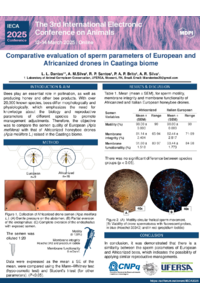
Banner - Lilian Leal Dantas.pdf
Sperm morphological, morphometric and ultrastructural aspects of European (Apis mellifera) and Africanized (Apis mellifera L.) honeybee drones
Short-term in vitro culture of canine ovarian tissue after
cryopreservation by different techniques
cryopreservation by different techniques