Event submissions
Published
This submission belongs to the session D. Environmental challenges to animals and precision livestock farming of the event The 3rd International Electronic Conference on Animals
Published date
07 Mar, 2025
Academic Editor
'%3e%3cpath%20d='M12.6657%2010.9104C12.4185%2010.325%2012.0599%209.79327%2011.6097%209.34482C11.1609%208.89508%2010.6293%208.5365%2010.0442%208.28888C10.0389%208.28626%2010.0337%208.28495%2010.0285%208.28233C10.8446%207.69279%2011.3752%206.73249%2011.3752%205.64904C11.3752%203.8542%209.92103%202.39999%208.1262%202.39999C6.33136%202.39999%204.87715%203.8542%204.87715%205.64904C4.87715%206.73249%205.40774%207.69279%206.22393%208.28364C6.21869%208.28626%206.21345%208.28757%206.20821%208.29019C5.62129%208.5378%205.09463%208.89284%204.64265%209.34613C4.1929%209.79493%203.83432%2010.3266%203.58671%2010.9117C3.34345%2011.4845%203.21226%2012.0987%203.20023%2012.7209C3.19988%2012.7349%203.20233%2012.7488%203.20744%2012.7619C3.21255%2012.7749%203.22022%2012.7867%203.22998%2012.7968C3.23975%2012.8068%203.25142%2012.8147%203.26431%2012.8202C3.2772%2012.8256%203.29105%2012.8284%203.30504%2012.8284H4.09109C4.14874%2012.8284%204.19459%2012.7825%204.1959%2012.7262C4.2221%2011.7148%204.62823%2010.7676%205.34617%2010.0497C6.08899%209.30683%207.0755%208.89808%208.1262%208.89808C9.17689%208.89808%2010.1634%209.30683%2010.9062%2010.0497C11.6242%2010.7676%2012.0303%2011.7148%2012.0565%2012.7262C12.0578%2012.7838%2012.1037%2012.8284%2012.1613%2012.8284H12.9474C12.9613%2012.8284%2012.9752%2012.8256%2012.9881%2012.8202C13.001%2012.8147%2013.0126%2012.8068%2013.0224%2012.7968C13.0322%2012.7867%2013.0398%2012.7749%2013.0449%2012.7619C13.0501%2012.7488%2013.0525%2012.7349%2013.0522%2012.7209C13.0391%2012.0947%2012.9094%2011.4855%2012.6657%2010.9104ZM8.1262%207.9024C7.52486%207.9024%206.9589%207.6679%206.53312%207.24211C6.10733%206.81633%205.87283%206.25037%205.87283%205.64904C5.87283%205.0477%206.10733%204.48174%206.53312%204.05596C6.9589%203.63018%207.52486%203.39567%208.1262%203.39567C8.72753%203.39567%209.29349%203.63018%209.71927%204.05596C10.1451%204.48174%2010.3796%205.0477%2010.3796%205.64904C10.3796%206.25037%2010.1451%206.81633%209.71927%207.24211C9.29349%207.6679%208.72753%207.9024%208.1262%207.9024Z'%20fill='%235D1EE1'/%3e%3c/g%3e%3c/svg%3e) Clive Julian Phillips
Clive Julian PhillipsCitation
Ao Wang, Liyun Han, Yachun Wang, Causal inference reveals long-term impact of health events on production performance in Holstein cattle, in Proceedings of The 3rd International Electronic Conference on Animals, 12 March–14 March 2025, MDPI: Basel, Switzerland
Share
Email
Facebook
Twitter
LinkedIn
Causal inference reveals long-term impact of health events on production performance in Holstein cattle
'%3e%3cpath%20d='M12.6647%2010.9104C12.4176%2010.325%2012.0589%209.7933%2011.6088%209.34485C11.16%208.89511%2010.6283%208.53653%2010.0432%208.28891C10.038%208.28629%2010.0327%208.28498%2010.0275%208.28236C10.8437%207.69282%2011.3743%206.73252%2011.3743%205.64907C11.3743%203.85423%209.92005%202.40002%208.12522%202.40002C6.33038%202.40002%204.87618%203.85423%204.87618%205.64907C4.87618%206.73252%205.40677%207.69282%206.22296%208.28367C6.21772%208.28629%206.21248%208.2876%206.20724%208.29022C5.62031%208.53783%205.09365%208.89287%204.64167%209.34616C4.19192%209.79496%203.83334%2010.3266%203.58573%2010.9117C3.34247%2011.4846%203.21128%2012.0987%203.19925%2012.721C3.1989%2012.735%203.20135%2012.7489%203.20646%2012.7619C3.21157%2012.7749%203.21924%2012.7868%203.22901%2012.7968C3.23877%2012.8068%203.25045%2012.8148%203.26334%2012.8202C3.27623%2012.8256%203.29007%2012.8284%203.30406%2012.8284H4.09012C4.14776%2012.8284%204.19362%2012.7825%204.19493%2012.7262C4.22113%2011.7148%204.62726%2010.7676%205.34519%2010.0497C6.08802%209.30686%207.07452%208.89811%208.12522%208.89811C9.17592%208.89811%2010.1624%209.30686%2010.9052%2010.0497C11.6232%2010.7676%2012.0293%2011.7148%2012.0555%2012.7262C12.0568%2012.7839%2012.1027%2012.8284%2012.1603%2012.8284H12.9464C12.9604%2012.8284%2012.9742%2012.8256%2012.9871%2012.8202C13%2012.8148%2013.0117%2012.8068%2013.0214%2012.7968C13.0312%2012.7868%2013.0389%2012.7749%2013.044%2012.7619C13.0491%2012.7489%2013.0515%2012.735%2013.0512%2012.721C13.0381%2012.0947%2012.9084%2011.4856%2012.6647%2010.9104ZM8.12522%207.90243C7.52388%207.90243%206.95792%207.66793%206.53214%207.24215C6.10636%206.81636%205.87185%206.2504%205.87185%205.64907C5.87185%205.04773%206.10636%204.48177%206.53214%204.05599C6.95792%203.63021%207.52388%203.3957%208.12522%203.3957C8.72655%203.3957%209.29252%203.63021%209.7183%204.05599C10.1441%204.48177%2010.3786%205.04773%2010.3786%205.64907C10.3786%206.2504%2010.1441%206.81636%209.7183%207.24215C9.29252%207.66793%208.72655%207.90243%208.12522%207.90243Z'%20fill='%235D1EE1'/%3e%3c/g%3e%3c/svg%3e)
Ao Wang 1
Liyun Han 2

Yachun Wang 1
1. State Key Laboratory of Animal Biotech Breeding, Key Laboratory of Animal Genetics, Breeding, and Reproduction (MARA), National Engineering Laboratory for Animal Breeding, College of Animal Science and Technology, China Agricultural University, Beijing, C
2. Key Laboratory of Ruminant Molecular and Cellular Breeding, College of Animal Science and Technology, Ningxia University, Yinchuan, China
Abstract
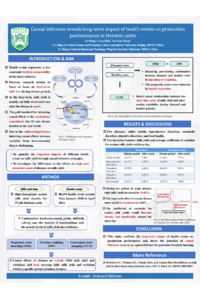
Health events represent a key constraint to farm sustainability in the dairy industry. Previous research tended to focus on short-term milk loss during disease periods. However, in the long term, milk yield is usually not fully recovered even after the disease is cured. In this context, our study aimed to quantify the long-term impacts of health events on milk yields through causal inference strategies. We collected high-throughput session milk yield records for a total of 37,246 Holstein cattle in China from 2020 to 2024, and 40,699 health event records. Three causal inference strategies were used to perform unbiased inference of causal effects on long-term milk losses, including propensity score matching (PSM), overlap weighting (OW), and convergent cross-mapping (CCM). PSM and OW estimated causal effects by balancing pre-existing confounders between diseased and healthy cows by matching or weighting to achieve conditions like randomization. CCM was used to detect causal relationships between two short time series of milk yield and inter-session variability during diseased and healthy periods. The confounders included herd–year–season, parity, stillbirths, calving ease, the number of inseminations, and the genetic levels of milk yield and resilience. Overall, the association between milk yield and inter-session variability was enhanced by all diseases. During the period of single disease, daily milk yield decreased by an average of 16.06% and the causal effect of different diseases ranged from 11.17% (reproductive disorders) to 24.76% (digestive disorders). After curing, the impacts of the five diseases (udder health, reproductive disorders, metabolic disorders, digestive disorders, and hoof health) on production performance were 7.88%, 4.99%, 4.06%, 8.42%, and 8.00%, respectively. The long-term effect of the second disease onset would be weakened to 3.28%. In summary, this study confirms the long-term impact of health events on production performance and shows the potential of causal inference to serve as a powerful tool for precision livestock farming.
Keywords
causal inference
milk yield
disease
milk loss
precision livestock farming
Poster
Causal inference reveals long-term impact of health events on production performance in Holstein cattle.pdf
Short-term in vitro culture of canine ovarian tissue after
cryopreservation by different techniques
cryopreservation by different techniques
Microplastics contamination in European anchovy (Engraulis encrasicolus) from the Romanian Black Sea coast—an emerging environmental threat