Event submissions
Published
This submission belongs to the session E. Sustainable animal welfare, ethics and human-animal interactions of the event The 3rd International Electronic Conference on Animals
Published date
07 Mar, 2025
Academic Editor
'%3e%3cpath%20d='M12.6657%2010.9104C12.4185%2010.325%2012.0599%209.79327%2011.6097%209.34482C11.1609%208.89508%2010.6293%208.5365%2010.0442%208.28888C10.0389%208.28626%2010.0337%208.28495%2010.0285%208.28233C10.8446%207.69279%2011.3752%206.73249%2011.3752%205.64904C11.3752%203.8542%209.92103%202.39999%208.1262%202.39999C6.33136%202.39999%204.87715%203.8542%204.87715%205.64904C4.87715%206.73249%205.40774%207.69279%206.22393%208.28364C6.21869%208.28626%206.21345%208.28757%206.20821%208.29019C5.62129%208.5378%205.09463%208.89284%204.64265%209.34613C4.1929%209.79493%203.83432%2010.3266%203.58671%2010.9117C3.34345%2011.4845%203.21226%2012.0987%203.20023%2012.7209C3.19988%2012.7349%203.20233%2012.7488%203.20744%2012.7619C3.21255%2012.7749%203.22022%2012.7867%203.22998%2012.7968C3.23975%2012.8068%203.25142%2012.8147%203.26431%2012.8202C3.2772%2012.8256%203.29105%2012.8284%203.30504%2012.8284H4.09109C4.14874%2012.8284%204.19459%2012.7825%204.1959%2012.7262C4.2221%2011.7148%204.62823%2010.7676%205.34617%2010.0497C6.08899%209.30683%207.0755%208.89808%208.1262%208.89808C9.17689%208.89808%2010.1634%209.30683%2010.9062%2010.0497C11.6242%2010.7676%2012.0303%2011.7148%2012.0565%2012.7262C12.0578%2012.7838%2012.1037%2012.8284%2012.1613%2012.8284H12.9474C12.9613%2012.8284%2012.9752%2012.8256%2012.9881%2012.8202C13.001%2012.8147%2013.0126%2012.8068%2013.0224%2012.7968C13.0322%2012.7867%2013.0398%2012.7749%2013.0449%2012.7619C13.0501%2012.7488%2013.0525%2012.7349%2013.0522%2012.7209C13.0391%2012.0947%2012.9094%2011.4855%2012.6657%2010.9104ZM8.1262%207.9024C7.52486%207.9024%206.9589%207.6679%206.53312%207.24211C6.10733%206.81633%205.87283%206.25037%205.87283%205.64904C5.87283%205.0477%206.10733%204.48174%206.53312%204.05596C6.9589%203.63018%207.52486%203.39567%208.1262%203.39567C8.72753%203.39567%209.29349%203.63018%209.71927%204.05596C10.1451%204.48174%2010.3796%205.0477%2010.3796%205.64904C10.3796%206.25037%2010.1451%206.81633%209.71927%207.24211C9.29349%207.6679%208.72753%207.9024%208.1262%207.9024Z'%20fill='%235D1EE1'/%3e%3c/g%3e%3c/svg%3e) Colin Scanes
Colin ScanesCitation
Wasseem Emam, Mohamed Bakr, Charlotte Flores, Christopher Bryant, Farmed fish welfare in Egypt: Surveying current practices and future directions for tilapia culture, in Proceedings of The 3rd International Electronic Conference on Animals, 12 March–14 March 2025, MDPI: Basel, Switzerland
Share
Email
Facebook
Twitter
LinkedIn
Farmed fish welfare in Egypt: Surveying current practices and future directions for tilapia culture
'%3e%3cpath%20d='M12.6647%2010.9104C12.4176%2010.325%2012.0589%209.7933%2011.6088%209.34485C11.16%208.89511%2010.6283%208.53653%2010.0432%208.28891C10.038%208.28629%2010.0327%208.28498%2010.0275%208.28236C10.8437%207.69282%2011.3743%206.73252%2011.3743%205.64907C11.3743%203.85423%209.92005%202.40002%208.12522%202.40002C6.33038%202.40002%204.87618%203.85423%204.87618%205.64907C4.87618%206.73252%205.40677%207.69282%206.22296%208.28367C6.21772%208.28629%206.21248%208.2876%206.20724%208.29022C5.62031%208.53783%205.09365%208.89287%204.64167%209.34616C4.19192%209.79496%203.83334%2010.3266%203.58573%2010.9117C3.34247%2011.4846%203.21128%2012.0987%203.19925%2012.721C3.1989%2012.735%203.20135%2012.7489%203.20646%2012.7619C3.21157%2012.7749%203.21924%2012.7868%203.22901%2012.7968C3.23877%2012.8068%203.25045%2012.8148%203.26334%2012.8202C3.27623%2012.8256%203.29007%2012.8284%203.30406%2012.8284H4.09012C4.14776%2012.8284%204.19362%2012.7825%204.19493%2012.7262C4.22113%2011.7148%204.62726%2010.7676%205.34519%2010.0497C6.08802%209.30686%207.07452%208.89811%208.12522%208.89811C9.17592%208.89811%2010.1624%209.30686%2010.9052%2010.0497C11.6232%2010.7676%2012.0293%2011.7148%2012.0555%2012.7262C12.0568%2012.7839%2012.1027%2012.8284%2012.1603%2012.8284H12.9464C12.9604%2012.8284%2012.9742%2012.8256%2012.9871%2012.8202C13%2012.8148%2013.0117%2012.8068%2013.0214%2012.7968C13.0312%2012.7868%2013.0389%2012.7749%2013.044%2012.7619C13.0491%2012.7489%2013.0515%2012.735%2013.0512%2012.721C13.0381%2012.0947%2012.9084%2011.4856%2012.6647%2010.9104ZM8.12522%207.90243C7.52388%207.90243%206.95792%207.66793%206.53214%207.24215C6.10636%206.81636%205.87185%206.2504%205.87185%205.64907C5.87185%205.04773%206.10636%204.48177%206.53214%204.05599C6.95792%203.63021%207.52388%203.3957%208.12522%203.3957C8.72655%203.3957%209.29252%203.63021%209.7183%204.05599C10.1441%204.48177%2010.3786%205.04773%2010.3786%205.64907C10.3786%206.2504%2010.1441%206.81636%209.7183%207.24215C9.29252%207.66793%208.72655%207.90243%208.12522%207.90243Z'%20fill='%235D1EE1'/%3e%3c/g%3e%3c/svg%3e)
Wasseem Emam 1,2,3
Mohamed Bakr 1
Charlotte Flores 4
Christopher Bryant 4,5
1. Ethical Seafood Research, Glasgow, G3 7QL, United Kingdom
2. Institute of Aquaculture, University of Stirling, Stirling, FK9 4LA, United Kingdom
3. Faculty of Veterinary Medicine, Complutense University of Madrid, Madrid, 28040, Spain
4. Bryant Research, London, WC2H 9JQ, United Kingdom
5. Department of Psychology, University of Bath, BA2 7AY, Bath, United Kingdom
Abstract
This study aimed to map the status of tilapia farming in Egypt’s Nile Delta region, particularly the knowledge, attitudes, and practices (KAPs) of Egyptian tilapia farmers towards the current state of animal welfare in the sector and the major challenges they face in their daily operations. To this end, a survey was conducted of tilapia farmers across different regions, asking about their farming practices, feed management, health and safety measures, and the economic aspects of tilapia farming. We found that just 11 % of the surveyed tilapia farmers had received some sort of training on the importance of animal welfare, while 76 % said they could benefit from such training. Farmers perceived maintaining good water quality as the most important metric for achieving good tilapia welfare. However, they were significantly less willing and able to intervene on this factor compared to other factors, such as changing feeding practices, minimising handling, and carrying out veterinary checks. In addition, we found evidence of better production outcomes for farmers that had received welfare training, with significantly fewer of them reporting high mortality rates and significantly fewer reporting frequent poor growth.
Most farmers expected the Egyptian tilapia production sector to continue to grow and intensify. We present the data as an overview of Egyptian tilapia farmers’ knowledge, attitudes, and practices relating to fish welfare and as a basis for future efforts to improve the welfare of farmed tilapia in Egypt given the lack of awareness around this topic and the fact that it is gaining increasing importance elsewhere. We can see a need for establishing minimum animal welfare standards in Egyptian tilapia farming, either through regulators or certification schemes. There is also a clear need for establishing training programmes that cover animal health and welfare aspects in aquaculture.
Keywords
fish welfare
tilapia
aquaculture
Egypt
sustainable development
sustainability
animal welfare
knowledge
attitudes and practices survey
food security
water quality
welfare standards
Nile Delta
Poster
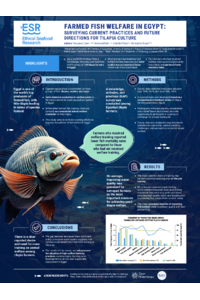
ESR_research_poster_60x80cm_RVB_02.pdf
Comparison of mathematical functions in modelling lactation curves based on automatic milking system records in Spanish Florida dairy goat
Perception of Brazilian livestock advisors toward cow–calf contact on dairy farms: a preliminary study