Event submissions
Published
This submission belongs to the session E. Sustainable animal welfare, ethics and human-animal interactions of the event The 3rd International Electronic Conference on Animals
Published date
07 Mar, 2025
Academic Editor
'%3e%3cpath%20d='M12.6657%2010.9104C12.4185%2010.325%2012.0599%209.79327%2011.6097%209.34482C11.1609%208.89508%2010.6293%208.5365%2010.0442%208.28888C10.0389%208.28626%2010.0337%208.28495%2010.0285%208.28233C10.8446%207.69279%2011.3752%206.73249%2011.3752%205.64904C11.3752%203.8542%209.92103%202.39999%208.1262%202.39999C6.33136%202.39999%204.87715%203.8542%204.87715%205.64904C4.87715%206.73249%205.40774%207.69279%206.22393%208.28364C6.21869%208.28626%206.21345%208.28757%206.20821%208.29019C5.62129%208.5378%205.09463%208.89284%204.64265%209.34613C4.1929%209.79493%203.83432%2010.3266%203.58671%2010.9117C3.34345%2011.4845%203.21226%2012.0987%203.20023%2012.7209C3.19988%2012.7349%203.20233%2012.7488%203.20744%2012.7619C3.21255%2012.7749%203.22022%2012.7867%203.22998%2012.7968C3.23975%2012.8068%203.25142%2012.8147%203.26431%2012.8202C3.2772%2012.8256%203.29105%2012.8284%203.30504%2012.8284H4.09109C4.14874%2012.8284%204.19459%2012.7825%204.1959%2012.7262C4.2221%2011.7148%204.62823%2010.7676%205.34617%2010.0497C6.08899%209.30683%207.0755%208.89808%208.1262%208.89808C9.17689%208.89808%2010.1634%209.30683%2010.9062%2010.0497C11.6242%2010.7676%2012.0303%2011.7148%2012.0565%2012.7262C12.0578%2012.7838%2012.1037%2012.8284%2012.1613%2012.8284H12.9474C12.9613%2012.8284%2012.9752%2012.8256%2012.9881%2012.8202C13.001%2012.8147%2013.0126%2012.8068%2013.0224%2012.7968C13.0322%2012.7867%2013.0398%2012.7749%2013.0449%2012.7619C13.0501%2012.7488%2013.0525%2012.7349%2013.0522%2012.7209C13.0391%2012.0947%2012.9094%2011.4855%2012.6657%2010.9104ZM8.1262%207.9024C7.52486%207.9024%206.9589%207.6679%206.53312%207.24211C6.10733%206.81633%205.87283%206.25037%205.87283%205.64904C5.87283%205.0477%206.10733%204.48174%206.53312%204.05596C6.9589%203.63018%207.52486%203.39567%208.1262%203.39567C8.72753%203.39567%209.29349%203.63018%209.71927%204.05596C10.1451%204.48174%2010.3796%205.0477%2010.3796%205.64904C10.3796%206.25037%2010.1451%206.81633%209.71927%207.24211C9.29349%207.6679%208.72753%207.9024%208.1262%207.9024Z'%20fill='%235D1EE1'/%3e%3c/g%3e%3c/svg%3e) Clive Julian Phillips
Clive Julian PhillipsCitation
Elisabeth-Lidwien Johanna Martina Magdalena Verdegaal, Todd J. McWhorter, Gordon S. Howarth, Catherine J. G. Delesalle, Overview of gastrointestinal pill temperature monitoring in mammals, in Proceedings of The 3rd International Electronic Conference on Animals, 12 March–14 March 2025, MDPI: Basel, Switzerland
Share
Email
Facebook
Twitter
LinkedIn
Overview of gastrointestinal pill temperature monitoring in mammals

Elisabeth-Lidwien Johanna Martina Magdalena Verdegaal 1

Todd J. McWhorter 1

Gordon S. Howarth 1
'%3e%3cpath%20d='M12.6647%2010.9104C12.4176%2010.325%2012.0589%209.7933%2011.6088%209.34485C11.16%208.89511%2010.6283%208.53653%2010.0432%208.28891C10.038%208.28629%2010.0327%208.28498%2010.0275%208.28236C10.8437%207.69282%2011.3743%206.73252%2011.3743%205.64907C11.3743%203.85423%209.92005%202.40002%208.12522%202.40002C6.33038%202.40002%204.87618%203.85423%204.87618%205.64907C4.87618%206.73252%205.40677%207.69282%206.22296%208.28367C6.21772%208.28629%206.21248%208.2876%206.20724%208.29022C5.62031%208.53783%205.09365%208.89287%204.64167%209.34616C4.19192%209.79496%203.83334%2010.3266%203.58573%2010.9117C3.34247%2011.4846%203.21128%2012.0987%203.19925%2012.721C3.1989%2012.735%203.20135%2012.7489%203.20646%2012.7619C3.21157%2012.7749%203.21924%2012.7868%203.22901%2012.7968C3.23877%2012.8068%203.25045%2012.8148%203.26334%2012.8202C3.27623%2012.8256%203.29007%2012.8284%203.30406%2012.8284H4.09012C4.14776%2012.8284%204.19362%2012.7825%204.19493%2012.7262C4.22113%2011.7148%204.62726%2010.7676%205.34519%2010.0497C6.08802%209.30686%207.07452%208.89811%208.12522%208.89811C9.17592%208.89811%2010.1624%209.30686%2010.9052%2010.0497C11.6232%2010.7676%2012.0293%2011.7148%2012.0555%2012.7262C12.0568%2012.7839%2012.1027%2012.8284%2012.1603%2012.8284H12.9464C12.9604%2012.8284%2012.9742%2012.8256%2012.9871%2012.8202C13%2012.8148%2013.0117%2012.8068%2013.0214%2012.7968C13.0312%2012.7868%2013.0389%2012.7749%2013.044%2012.7619C13.0491%2012.7489%2013.0515%2012.735%2013.0512%2012.721C13.0381%2012.0947%2012.9084%2011.4856%2012.6647%2010.9104ZM8.12522%207.90243C7.52388%207.90243%206.95792%207.66793%206.53214%207.24215C6.10636%206.81636%205.87185%206.2504%205.87185%205.64907C5.87185%205.04773%206.10636%204.48177%206.53214%204.05599C6.95792%203.63021%207.52388%203.3957%208.12522%203.3957C8.72655%203.3957%209.29252%203.63021%209.7183%204.05599C10.1441%204.48177%2010.3786%205.04773%2010.3786%205.64907C10.3786%206.2504%2010.1441%206.81636%209.7183%207.24215C9.29252%207.66793%208.72655%207.90243%208.12522%207.90243Z'%20fill='%235D1EE1'/%3e%3c/g%3e%3c/svg%3e)
Catherine J. G. Delesalle 2
1. School of Animal and Veterinary Sciences, University of Adelaide, Adelaide, Australia
2. Department of Translational Physiology, Infectiology and Public Health, Faculty of Veterinary Medicine, Ghent University, Ghent, Belgium
Abstract
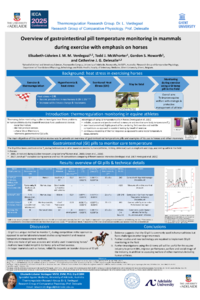
The gastrointestinal (GI) pill is an innovative tool for monitoring core body temperature (Tc) in both human and animal studies, offering insights into thermoregulation and exertional heat stress. Traditional approaches to monitoring Tc in athletes often involve rectal thermistors, skin temperature sensors, or subjective measures of heat perception. However, the GI pill provides a non-invasive, accurate, and continuous measurement of Tc, which is particularly beneficial during field exercises.
GI pills are widely used due to their ease of administration and reliability during exercise, outperforming serial rectal temperature (Tre) measurements in terms of precision and practicality. In animals, GI pills have been used to monitor Tc in elephants and dogs during exercise, as well as in cattle at rest.
Research has extended into equine studies, where the GI pill has been used to monitor core temperature in horses during rest and transport and, notably, during field exercise. Our group studied the use of the GI pill during different types of field exercise in horses; this unique method breaks new ground because it includes the first studies to focus on the continuous monitoring of core body temperature in sport horses during work and competition in the open air ("in the field"). Earlier laboratory-based studies employed treadmills and more invasive temperature measurement methods.
In our studies, the GI pill showed that different exercise types produce distinct thermoregulatory responses, with significant inter-individual variability in thermo-regulation among horses. This variability underscores the importance of individual monitoring in assessing and managing heat stress, as well as the complexity of mammalian thermoregulation, influenced by numerous intrinsic factors. This study will provide an overview of existing GI pills and their use in mammals. The application of the GI pill has the potential to advance heat illness prevention and improve animal welfare, making it a vital tool in both human and veterinary sports science.
Keywords
thermoregulation
heat illness
equine
gastrointestinal pill
temperature monitoring
exercise
welfare
Poster
Verdegaal et al. Overview of GI pill temperature monitoring in mammals. Int conf Electronics Animals 2025 final final .pdf
SharkHI: a Novel Pipeline for Health Index Calculation of Carcharodon Carcharias.
Rethinking environmental enrichment for dairy calves: improvements for basic biological needs?