Event submissions
Published
This submission belongs to the session E. Sustainable animal welfare, ethics and human-animal interactions of the event The 3rd International Electronic Conference on Animals
Published date
07 Mar, 2025
Academic Editor
'%3e%3cpath%20d='M12.6657%2010.9104C12.4185%2010.325%2012.0599%209.79327%2011.6097%209.34482C11.1609%208.89508%2010.6293%208.5365%2010.0442%208.28888C10.0389%208.28626%2010.0337%208.28495%2010.0285%208.28233C10.8446%207.69279%2011.3752%206.73249%2011.3752%205.64904C11.3752%203.8542%209.92103%202.39999%208.1262%202.39999C6.33136%202.39999%204.87715%203.8542%204.87715%205.64904C4.87715%206.73249%205.40774%207.69279%206.22393%208.28364C6.21869%208.28626%206.21345%208.28757%206.20821%208.29019C5.62129%208.5378%205.09463%208.89284%204.64265%209.34613C4.1929%209.79493%203.83432%2010.3266%203.58671%2010.9117C3.34345%2011.4845%203.21226%2012.0987%203.20023%2012.7209C3.19988%2012.7349%203.20233%2012.7488%203.20744%2012.7619C3.21255%2012.7749%203.22022%2012.7867%203.22998%2012.7968C3.23975%2012.8068%203.25142%2012.8147%203.26431%2012.8202C3.2772%2012.8256%203.29105%2012.8284%203.30504%2012.8284H4.09109C4.14874%2012.8284%204.19459%2012.7825%204.1959%2012.7262C4.2221%2011.7148%204.62823%2010.7676%205.34617%2010.0497C6.08899%209.30683%207.0755%208.89808%208.1262%208.89808C9.17689%208.89808%2010.1634%209.30683%2010.9062%2010.0497C11.6242%2010.7676%2012.0303%2011.7148%2012.0565%2012.7262C12.0578%2012.7838%2012.1037%2012.8284%2012.1613%2012.8284H12.9474C12.9613%2012.8284%2012.9752%2012.8256%2012.9881%2012.8202C13.001%2012.8147%2013.0126%2012.8068%2013.0224%2012.7968C13.0322%2012.7867%2013.0398%2012.7749%2013.0449%2012.7619C13.0501%2012.7488%2013.0525%2012.7349%2013.0522%2012.7209C13.0391%2012.0947%2012.9094%2011.4855%2012.6657%2010.9104ZM8.1262%207.9024C7.52486%207.9024%206.9589%207.6679%206.53312%207.24211C6.10733%206.81633%205.87283%206.25037%205.87283%205.64904C5.87283%205.0477%206.10733%204.48174%206.53312%204.05596C6.9589%203.63018%207.52486%203.39567%208.1262%203.39567C8.72753%203.39567%209.29349%203.63018%209.71927%204.05596C10.1451%204.48174%2010.3796%205.0477%2010.3796%205.64904C10.3796%206.25037%2010.1451%206.81633%209.71927%207.24211C9.29349%207.6679%208.72753%207.9024%208.1262%207.9024Z'%20fill='%235D1EE1'/%3e%3c/g%3e%3c/svg%3e) Colin Scanes
Colin ScanesCitation
Syeda Maryam Hussain, Evelyn Saba, Usman Rashid, Mansoor Abdullah, Imtiaz Ahmad Khan, Aayesha Riaz, Zahid Manzoor, Muhammad Fiaz, Effects of varied photo-period durations and Red Korean Ginseng extract supplementation on growth performance, feed efficiency, and health status in New Zealand White Rabbits, in Proceedings of The 3rd International Electronic Conference on Animals, 12 March–14 March 2025, MDPI: Basel, Switzerland
Share
Email
Facebook
Twitter
LinkedIn
Effects of varied photo-period durations and Red Korean Ginseng extract supplementation on growth performance, feed efficiency, and health status in New Zealand White Rabbits
'%3e%3cpath%20d='M12.6647%2010.9104C12.4176%2010.325%2012.0589%209.7933%2011.6088%209.34485C11.16%208.89511%2010.6283%208.53653%2010.0432%208.28891C10.038%208.28629%2010.0327%208.28498%2010.0275%208.28236C10.8437%207.69282%2011.3743%206.73252%2011.3743%205.64907C11.3743%203.85423%209.92005%202.40002%208.12522%202.40002C6.33038%202.40002%204.87618%203.85423%204.87618%205.64907C4.87618%206.73252%205.40677%207.69282%206.22296%208.28367C6.21772%208.28629%206.21248%208.2876%206.20724%208.29022C5.62031%208.53783%205.09365%208.89287%204.64167%209.34616C4.19192%209.79496%203.83334%2010.3266%203.58573%2010.9117C3.34247%2011.4846%203.21128%2012.0987%203.19925%2012.721C3.1989%2012.735%203.20135%2012.7489%203.20646%2012.7619C3.21157%2012.7749%203.21924%2012.7868%203.22901%2012.7968C3.23877%2012.8068%203.25045%2012.8148%203.26334%2012.8202C3.27623%2012.8256%203.29007%2012.8284%203.30406%2012.8284H4.09012C4.14776%2012.8284%204.19362%2012.7825%204.19493%2012.7262C4.22113%2011.7148%204.62726%2010.7676%205.34519%2010.0497C6.08802%209.30686%207.07452%208.89811%208.12522%208.89811C9.17592%208.89811%2010.1624%209.30686%2010.9052%2010.0497C11.6232%2010.7676%2012.0293%2011.7148%2012.0555%2012.7262C12.0568%2012.7839%2012.1027%2012.8284%2012.1603%2012.8284H12.9464C12.9604%2012.8284%2012.9742%2012.8256%2012.9871%2012.8202C13%2012.8148%2013.0117%2012.8068%2013.0214%2012.7968C13.0312%2012.7868%2013.0389%2012.7749%2013.044%2012.7619C13.0491%2012.7489%2013.0515%2012.735%2013.0512%2012.721C13.0381%2012.0947%2012.9084%2011.4856%2012.6647%2010.9104ZM8.12522%207.90243C7.52388%207.90243%206.95792%207.66793%206.53214%207.24215C6.10636%206.81636%205.87185%206.2504%205.87185%205.64907C5.87185%205.04773%206.10636%204.48177%206.53214%204.05599C6.95792%203.63021%207.52388%203.3957%208.12522%203.3957C8.72655%203.3957%209.29252%203.63021%209.7183%204.05599C10.1441%204.48177%2010.3786%205.04773%2010.3786%205.64907C10.3786%206.2504%2010.1441%206.81636%209.7183%207.24215C9.29252%207.66793%208.72655%207.90243%208.12522%207.90243Z'%20fill='%235D1EE1'/%3e%3c/g%3e%3c/svg%3e)
Syeda Maryam Hussain 1

Evelyn Saba 1
Usman Rashid 1

Mansoor Abdullah 1
Imtiaz Ahmad Khan 1
Aayesha Riaz 1
Zahid Manzoor 1
Muhammad Fiaz 1
1. Department of Livestock production and management, faculty of Veterinary and Animal Sciences, Pir Meher Ali Shah- Arid Agriculture University, Rawalpindi, Pakistan
Abstract
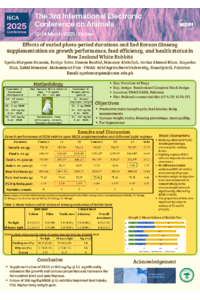
Thirty-six New Zealand White rabbits at six weeks of age were kept at the animal house of PMAS-UAAR for 42 days and divided into 0 groups (T1 (Control), T2 (200 mg/Kg body weight), T3 (300 mg/Kg Body weight), T4 (300 mg/Kg Body weight)), and red Korean ginseng extracts were use).Two lightning regimes (L1, normal daylight length hours; L2, 18 hours) were applied. Sampling was performedfor growth performance, carcass properties and etiology. Mean higher live body weight (1.273 Kgs), higher feed intake (38.47 gms) and higher feed conversion ratio (3.25) were noticed in T4, while the lowest values were in control (1.215 kg, 26.65 gms, and 4.78). The highest growth rate was noted in T4, the mean carcass weight was higher in control (5.35), and the lowest carcass weight was in T3 (4.17). Rabbit fur quality, comfort factor and fur diameter were higher in T2 under L1, but spin fineness and medulations were higher under T4 with L2. The loss of rabbit meat through the drip was higher in the control group and lowest in T3. The loss of rabbit meat from cooking was higher in T2 (22.76) and the lowest was in T3 (18.59). The T4 rabbits showed aggression and less efficiency while the T2 rabbits showed friendly, social behaviour with good instincts. Ginseng supplementation at a concentration of 300mgimproves performance and etiology in NZW rabbits.
Keywords
rabbits
etiology
stress
Ginseng
carcass
Poster
3rd animal conf. Poster.pdf
Sanctuaries as Living Laboratories: Exploring Animal Autonomy and Reproductive Ethics in Italian Multispecies Communities
Gender Effect on Carcass and Meat Quality Characteristics in Gerze Native Chickens