Event submissions
Published
This submission belongs to the session G. One health: Improve Disease Manifestation and Management in Animals, Humans, and the Environment of the event The 3rd International Electronic Conference on Animals
Published date
07 Mar, 2025
Academic Editor
'%3e%3cpath%20d='M12.6657%2010.9104C12.4185%2010.325%2012.0599%209.79327%2011.6097%209.34482C11.1609%208.89508%2010.6293%208.5365%2010.0442%208.28888C10.0389%208.28626%2010.0337%208.28495%2010.0285%208.28233C10.8446%207.69279%2011.3752%206.73249%2011.3752%205.64904C11.3752%203.8542%209.92103%202.39999%208.1262%202.39999C6.33136%202.39999%204.87715%203.8542%204.87715%205.64904C4.87715%206.73249%205.40774%207.69279%206.22393%208.28364C6.21869%208.28626%206.21345%208.28757%206.20821%208.29019C5.62129%208.5378%205.09463%208.89284%204.64265%209.34613C4.1929%209.79493%203.83432%2010.3266%203.58671%2010.9117C3.34345%2011.4845%203.21226%2012.0987%203.20023%2012.7209C3.19988%2012.7349%203.20233%2012.7488%203.20744%2012.7619C3.21255%2012.7749%203.22022%2012.7867%203.22998%2012.7968C3.23975%2012.8068%203.25142%2012.8147%203.26431%2012.8202C3.2772%2012.8256%203.29105%2012.8284%203.30504%2012.8284H4.09109C4.14874%2012.8284%204.19459%2012.7825%204.1959%2012.7262C4.2221%2011.7148%204.62823%2010.7676%205.34617%2010.0497C6.08899%209.30683%207.0755%208.89808%208.1262%208.89808C9.17689%208.89808%2010.1634%209.30683%2010.9062%2010.0497C11.6242%2010.7676%2012.0303%2011.7148%2012.0565%2012.7262C12.0578%2012.7838%2012.1037%2012.8284%2012.1613%2012.8284H12.9474C12.9613%2012.8284%2012.9752%2012.8256%2012.9881%2012.8202C13.001%2012.8147%2013.0126%2012.8068%2013.0224%2012.7968C13.0322%2012.7867%2013.0398%2012.7749%2013.0449%2012.7619C13.0501%2012.7488%2013.0525%2012.7349%2013.0522%2012.7209C13.0391%2012.0947%2012.9094%2011.4855%2012.6657%2010.9104ZM8.1262%207.9024C7.52486%207.9024%206.9589%207.6679%206.53312%207.24211C6.10733%206.81633%205.87283%206.25037%205.87283%205.64904C5.87283%205.0477%206.10733%204.48174%206.53312%204.05596C6.9589%203.63018%207.52486%203.39567%208.1262%203.39567C8.72753%203.39567%209.29349%203.63018%209.71927%204.05596C10.1451%204.48174%2010.3796%205.0477%2010.3796%205.64904C10.3796%206.25037%2010.1451%206.81633%209.71927%207.24211C9.29349%207.6679%208.72753%207.9024%208.1262%207.9024Z'%20fill='%235D1EE1'/%3e%3c/g%3e%3c/svg%3e) Michael Hässig
Michael HässigCitation
Catarina Freitas, Teresa Tavares, Vanessa Silva, Gilberto Igrejas, Teresa Semedo-Lemsaddek, Manuela Caniça, Patrícia Poeta, Evaluation of Staphylococcus aureus Prevalence and Antimicrobial Resistance in Rabbit Infections: Public Health Concerns, in Proceedings of The 3rd International Electronic Conference on Animals, 12 March–14 March 2025, MDPI: Basel, Switzerland
Share
Email
Facebook
Twitter
LinkedIn
Evaluation of Staphylococcus aureus Prevalence and Antimicrobial Resistance in Rabbit Infections: Public Health Concerns

Catarina Freitas 1,2
'%3e%3cpath%20d='M12.6647%2010.9104C12.4176%2010.325%2012.0589%209.7933%2011.6088%209.34485C11.16%208.89511%2010.6283%208.53653%2010.0432%208.28891C10.038%208.28629%2010.0327%208.28498%2010.0275%208.28236C10.8437%207.69282%2011.3743%206.73252%2011.3743%205.64907C11.3743%203.85423%209.92005%202.40002%208.12522%202.40002C6.33038%202.40002%204.87618%203.85423%204.87618%205.64907C4.87618%206.73252%205.40677%207.69282%206.22296%208.28367C6.21772%208.28629%206.21248%208.2876%206.20724%208.29022C5.62031%208.53783%205.09365%208.89287%204.64167%209.34616C4.19192%209.79496%203.83334%2010.3266%203.58573%2010.9117C3.34247%2011.4846%203.21128%2012.0987%203.19925%2012.721C3.1989%2012.735%203.20135%2012.7489%203.20646%2012.7619C3.21157%2012.7749%203.21924%2012.7868%203.22901%2012.7968C3.23877%2012.8068%203.25045%2012.8148%203.26334%2012.8202C3.27623%2012.8256%203.29007%2012.8284%203.30406%2012.8284H4.09012C4.14776%2012.8284%204.19362%2012.7825%204.19493%2012.7262C4.22113%2011.7148%204.62726%2010.7676%205.34519%2010.0497C6.08802%209.30686%207.07452%208.89811%208.12522%208.89811C9.17592%208.89811%2010.1624%209.30686%2010.9052%2010.0497C11.6232%2010.7676%2012.0293%2011.7148%2012.0555%2012.7262C12.0568%2012.7839%2012.1027%2012.8284%2012.1603%2012.8284H12.9464C12.9604%2012.8284%2012.9742%2012.8256%2012.9871%2012.8202C13%2012.8148%2013.0117%2012.8068%2013.0214%2012.7968C13.0312%2012.7868%2013.0389%2012.7749%2013.044%2012.7619C13.0491%2012.7489%2013.0515%2012.735%2013.0512%2012.721C13.0381%2012.0947%2012.9084%2011.4856%2012.6647%2010.9104ZM8.12522%207.90243C7.52388%207.90243%206.95792%207.66793%206.53214%207.24215C6.10636%206.81636%205.87185%206.2504%205.87185%205.64907C5.87185%205.04773%206.10636%204.48177%206.53214%204.05599C6.95792%203.63021%207.52388%203.3957%208.12522%203.3957C8.72655%203.3957%209.29252%203.63021%209.7183%204.05599C10.1441%204.48177%2010.3786%205.04773%2010.3786%205.64907C10.3786%206.2504%2010.1441%206.81636%209.7183%207.24215C9.29252%207.66793%208.72655%207.90243%208.12522%207.90243Z'%20fill='%235D1EE1'/%3e%3c/g%3e%3c/svg%3e)
Teresa Tavares 1,3,4

Vanessa Silva 1,2,3,4

Gilberto Igrejas 2,5,6

Teresa Semedo-Lemsaddek 7,8
Manuela Caniça 7,9,10

Patrícia Poeta 1,5,8
1. Microbiology and Antibiotic Resistance Team (MicroART), Department of Veterinary Sciences, University of Trás-os-Montes and Alto Douro (UTAD), Vila Real, Portugal
2. Department of Genetics and Biotechnology, University of Trás-os-Montes and Alto Douro, Vila Real, Portugal
3. Functional Genomics and Proteomics Unit, University of Trás-os-Montes and Alto Douro (UTAD), Vila Real, Portugal
4. LAQV-REQUIMTE, Department of Chemistry, NOVA School of Science and Technology, University NOVA of Lisbon, Caparica, Portugal
5. CECAV—Veterinary and Animal Research Centre, University of Trás-os-Montes and Alto Douro (UTAD), 5000-801 Vila Real, Portugal
6. Department of Veterinary Sciences, University of Trás-os-Montes and Alto Douro (UTAD), Vila Real, Portugal
7. Centre for Interdisciplinary Research in Animal Health (CIISA), Faculty of Veterinary Medicine, University of Lisbon, Av. da Universidade Técnica de Lisboa, 1300-477 Lisbon, Portugal
8. Associate Laboratory for Animal and Veterinary Sciences (AL4AnimalS), 1300-477 Lisbon, Portugal
9. National Reference Laboratory of Antibiotic Resistances and Healthcare Associated Infections, Department of Infectious Diseases, National Institute of Health Dr. Ricardo Jorge, Lisbon, Portugal
10. Centre for the Studies of Animal Science, Institute of Agrarian and Agri-Food Sciences and Technologies, University of Porto, Porto, Portugal
Abstract
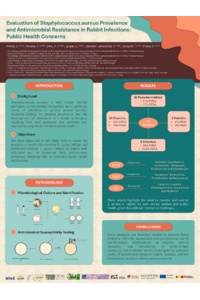
Staphylococcus aureus, a well known human pathogen, is increasingly recognized as a significant cause of infections in various animal species, including rabbits. Its growing prevalence and the development of resistance to multiple antibiotics, resulting from their excessive and incorrect use, represents a significant threat to public health. Therefore, the main objectives of this study were to assess the presence of methicillin-sensitive S. aureus (MSSA) and methicillin-resistant S. aureus (MRSA) in rabbits with infections and to determine their antimicrobial resistance, shedding light on potential public health implications.
In this study, 79 samples were collected from rabbits with infections from different farms in northern Portugal. Eight MRSA strains were randomly selected and then tested against 14 antimicrobial agents, including penicillin, cephalosporins, fluoroquinolones, aminoglycosides, macrolides, tetracyclines, oxazolidinones, and other miscellaneous agents. Susceptibility testing was carried out using the agar disc diffusion method, as recommended by the EUCAST and CLSI guidelines.
Of the 79 samples, 35 were from pododermatitis, of which 31.43% corresponded with MRSA and 17.14% with MSSA. Of the 33 samples from mastitis, 45.45% were MRSA and 15.15% were MSSA. The abscess samples (eight) had 25% MRSA and 12.5% MSSA. None of the metritis samples (three) tested positive for MRSA or MSSA. Of the strains selected, 37.5% were resistant to penicillin, ciprofloxacin, gentamicin, tobramycin, erythromycin, and clindamycin. Only 12.5% showed resistance to kanamycin, tetracycline, and trimethoprim-sulfamethoxazole. None of the strains studied showed resistance to cefoxitin, linezolid, chloramphenicol, fusidic acid, or mupirocin.
These results highlight the need to monitor and control S. aureus in rabbits for both animal welfare and public health, given the antibiotic resistance challenges. Some strategies are therefore needed to alleviate these problems, from the appropriate and conscientious use of antimicrobials, reinforcement of infection control measures, and surveillance of antimicrobial resistance. Future studies should investigate the potential routes of transmission between rabbits, humans, and the environment to better inform control measures
Keywords
Rabbit infections
MRSA
MSSA
Zoonosis
One Health
Antimicrobial Resistance
Poster
Poster_Animals.pdf
Analysis of volatile organic compounds (VOCs) in dog food using gas chromatography-mass spectrometry (GC-MS) and the correlation with dog appetite
Isolation and characterization of class II Newcastle disease from circulating strains in Mizoram, NER, India