Event submissions
Published
This submission belongs to the session G. One health: Improve Disease Manifestation and Management in Animals, Humans, and the Environment of the event The 3rd International Electronic Conference on Animals
Published date
07 Mar, 2025
Academic Editor
'%3e%3cpath%20d='M12.6657%2010.9104C12.4185%2010.325%2012.0599%209.79327%2011.6097%209.34482C11.1609%208.89508%2010.6293%208.5365%2010.0442%208.28888C10.0389%208.28626%2010.0337%208.28495%2010.0285%208.28233C10.8446%207.69279%2011.3752%206.73249%2011.3752%205.64904C11.3752%203.8542%209.92103%202.39999%208.1262%202.39999C6.33136%202.39999%204.87715%203.8542%204.87715%205.64904C4.87715%206.73249%205.40774%207.69279%206.22393%208.28364C6.21869%208.28626%206.21345%208.28757%206.20821%208.29019C5.62129%208.5378%205.09463%208.89284%204.64265%209.34613C4.1929%209.79493%203.83432%2010.3266%203.58671%2010.9117C3.34345%2011.4845%203.21226%2012.0987%203.20023%2012.7209C3.19988%2012.7349%203.20233%2012.7488%203.20744%2012.7619C3.21255%2012.7749%203.22022%2012.7867%203.22998%2012.7968C3.23975%2012.8068%203.25142%2012.8147%203.26431%2012.8202C3.2772%2012.8256%203.29105%2012.8284%203.30504%2012.8284H4.09109C4.14874%2012.8284%204.19459%2012.7825%204.1959%2012.7262C4.2221%2011.7148%204.62823%2010.7676%205.34617%2010.0497C6.08899%209.30683%207.0755%208.89808%208.1262%208.89808C9.17689%208.89808%2010.1634%209.30683%2010.9062%2010.0497C11.6242%2010.7676%2012.0303%2011.7148%2012.0565%2012.7262C12.0578%2012.7838%2012.1037%2012.8284%2012.1613%2012.8284H12.9474C12.9613%2012.8284%2012.9752%2012.8256%2012.9881%2012.8202C13.001%2012.8147%2013.0126%2012.8068%2013.0224%2012.7968C13.0322%2012.7867%2013.0398%2012.7749%2013.0449%2012.7619C13.0501%2012.7488%2013.0525%2012.7349%2013.0522%2012.7209C13.0391%2012.0947%2012.9094%2011.4855%2012.6657%2010.9104ZM8.1262%207.9024C7.52486%207.9024%206.9589%207.6679%206.53312%207.24211C6.10733%206.81633%205.87283%206.25037%205.87283%205.64904C5.87283%205.0477%206.10733%204.48174%206.53312%204.05596C6.9589%203.63018%207.52486%203.39567%208.1262%203.39567C8.72753%203.39567%209.29349%203.63018%209.71927%204.05596C10.1451%204.48174%2010.3796%205.0477%2010.3796%205.64904C10.3796%206.25037%2010.1451%206.81633%209.71927%207.24211C9.29349%207.6679%208.72753%207.9024%208.1262%207.9024Z'%20fill='%235D1EE1'/%3e%3c/g%3e%3c/svg%3e) Michael Hässig
Michael HässigCitation
Ana Avilés del Valle, Tania Ayllón Santiago, Marta Mateo Barrientos, Rocío Checa Herraiz, Adriana Ripa López-Barrantes, Seroprevalence study of Ehrlichia canis and Anaplasma phagocytophilum in feral cats in Autonomous Community of Madrid, in Proceedings of The 3rd International Electronic Conference on Animals, 12 March–14 March 2025, MDPI: Basel, Switzerland
Share
Email
Facebook
Twitter
LinkedIn
Seroprevalence study of Ehrlichia canis and Anaplasma phagocytophilum in feral cats in Autonomous Community of Madrid
'%3e%3cpath%20d='M12.6647%2010.9104C12.4176%2010.325%2012.0589%209.7933%2011.6088%209.34485C11.16%208.89511%2010.6283%208.53653%2010.0432%208.28891C10.038%208.28629%2010.0327%208.28498%2010.0275%208.28236C10.8437%207.69282%2011.3743%206.73252%2011.3743%205.64907C11.3743%203.85423%209.92005%202.40002%208.12522%202.40002C6.33038%202.40002%204.87618%203.85423%204.87618%205.64907C4.87618%206.73252%205.40677%207.69282%206.22296%208.28367C6.21772%208.28629%206.21248%208.2876%206.20724%208.29022C5.62031%208.53783%205.09365%208.89287%204.64167%209.34616C4.19192%209.79496%203.83334%2010.3266%203.58573%2010.9117C3.34247%2011.4846%203.21128%2012.0987%203.19925%2012.721C3.1989%2012.735%203.20135%2012.7489%203.20646%2012.7619C3.21157%2012.7749%203.21924%2012.7868%203.22901%2012.7968C3.23877%2012.8068%203.25045%2012.8148%203.26334%2012.8202C3.27623%2012.8256%203.29007%2012.8284%203.30406%2012.8284H4.09012C4.14776%2012.8284%204.19362%2012.7825%204.19493%2012.7262C4.22113%2011.7148%204.62726%2010.7676%205.34519%2010.0497C6.08802%209.30686%207.07452%208.89811%208.12522%208.89811C9.17592%208.89811%2010.1624%209.30686%2010.9052%2010.0497C11.6232%2010.7676%2012.0293%2011.7148%2012.0555%2012.7262C12.0568%2012.7839%2012.1027%2012.8284%2012.1603%2012.8284H12.9464C12.9604%2012.8284%2012.9742%2012.8256%2012.9871%2012.8202C13%2012.8148%2013.0117%2012.8068%2013.0214%2012.7968C13.0312%2012.7868%2013.0389%2012.7749%2013.044%2012.7619C13.0491%2012.7489%2013.0515%2012.735%2013.0512%2012.721C13.0381%2012.0947%2012.9084%2011.4856%2012.6647%2010.9104ZM8.12522%207.90243C7.52388%207.90243%206.95792%207.66793%206.53214%207.24215C6.10636%206.81636%205.87185%206.2504%205.87185%205.64907C5.87185%205.04773%206.10636%204.48177%206.53214%204.05599C6.95792%203.63021%207.52388%203.3957%208.12522%203.3957C8.72655%203.3957%209.29252%203.63021%209.7183%204.05599C10.1441%204.48177%2010.3786%205.04773%2010.3786%205.64907C10.3786%206.2504%2010.1441%206.81636%209.7183%207.24215C9.29252%207.66793%208.72655%207.90243%208.12522%207.90243Z'%20fill='%235D1EE1'/%3e%3c/g%3e%3c/svg%3e)
Ana Avilés del Valle 1

Tania Ayllón Santiago 1,2
Marta Mateo Barrientos 3
Rocío Checa Herraiz 3
Adriana Ripa López-Barrantes 1
1. Faculty of Veterinary Medicine. Alfonso X el Sabio University, Madrid, Spain
2. Faculty of Veterinary Medicine, Complutense University of Madrid, Spain
3. Faculty of Pharmacy. Complutense University of Madrid, Spain
Abstract
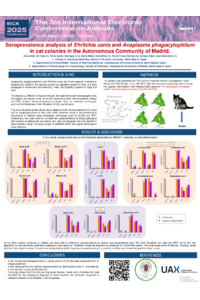
Bacteria of the genera Anaplasma and Ehrlichia, both belonging to the family Anaplasmataceae, are obligate intracellular, Gram-negative bacteria. Rhipicephalus sanguineus and Ixodes ricinus ticks act as vectors for these pathogens. R. sanguineus is typically found in Mediterranean areas, while I. ricinus is referred to as the “winter tick” due to its preference for cooler climates. Currently, diagnostic techniques are predominantly focused on pathogens affecting canines, which presents a significant challenge in the detection of infectious diseases in felines. Serological cross-reactivity between certain microorganisms is a potential concern, and clinicians do not usually have access to suitable tests for cat-specific pathogens.
The objective of this study was to assess the seroprevalence of Ehrlichia canis and Anaplasma phagocytophilum in feral cats (Felis silvestris catus) in the community of Madrid using serological techniques such as enzyme-linked immunosorbent assay (ELISA) and indirect immunofluorescence assay (IFA) tests. The influence of environmental factors and the most appropriate diagnostic method for this species were also determined. Blood from 293 cats was collected in four sampling areas in Madrid: Las Rozas, Arroyomolinos, Fuenlabrada, and Torrelodones, between February and October, 2022.
The results indicate that 51% of the cats tested positive for Ehrlichia canis IFAT, 5.46% were positive by byELISA, and 3.75% by both tests. For Anaplasma phagocytophilum, 34.47% tested positive by IFAT, 3.41% by ELISA, and 3.07% by both methods. The highest seroprevalence for both pathogens was observed in Torrelodones, particularly during spring, in young adult male cats.
This study confirms the circulation of E. canis and A. phagocytophilum in feral cats in Madrid. It also highlights a higher seroprevalence detected using IFAT, which showed low concordance with the ELISA technique. However, molecular diagnostics are needed to determine its reliability in feline species.
Keywords
Ehrlichia canis
Anaplasma phagocytophilum
Feral cats
Seroprevalence
IFAT
ELISA.
Poster
poster.pdf
Mitigating the Impact of Lyme Disease on One Health: A Holistic Approach
Analysis of beta-Casein variants in Brown Swiss cattle from northern Peru