Event submissions
Published
This submission belongs to the session C. Sustainable animal physiology and reproduction of the event The 3rd International Electronic Conference on Animals
Published date
07 Mar, 2025
Academic Editor
'%3e%3cpath%20d='M12.6657%2010.9104C12.4185%2010.325%2012.0599%209.79327%2011.6097%209.34482C11.1609%208.89508%2010.6293%208.5365%2010.0442%208.28888C10.0389%208.28626%2010.0337%208.28495%2010.0285%208.28233C10.8446%207.69279%2011.3752%206.73249%2011.3752%205.64904C11.3752%203.8542%209.92103%202.39999%208.1262%202.39999C6.33136%202.39999%204.87715%203.8542%204.87715%205.64904C4.87715%206.73249%205.40774%207.69279%206.22393%208.28364C6.21869%208.28626%206.21345%208.28757%206.20821%208.29019C5.62129%208.5378%205.09463%208.89284%204.64265%209.34613C4.1929%209.79493%203.83432%2010.3266%203.58671%2010.9117C3.34345%2011.4845%203.21226%2012.0987%203.20023%2012.7209C3.19988%2012.7349%203.20233%2012.7488%203.20744%2012.7619C3.21255%2012.7749%203.22022%2012.7867%203.22998%2012.7968C3.23975%2012.8068%203.25142%2012.8147%203.26431%2012.8202C3.2772%2012.8256%203.29105%2012.8284%203.30504%2012.8284H4.09109C4.14874%2012.8284%204.19459%2012.7825%204.1959%2012.7262C4.2221%2011.7148%204.62823%2010.7676%205.34617%2010.0497C6.08899%209.30683%207.0755%208.89808%208.1262%208.89808C9.17689%208.89808%2010.1634%209.30683%2010.9062%2010.0497C11.6242%2010.7676%2012.0303%2011.7148%2012.0565%2012.7262C12.0578%2012.7838%2012.1037%2012.8284%2012.1613%2012.8284H12.9474C12.9613%2012.8284%2012.9752%2012.8256%2012.9881%2012.8202C13.001%2012.8147%2013.0126%2012.8068%2013.0224%2012.7968C13.0322%2012.7867%2013.0398%2012.7749%2013.0449%2012.7619C13.0501%2012.7488%2013.0525%2012.7349%2013.0522%2012.7209C13.0391%2012.0947%2012.9094%2011.4855%2012.6657%2010.9104ZM8.1262%207.9024C7.52486%207.9024%206.9589%207.6679%206.53312%207.24211C6.10733%206.81633%205.87283%206.25037%205.87283%205.64904C5.87283%205.0477%206.10733%204.48174%206.53312%204.05596C6.9589%203.63018%207.52486%203.39567%208.1262%203.39567C8.72753%203.39567%209.29349%203.63018%209.71927%204.05596C10.1451%204.48174%2010.3796%205.0477%2010.3796%205.64904C10.3796%206.25037%2010.1451%206.81633%209.71927%207.24211C9.29349%207.6679%208.72753%207.9024%208.1262%207.9024Z'%20fill='%235D1EE1'/%3e%3c/g%3e%3c/svg%3e) Michael Hässig
Michael HässigCitation
Miguel A. Gutiérrez-Reinoso, Jaime O. Armijos-Román, Luis F. Cartuche-Macas, Manuel B. Quezada-Padilla, Manuel Garcia-Herreros, Estrus pre-synchronisation (pre-Synch) using high long-acting progesterone doses in Fixed-Time Artificial Insemination (FTAI) protocols: effects on pregnancy rate in Bos indicus cows, in Proceedings of The 3rd International Electronic Conference on Animals, 12 March–14 March 2025, MDPI: Basel, Switzerland
Share
Email
Facebook
Twitter
LinkedIn
Estrus pre-synchronisation (pre-Synch) using high long-acting progesterone doses in Fixed-Time Artificial Insemination (FTAI) protocols: effects on pregnancy rate in Bos indicus cows
'%3e%3cpath%20d='M12.6647%2010.9104C12.4176%2010.325%2012.0589%209.7933%2011.6088%209.34485C11.16%208.89511%2010.6283%208.53653%2010.0432%208.28891C10.038%208.28629%2010.0327%208.28498%2010.0275%208.28236C10.8437%207.69282%2011.3743%206.73252%2011.3743%205.64907C11.3743%203.85423%209.92005%202.40002%208.12522%202.40002C6.33038%202.40002%204.87618%203.85423%204.87618%205.64907C4.87618%206.73252%205.40677%207.69282%206.22296%208.28367C6.21772%208.28629%206.21248%208.2876%206.20724%208.29022C5.62031%208.53783%205.09365%208.89287%204.64167%209.34616C4.19192%209.79496%203.83334%2010.3266%203.58573%2010.9117C3.34247%2011.4846%203.21128%2012.0987%203.19925%2012.721C3.1989%2012.735%203.20135%2012.7489%203.20646%2012.7619C3.21157%2012.7749%203.21924%2012.7868%203.22901%2012.7968C3.23877%2012.8068%203.25045%2012.8148%203.26334%2012.8202C3.27623%2012.8256%203.29007%2012.8284%203.30406%2012.8284H4.09012C4.14776%2012.8284%204.19362%2012.7825%204.19493%2012.7262C4.22113%2011.7148%204.62726%2010.7676%205.34519%2010.0497C6.08802%209.30686%207.07452%208.89811%208.12522%208.89811C9.17592%208.89811%2010.1624%209.30686%2010.9052%2010.0497C11.6232%2010.7676%2012.0293%2011.7148%2012.0555%2012.7262C12.0568%2012.7839%2012.1027%2012.8284%2012.1603%2012.8284H12.9464C12.9604%2012.8284%2012.9742%2012.8256%2012.9871%2012.8202C13%2012.8148%2013.0117%2012.8068%2013.0214%2012.7968C13.0312%2012.7868%2013.0389%2012.7749%2013.044%2012.7619C13.0491%2012.7489%2013.0515%2012.735%2013.0512%2012.721C13.0381%2012.0947%2012.9084%2011.4856%2012.6647%2010.9104ZM8.12522%207.90243C7.52388%207.90243%206.95792%207.66793%206.53214%207.24215C6.10636%206.81636%205.87185%206.2504%205.87185%205.64907C5.87185%205.04773%206.10636%204.48177%206.53214%204.05599C6.95792%203.63021%207.52388%203.3957%208.12522%203.3957C8.72655%203.3957%209.29252%203.63021%209.7183%204.05599C10.1441%204.48177%2010.3786%205.04773%2010.3786%205.64907C10.3786%206.2504%2010.1441%206.81636%209.7183%207.24215C9.29252%207.66793%208.72655%207.90243%208.12522%207.90243Z'%20fill='%235D1EE1'/%3e%3c/g%3e%3c/svg%3e)
Miguel A. Gutiérrez-Reinoso 1
Jaime O. Armijos-Román 2

Luis F. Cartuche-Macas 3
Manuel B. Quezada-Padilla 2

Manuel Garcia-Herreros 4,5
1. Technical University of Cotopaxi (UTC), 050150 Latacunga, Ecuador
2. Faculty of Agriculture and Renewable Natural Resources. National University of Loja (UNL), 110101 Loja, Ecuador
3. "Pachamamata Kamak" Biodiversity Research Institute, Intercultural University of Nationalities and Indigenous Peoples (UINPIAW), 170524 Quito, Ecuador
4. National Institute of Agricultural and Veterinary Research (INIAV), 2005-424 Santarém, Portugal
5. CIISA-AL4AnimalS, Faculty of Veterinary Medicine, University of Lisbon, 1300-477 Lisbon, Portugal
Abstract
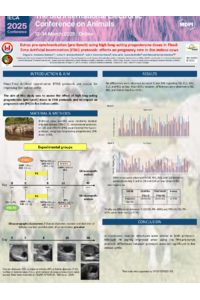
Fixed-Time Artificial Insemination (FTAI) protocols are crucial for improving Bos indicus cattle. The aim of this study was to assess the effect of high long-acting progesterone (pre-synch) doses in FTAI protocols and its impact on pregnancy rate (PR) in Bos indicus cattle. Brahman cows (n=100) were randomly divided into two groups, FTAI-C (C; conventional-protocol; n= 50) and FTAI-P4 (PP4; experimental-Pre-Synch-protocol, using high long-acting progesterone (P4) dose; n=50). A concentration of 200 mg of P4 was applied on Day -8 of the PP4 protocol. On Day 0, the progesterone device (CIDR-1.38 g intravaginal) and Estradiol Benzoate (E2B= 2.0 mg I.M.) were applied in both protocols. On Day 8, the cows received PGF2α (500 µg D-cloprostenol I.M.) + eCG (400 I.U., I.M.) + Estradiol cypionate (E2C= 1 mg I.M.). The CIDR was removed 12h later. Cows showed estrus at 36h post-CIDR removal and the FTAI was performed at 52h (cows showing estrus) and 60h (cows without estrus + GnRH application: 2,500 I.U.). Ovarian evaluation was performed on Day -8 (application of long-acting P4), Day 0 (CIDR application), Day 8 (implant removal), and Day 10 (estrus). PR was evaluated on Day 40. Ovarian diameter (OD), number of follicles (NFLs) follicle diameter (FLD), number of corpora lutea (NCL), and diameter of corpora lutea (CLD) were scored. Data were analyzed by GLMM (SPSS® 25, IBM Corp., USA). No differences were observed between C and PP4 regarding OD, FLD, NFL, CLD, and NCL on Day -8 (p> 0.05); however, differences were observed in OD, NFL, and CLD on Day 0 (p< 0.05). Differences were observed in OD, NFL, FLD, and CLD between protocols on Day 8 and in OD and CLD on Day 10 (p< 0.05). Finally, no differences between C (23/50; PR= 46%) and PP4 (31/50; PR= 62%) were observed (p= 0.06). In conclusion, ovarian structures were similar in both protocols. Although PR slightly improved when using the PP4-pre-Synch protocol, differences between protocols were not significant in Bos indicus cattle. This study was supported by DIRGI-CP2022-005.
Keywords
FTAI
ovarian structures
pregnancy rate
Bos indicus
cattle
Poster
IECA2025Poster-110563.pdf
Genomic profiling of production traits of the Arequipa fighting cattle in Peru
Public Perceptions of Shade Provision for Dairy Cows: Silvopastoral and Agrivoltaic Systems