Event submissions
Published
This submission belongs to the session E. Sustainable animal welfare, ethics and human-animal interactions of the event The 3rd International Electronic Conference on Animals
Published date
07 Mar, 2025
Academic Editor
'%3e%3cpath%20d='M12.6657%2010.9104C12.4185%2010.325%2012.0599%209.79327%2011.6097%209.34482C11.1609%208.89508%2010.6293%208.5365%2010.0442%208.28888C10.0389%208.28626%2010.0337%208.28495%2010.0285%208.28233C10.8446%207.69279%2011.3752%206.73249%2011.3752%205.64904C11.3752%203.8542%209.92103%202.39999%208.1262%202.39999C6.33136%202.39999%204.87715%203.8542%204.87715%205.64904C4.87715%206.73249%205.40774%207.69279%206.22393%208.28364C6.21869%208.28626%206.21345%208.28757%206.20821%208.29019C5.62129%208.5378%205.09463%208.89284%204.64265%209.34613C4.1929%209.79493%203.83432%2010.3266%203.58671%2010.9117C3.34345%2011.4845%203.21226%2012.0987%203.20023%2012.7209C3.19988%2012.7349%203.20233%2012.7488%203.20744%2012.7619C3.21255%2012.7749%203.22022%2012.7867%203.22998%2012.7968C3.23975%2012.8068%203.25142%2012.8147%203.26431%2012.8202C3.2772%2012.8256%203.29105%2012.8284%203.30504%2012.8284H4.09109C4.14874%2012.8284%204.19459%2012.7825%204.1959%2012.7262C4.2221%2011.7148%204.62823%2010.7676%205.34617%2010.0497C6.08899%209.30683%207.0755%208.89808%208.1262%208.89808C9.17689%208.89808%2010.1634%209.30683%2010.9062%2010.0497C11.6242%2010.7676%2012.0303%2011.7148%2012.0565%2012.7262C12.0578%2012.7838%2012.1037%2012.8284%2012.1613%2012.8284H12.9474C12.9613%2012.8284%2012.9752%2012.8256%2012.9881%2012.8202C13.001%2012.8147%2013.0126%2012.8068%2013.0224%2012.7968C13.0322%2012.7867%2013.0398%2012.7749%2013.0449%2012.7619C13.0501%2012.7488%2013.0525%2012.7349%2013.0522%2012.7209C13.0391%2012.0947%2012.9094%2011.4855%2012.6657%2010.9104ZM8.1262%207.9024C7.52486%207.9024%206.9589%207.6679%206.53312%207.24211C6.10733%206.81633%205.87283%206.25037%205.87283%205.64904C5.87283%205.0477%206.10733%204.48174%206.53312%204.05596C6.9589%203.63018%207.52486%203.39567%208.1262%203.39567C8.72753%203.39567%209.29349%203.63018%209.71927%204.05596C10.1451%204.48174%2010.3796%205.0477%2010.3796%205.64904C10.3796%206.25037%2010.1451%206.81633%209.71927%207.24211C9.29349%207.6679%208.72753%207.9024%208.1262%207.9024Z'%20fill='%235D1EE1'/%3e%3c/g%3e%3c/svg%3e) Clive Julian Phillips
Clive Julian PhillipsCitation
Linley Maciel, Matheus Deniz, Karolini De-Sousa, Hingryd Ferreira, Maria José Hötzel, Public Perceptions of Shade Provision for Dairy Cows: Silvopastoral and Agrivoltaic Systems, in Proceedings of The 3rd International Electronic Conference on Animals, 12 March–14 March 2025, MDPI: Basel, Switzerland
Share
Email
Facebook
Twitter
LinkedIn
Public Perceptions of Shade Provision for Dairy Cows: Silvopastoral and Agrivoltaic Systems
'%3e%3cpath%20d='M12.6647%2010.9104C12.4176%2010.325%2012.0589%209.7933%2011.6088%209.34485C11.16%208.89511%2010.6283%208.53653%2010.0432%208.28891C10.038%208.28629%2010.0327%208.28498%2010.0275%208.28236C10.8437%207.69282%2011.3743%206.73252%2011.3743%205.64907C11.3743%203.85423%209.92005%202.40002%208.12522%202.40002C6.33038%202.40002%204.87618%203.85423%204.87618%205.64907C4.87618%206.73252%205.40677%207.69282%206.22296%208.28367C6.21772%208.28629%206.21248%208.2876%206.20724%208.29022C5.62031%208.53783%205.09365%208.89287%204.64167%209.34616C4.19192%209.79496%203.83334%2010.3266%203.58573%2010.9117C3.34247%2011.4846%203.21128%2012.0987%203.19925%2012.721C3.1989%2012.735%203.20135%2012.7489%203.20646%2012.7619C3.21157%2012.7749%203.21924%2012.7868%203.22901%2012.7968C3.23877%2012.8068%203.25045%2012.8148%203.26334%2012.8202C3.27623%2012.8256%203.29007%2012.8284%203.30406%2012.8284H4.09012C4.14776%2012.8284%204.19362%2012.7825%204.19493%2012.7262C4.22113%2011.7148%204.62726%2010.7676%205.34519%2010.0497C6.08802%209.30686%207.07452%208.89811%208.12522%208.89811C9.17592%208.89811%2010.1624%209.30686%2010.9052%2010.0497C11.6232%2010.7676%2012.0293%2011.7148%2012.0555%2012.7262C12.0568%2012.7839%2012.1027%2012.8284%2012.1603%2012.8284H12.9464C12.9604%2012.8284%2012.9742%2012.8256%2012.9871%2012.8202C13%2012.8148%2013.0117%2012.8068%2013.0214%2012.7968C13.0312%2012.7868%2013.0389%2012.7749%2013.044%2012.7619C13.0491%2012.7489%2013.0515%2012.735%2013.0512%2012.721C13.0381%2012.0947%2012.9084%2011.4856%2012.6647%2010.9104ZM8.12522%207.90243C7.52388%207.90243%206.95792%207.66793%206.53214%207.24215C6.10636%206.81636%205.87185%206.2504%205.87185%205.64907C5.87185%205.04773%206.10636%204.48177%206.53214%204.05599C6.95792%203.63021%207.52388%203.3957%208.12522%203.3957C8.72655%203.3957%209.29252%203.63021%209.7183%204.05599C10.1441%204.48177%2010.3786%205.04773%2010.3786%205.64907C10.3786%206.2504%2010.1441%206.81636%209.7183%207.24215C9.29252%207.66793%208.72655%207.90243%208.12522%207.90243Z'%20fill='%235D1EE1'/%3e%3c/g%3e%3c/svg%3e)
Linley Maciel 1

Matheus Deniz 2

Karolini De-Sousa 3

Hingryd Ferreira 1
Maria José Hötzel 4
1. São Paulo State University (UNESP), Faculty of Veterinary Medicine and Animal Science, Botucatu, Brazil
2. São Paulo State University (UNESP), Faculty of Veterinary Medicine and Animal Science of Botucatu, Department of Animal Production and Preventive Veterinary Medicine, Botucatu, Brazil
3. Institute of Animal Science of the Government of the State of São Paulo, Sertãozinho Experimental Station, Sertãozinho, Brazil
4. Federal University of Santa Catarina, Center of Agricultural Sciences, Department of Animal Science, Florianópolis, Brazil
Abstract
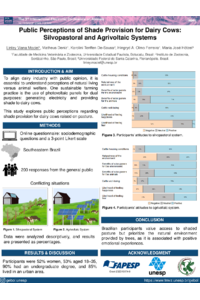
To align the dairy industry with public opinion, it is essential to understand perceptions of natural living versus animal welfare. One sustainable farming practice is the use of photovoltaic panels for dual purposes: generating electricity and providing shade to dairy cows. This study explores public perceptions regarding shade provision for dairy cows raised on pasture. We received 200 responses from the general public in southeastern Brazil through an online questionnaire that included sociodemographic questions and a three-point Likert scale. Participants were randomly assigned to one of two situations: the Silvopastoral System (SPS, n=100), where cows have access to shade from trees or the Agrivoltaic System (AgriPV, n=100), where cows have access to shade from photovoltaic panels. Data were analyzed descriptively, and the results are presented as percentages. Percentages were calculated by dividing the number of responses in each Likert scale by the total number of responses and multiplying by 100. The participants were predominantly women (52%), were aged between 18 and 35 years old (53%), had an undergraduate degree (90%) and lived in an urban area (85%). Regardless of their situation, most participants had a positive perception toward raising cows on pasture (SPS: 90%; AgriPV: 81%) and their welfare (SPS: 89%; AgriPV: 76%). Most (82%) viewed the SPS as a natural environment, while perceptions of AgriPV varied, with 38% seeing it as artificial and 35% being neutral. Interestingly, 64% of the participants believed that cows on the SPS are unlikely to feel fear, while perceptions of AgriPV varied, with 35% stating that cows can feel fear and 33% believing they are unlikely to. Meanwhile, 73% believe that cows are likely to experience happiness in the SPS, compared to 50% in AgriPV. We conclude that participants value access to pasture but prioritize the natural environment provided by trees, as it is associated with positive emotional experiences.
Keywords
Integrated systems
animal welfare
heat stress
social license
Poster
Poster_IECA_Linley_MD17fev25.pdf
Estrus pre-synchronisation (pre-Synch) using high long-acting progesterone doses in Fixed-Time Artificial Insemination (FTAI) protocols: effects on pregnancy rate in Bos indicus cows
Advancing Animals' Nutrition: Sustainable feed ingredients for the future