Event submissions
Published
This submission belongs to the session S5. Orthopedic Surgery of the event The 1st International Online Conference on Clinical Reports
Published date
17 Mar, 2025
Academic Editor
'%3e%3cpath%20d='M12.6657%2010.9104C12.4185%2010.325%2012.0599%209.79327%2011.6097%209.34482C11.1609%208.89508%2010.6293%208.5365%2010.0442%208.28888C10.0389%208.28626%2010.0337%208.28495%2010.0285%208.28233C10.8446%207.69279%2011.3752%206.73249%2011.3752%205.64904C11.3752%203.8542%209.92103%202.39999%208.1262%202.39999C6.33136%202.39999%204.87715%203.8542%204.87715%205.64904C4.87715%206.73249%205.40774%207.69279%206.22393%208.28364C6.21869%208.28626%206.21345%208.28757%206.20821%208.29019C5.62129%208.5378%205.09463%208.89284%204.64265%209.34613C4.1929%209.79493%203.83432%2010.3266%203.58671%2010.9117C3.34345%2011.4845%203.21226%2012.0987%203.20023%2012.7209C3.19988%2012.7349%203.20233%2012.7488%203.20744%2012.7619C3.21255%2012.7749%203.22022%2012.7867%203.22998%2012.7968C3.23975%2012.8068%203.25142%2012.8147%203.26431%2012.8202C3.2772%2012.8256%203.29105%2012.8284%203.30504%2012.8284H4.09109C4.14874%2012.8284%204.19459%2012.7825%204.1959%2012.7262C4.2221%2011.7148%204.62823%2010.7676%205.34617%2010.0497C6.08899%209.30683%207.0755%208.89808%208.1262%208.89808C9.17689%208.89808%2010.1634%209.30683%2010.9062%2010.0497C11.6242%2010.7676%2012.0303%2011.7148%2012.0565%2012.7262C12.0578%2012.7838%2012.1037%2012.8284%2012.1613%2012.8284H12.9474C12.9613%2012.8284%2012.9752%2012.8256%2012.9881%2012.8202C13.001%2012.8147%2013.0126%2012.8068%2013.0224%2012.7968C13.0322%2012.7867%2013.0398%2012.7749%2013.0449%2012.7619C13.0501%2012.7488%2013.0525%2012.7349%2013.0522%2012.7209C13.0391%2012.0947%2012.9094%2011.4855%2012.6657%2010.9104ZM8.1262%207.9024C7.52486%207.9024%206.9589%207.6679%206.53312%207.24211C6.10733%206.81633%205.87283%206.25037%205.87283%205.64904C5.87283%205.0477%206.10733%204.48174%206.53312%204.05596C6.9589%203.63018%207.52486%203.39567%208.1262%203.39567C8.72753%203.39567%209.29349%203.63018%209.71927%204.05596C10.1451%204.48174%2010.3796%205.0477%2010.3796%205.64904C10.3796%206.25037%2010.1451%206.81633%209.71927%207.24211C9.29349%207.6679%208.72753%207.9024%208.1262%207.9024Z'%20fill='%235D1EE1'/%3e%3c/g%3e%3c/svg%3e) Iuliana Adelina Platon
Iuliana Adelina PlatonCitation
Mr. Newton Neogi, Mrs. Kristi Priya Choudhury, Mr. Sabbir Hossain, Mr. Ibrahim Hossain, Advancements in Nanotechnology for Orthopedic Applications: A Comprehensive Overview of Nanomaterials in Bone Tissue Engineering and Implant Innovation, in Proceedings of The 1st International Online Conference on Clinical Reports, 19 March–20 March 2025, MDPI: Basel, Switzerland
Share
Email
Facebook
Twitter
LinkedIn
Advancements in Nanotechnology for Orthopedic Applications: A Comprehensive Overview of Nanomaterials in Bone Tissue Engineering and Implant Innovation
'%3e%3cpath%20d='M12.6647%2010.9104C12.4176%2010.325%2012.0589%209.7933%2011.6088%209.34485C11.16%208.89511%2010.6283%208.53653%2010.0432%208.28891C10.038%208.28629%2010.0327%208.28498%2010.0275%208.28236C10.8437%207.69282%2011.3743%206.73252%2011.3743%205.64907C11.3743%203.85423%209.92005%202.40002%208.12522%202.40002C6.33038%202.40002%204.87618%203.85423%204.87618%205.64907C4.87618%206.73252%205.40677%207.69282%206.22296%208.28367C6.21772%208.28629%206.21248%208.2876%206.20724%208.29022C5.62031%208.53783%205.09365%208.89287%204.64167%209.34616C4.19192%209.79496%203.83334%2010.3266%203.58573%2010.9117C3.34247%2011.4846%203.21128%2012.0987%203.19925%2012.721C3.1989%2012.735%203.20135%2012.7489%203.20646%2012.7619C3.21157%2012.7749%203.21924%2012.7868%203.22901%2012.7968C3.23877%2012.8068%203.25045%2012.8148%203.26334%2012.8202C3.27623%2012.8256%203.29007%2012.8284%203.30406%2012.8284H4.09012C4.14776%2012.8284%204.19362%2012.7825%204.19493%2012.7262C4.22113%2011.7148%204.62726%2010.7676%205.34519%2010.0497C6.08802%209.30686%207.07452%208.89811%208.12522%208.89811C9.17592%208.89811%2010.1624%209.30686%2010.9052%2010.0497C11.6232%2010.7676%2012.0293%2011.7148%2012.0555%2012.7262C12.0568%2012.7839%2012.1027%2012.8284%2012.1603%2012.8284H12.9464C12.9604%2012.8284%2012.9742%2012.8256%2012.9871%2012.8202C13%2012.8148%2013.0117%2012.8068%2013.0214%2012.7968C13.0312%2012.7868%2013.0389%2012.7749%2013.044%2012.7619C13.0491%2012.7489%2013.0515%2012.735%2013.0512%2012.721C13.0381%2012.0947%2012.9084%2011.4856%2012.6647%2010.9104ZM8.12522%207.90243C7.52388%207.90243%206.95792%207.66793%206.53214%207.24215C6.10636%206.81636%205.87185%206.2504%205.87185%205.64907C5.87185%205.04773%206.10636%204.48177%206.53214%204.05599C6.95792%203.63021%207.52388%203.3957%208.12522%203.3957C8.72655%203.3957%209.29252%203.63021%209.7183%204.05599C10.1441%204.48177%2010.3786%205.04773%2010.3786%205.64907C10.3786%206.2504%2010.1441%206.81636%209.7183%207.24215C9.29252%207.66793%208.72655%207.90243%208.12522%207.90243Z'%20fill='%235D1EE1'/%3e%3c/g%3e%3c/svg%3e)
Mr. Newton Neogi 1
Mrs. Kristi Priya Choudhury 1

Mr. Sabbir Hossain 1

Mr. Ibrahim Hossain 1
1. Department of biological research, Nano Research Centre, Sylhet 3114, Bangladesh
Abstract
Orthopedic implant technology has historically seen difficulties in attaining long-term stability and biological integration, leading to complications such as implant loosening, wear debris production, and heightened infection risk. Nanotechnology provides a revolutionary method for addressing these constraints through the introduction of materials characterized by exceptional biocompatibility, durability, and integration potential. Nanomaterials, characterized by distinctive surface topographies and elevated surface area-to-volume ratios, facilitate improved osseointegration and provide regulated medication release, thereby creating a localized therapeutic milieu surrounding the implant site. To overcome the long-standing constraints of conventional implants, such as poor osseointegration, low mechanical fixation, immunological rejection, and implant-related infections, nanotechnology is causing a revolution in the field of orthopedic research. Nanomaterials are ideally suited for orthopedic applications due to their exceptional features, including increased tribology, wear resistance, prolonged drug administration, and excellent tissue regeneration. Because of their nanoscale size, they can imitate the hierarchical structure of real bone, which in turn encourages the proliferation of cells, lowers the risk of infection, and helps with the mending of bone fractures. This article will investigate the wide-ranging possibilities of nanostructured ceramics, polymers, metals, and carbon materials in bone tissue engineering, diagnostics, and the treatment of implant-related infections, bone malignancies, and bone healing. In addition, this paper will provide a basic overview of the most recent discoveries in nanotechnology driving the future of translational orthopedic research. It will also highlight safety evaluations and regulatory requirements for orthopedic devices.
Keywords
Osseointegration
Orthopedic implants
bone tissue engineering
Implant-related infections
Biofilm prevention
Poster
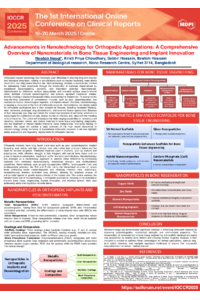
(sciforum-109558) Advancements in Nanotechnology for Orthopedic Applications. A Comprehensive Overview of Nanomaterials in Bone Tissue Engineering and Implant Innovation.pdf
Exploring Lifestyle Factors Contributing to Osteoarthritis in the UAE: Assessing Risk Awareness and Prevention Behaviors in Adult Populations
Paternal Teratogen Exposure and Risk of Congenital Heart Disease in Offspring: A Two-Year Retrospective Observational Study