Event submissions
Published
This submission belongs to the session S3. Cardiovascular Diseases of the event The 1st International Online Conference on Clinical Reports
Published date
17 Mar, 2025
Academic Editor
'%3e%3cpath%20d='M12.6657%2010.9104C12.4185%2010.325%2012.0599%209.79327%2011.6097%209.34482C11.1609%208.89508%2010.6293%208.5365%2010.0442%208.28888C10.0389%208.28626%2010.0337%208.28495%2010.0285%208.28233C10.8446%207.69279%2011.3752%206.73249%2011.3752%205.64904C11.3752%203.8542%209.92103%202.39999%208.1262%202.39999C6.33136%202.39999%204.87715%203.8542%204.87715%205.64904C4.87715%206.73249%205.40774%207.69279%206.22393%208.28364C6.21869%208.28626%206.21345%208.28757%206.20821%208.29019C5.62129%208.5378%205.09463%208.89284%204.64265%209.34613C4.1929%209.79493%203.83432%2010.3266%203.58671%2010.9117C3.34345%2011.4845%203.21226%2012.0987%203.20023%2012.7209C3.19988%2012.7349%203.20233%2012.7488%203.20744%2012.7619C3.21255%2012.7749%203.22022%2012.7867%203.22998%2012.7968C3.23975%2012.8068%203.25142%2012.8147%203.26431%2012.8202C3.2772%2012.8256%203.29105%2012.8284%203.30504%2012.8284H4.09109C4.14874%2012.8284%204.19459%2012.7825%204.1959%2012.7262C4.2221%2011.7148%204.62823%2010.7676%205.34617%2010.0497C6.08899%209.30683%207.0755%208.89808%208.1262%208.89808C9.17689%208.89808%2010.1634%209.30683%2010.9062%2010.0497C11.6242%2010.7676%2012.0303%2011.7148%2012.0565%2012.7262C12.0578%2012.7838%2012.1037%2012.8284%2012.1613%2012.8284H12.9474C12.9613%2012.8284%2012.9752%2012.8256%2012.9881%2012.8202C13.001%2012.8147%2013.0126%2012.8068%2013.0224%2012.7968C13.0322%2012.7867%2013.0398%2012.7749%2013.0449%2012.7619C13.0501%2012.7488%2013.0525%2012.7349%2013.0522%2012.7209C13.0391%2012.0947%2012.9094%2011.4855%2012.6657%2010.9104ZM8.1262%207.9024C7.52486%207.9024%206.9589%207.6679%206.53312%207.24211C6.10733%206.81633%205.87283%206.25037%205.87283%205.64904C5.87283%205.0477%206.10733%204.48174%206.53312%204.05596C6.9589%203.63018%207.52486%203.39567%208.1262%203.39567C8.72753%203.39567%209.29349%203.63018%209.71927%204.05596C10.1451%204.48174%2010.3796%205.0477%2010.3796%205.64904C10.3796%206.25037%2010.1451%206.81633%209.71927%207.24211C9.29349%207.6679%208.72753%207.9024%208.1262%207.9024Z'%20fill='%235D1EE1'/%3e%3c/g%3e%3c/svg%3e) Takatoshi Kasai
Takatoshi KasaiCitation
Shadab Ahamad, Paramvir Singh, Anuj Kumar Sharma, Adhi Arya, Prachi Kukshal, Paternal Teratogen Exposure and Risk of Congenital Heart Disease in Offspring: A Two-Year Retrospective Observational Study, in Proceedings of The 1st International Online Conference on Clinical Reports, 19 March–20 March 2025, MDPI: Basel, Switzerland
Share
Email
Facebook
Twitter
LinkedIn
Paternal Teratogen Exposure and Risk of Congenital Heart Disease in Offspring: A Two-Year Retrospective Observational Study
'%3e%3cpath%20d='M12.6647%2010.9104C12.4176%2010.325%2012.0589%209.7933%2011.6088%209.34485C11.16%208.89511%2010.6283%208.53653%2010.0432%208.28891C10.038%208.28629%2010.0327%208.28498%2010.0275%208.28236C10.8437%207.69282%2011.3743%206.73252%2011.3743%205.64907C11.3743%203.85423%209.92005%202.40002%208.12522%202.40002C6.33038%202.40002%204.87618%203.85423%204.87618%205.64907C4.87618%206.73252%205.40677%207.69282%206.22296%208.28367C6.21772%208.28629%206.21248%208.2876%206.20724%208.29022C5.62031%208.53783%205.09365%208.89287%204.64167%209.34616C4.19192%209.79496%203.83334%2010.3266%203.58573%2010.9117C3.34247%2011.4846%203.21128%2012.0987%203.19925%2012.721C3.1989%2012.735%203.20135%2012.7489%203.20646%2012.7619C3.21157%2012.7749%203.21924%2012.7868%203.22901%2012.7968C3.23877%2012.8068%203.25045%2012.8148%203.26334%2012.8202C3.27623%2012.8256%203.29007%2012.8284%203.30406%2012.8284H4.09012C4.14776%2012.8284%204.19362%2012.7825%204.19493%2012.7262C4.22113%2011.7148%204.62726%2010.7676%205.34519%2010.0497C6.08802%209.30686%207.07452%208.89811%208.12522%208.89811C9.17592%208.89811%2010.1624%209.30686%2010.9052%2010.0497C11.6232%2010.7676%2012.0293%2011.7148%2012.0555%2012.7262C12.0568%2012.7839%2012.1027%2012.8284%2012.1603%2012.8284H12.9464C12.9604%2012.8284%2012.9742%2012.8256%2012.9871%2012.8202C13%2012.8148%2013.0117%2012.8068%2013.0214%2012.7968C13.0312%2012.7868%2013.0389%2012.7749%2013.044%2012.7619C13.0491%2012.7489%2013.0515%2012.735%2013.0512%2012.721C13.0381%2012.0947%2012.9084%2011.4856%2012.6647%2010.9104ZM8.12522%207.90243C7.52388%207.90243%206.95792%207.66793%206.53214%207.24215C6.10636%206.81636%205.87185%206.2504%205.87185%205.64907C5.87185%205.04773%206.10636%204.48177%206.53214%204.05599C6.95792%203.63021%207.52388%203.3957%208.12522%203.3957C8.72655%203.3957%209.29252%203.63021%209.7183%204.05599C10.1441%204.48177%2010.3786%205.04773%2010.3786%205.64907C10.3786%206.2504%2010.1441%206.81636%209.7183%207.24215C9.29252%207.66793%208.72655%207.90243%208.12522%207.90243Z'%20fill='%235D1EE1'/%3e%3c/g%3e%3c/svg%3e)
Shadab Ahamad 1
Paramvir Singh 2
Anuj Kumar Sharma 2
Adhi Arya 2
Prachi Kukshal 1
1. Sri Sathya Sai Sanjeevani Research Centre, Palwal, Haryana, India
2. Sri Sathya Sai Sanjeevani International Centre for Child Heart Care & Research, Palwal, Haryana, India
Abstract
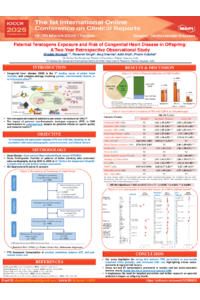
Introduction: Exposure to teratogens such as alcohol, drugs, tobacco, etc. before or during pregnancy is a well-established risk factor for adverse birth outcomes, including low birth weight, preterm birth, and congenital heart disease (CHD). While maternal exposure has been extensively studied, the impact of paternal addictions on CHD risk in offspring remains underexplored, despite their potential effects on sperm quality and maternal health. This study investigates the role of paternal teratogen exposure in CHD development, with a focus on its correlation with socio-demographic and socio-economic factors.
Methods: A retrospective case–control study was conducted on children screened for CHD during 2022-2024. Data were analyzed using SPSS and MS Excel, employing ꭓ2 test, Fisher’s exact test, and multivariate logistic regression.
Results: Of the 8798 children screened, 7626 (86.7 %) were diagnosed with CHD, and 1172 were controls. Paternal addictions included alcohol (10.9 %), chewable tobacco (18.1 %), and pan-masala/supari (4.9 %). Alcohol consumption, prevalent in northeast India (p = 0.055; OR = 3.92) and among nuclear families (p < 0.001; OR = 1.76) in urban areas (p < 0.001; OR = 1.54), was linked to a reduced risk of total anomalous pulmonary venous connection [p = 0.03; OR (95 % CI) = 0.55 (0.32-0.94)]. Tobacco and pan-masala consumption was associated with nearly double the risk of cyanotic CHD (p < 0.001) and complex CHD manifestations (p < 0.05), particularly in families from eastern and central India (p < 0.05) with low socio-economic status (p = 0.04; OR = 19.43), and contributed to low birth weight (p = 0.003; OR = 1.25).
Conclusion: Our study highlights the significant role of paternal addiction in CHD prognosis, revealing critical socio-economic and regional risk factors. It underscores the need for targeted preventive strategies and further research on paternal teratogen exposure and its impact on offspring health.
Keywords
Tobacco
Alcohol
Pan-masala
Congenital heart disease
Association
India
Poster
Sciforum-110879_Shadab Ahamad.pdf
Advancements in Nanotechnology for Orthopedic Applications: A Comprehensive Overview of Nanomaterials in Bone Tissue Engineering and Implant Innovation
Hyperbaric Oxygen Therapy to Enhance Functional Recovery in Bell’s Palsy: a Case Series