Event submissions
Published
This submission belongs to the session S4. Oral Diseases of the event The 1st International Online Conference on Clinical Reports
Published date
17 Mar, 2025
Academic Editor
'%3e%3cpath%20d='M12.6657%2010.9104C12.4185%2010.325%2012.0599%209.79327%2011.6097%209.34482C11.1609%208.89508%2010.6293%208.5365%2010.0442%208.28888C10.0389%208.28626%2010.0337%208.28495%2010.0285%208.28233C10.8446%207.69279%2011.3752%206.73249%2011.3752%205.64904C11.3752%203.8542%209.92103%202.39999%208.1262%202.39999C6.33136%202.39999%204.87715%203.8542%204.87715%205.64904C4.87715%206.73249%205.40774%207.69279%206.22393%208.28364C6.21869%208.28626%206.21345%208.28757%206.20821%208.29019C5.62129%208.5378%205.09463%208.89284%204.64265%209.34613C4.1929%209.79493%203.83432%2010.3266%203.58671%2010.9117C3.34345%2011.4845%203.21226%2012.0987%203.20023%2012.7209C3.19988%2012.7349%203.20233%2012.7488%203.20744%2012.7619C3.21255%2012.7749%203.22022%2012.7867%203.22998%2012.7968C3.23975%2012.8068%203.25142%2012.8147%203.26431%2012.8202C3.2772%2012.8256%203.29105%2012.8284%203.30504%2012.8284H4.09109C4.14874%2012.8284%204.19459%2012.7825%204.1959%2012.7262C4.2221%2011.7148%204.62823%2010.7676%205.34617%2010.0497C6.08899%209.30683%207.0755%208.89808%208.1262%208.89808C9.17689%208.89808%2010.1634%209.30683%2010.9062%2010.0497C11.6242%2010.7676%2012.0303%2011.7148%2012.0565%2012.7262C12.0578%2012.7838%2012.1037%2012.8284%2012.1613%2012.8284H12.9474C12.9613%2012.8284%2012.9752%2012.8256%2012.9881%2012.8202C13.001%2012.8147%2013.0126%2012.8068%2013.0224%2012.7968C13.0322%2012.7867%2013.0398%2012.7749%2013.0449%2012.7619C13.0501%2012.7488%2013.0525%2012.7349%2013.0522%2012.7209C13.0391%2012.0947%2012.9094%2011.4855%2012.6657%2010.9104ZM8.1262%207.9024C7.52486%207.9024%206.9589%207.6679%206.53312%207.24211C6.10733%206.81633%205.87283%206.25037%205.87283%205.64904C5.87283%205.0477%206.10733%204.48174%206.53312%204.05596C6.9589%203.63018%207.52486%203.39567%208.1262%203.39567C8.72753%203.39567%209.29349%203.63018%209.71927%204.05596C10.1451%204.48174%2010.3796%205.0477%2010.3796%205.64904C10.3796%206.25037%2010.1451%206.81633%209.71927%207.24211C9.29349%207.6679%208.72753%207.9024%208.1262%207.9024Z'%20fill='%235D1EE1'/%3e%3c/g%3e%3c/svg%3e) Federica Di Spirito
Federica Di SpiritoCitation
Debprasad Dutta, Franklin Binoy Jestin, Aiswarya Radhakrishnan, Amritha Suresh, Srikant Venkatakrishnan, Hyperbaric Oxygen Therapy to Enhance Functional Recovery in Bell’s Palsy: a Case Series, in Proceedings of The 1st International Online Conference on Clinical Reports, 19 March–20 March 2025, MDPI: Basel, Switzerland
Share
Email
Facebook
Twitter
LinkedIn
Hyperbaric Oxygen Therapy to Enhance Functional Recovery in Bell’s Palsy: a Case Series

Debprasad Dutta 1
'%3e%3cpath%20d='M12.6647%2010.9104C12.4176%2010.325%2012.0589%209.7933%2011.6088%209.34485C11.16%208.89511%2010.6283%208.53653%2010.0432%208.28891C10.038%208.28629%2010.0327%208.28498%2010.0275%208.28236C10.8437%207.69282%2011.3743%206.73252%2011.3743%205.64907C11.3743%203.85423%209.92005%202.40002%208.12522%202.40002C6.33038%202.40002%204.87618%203.85423%204.87618%205.64907C4.87618%206.73252%205.40677%207.69282%206.22296%208.28367C6.21772%208.28629%206.21248%208.2876%206.20724%208.29022C5.62031%208.53783%205.09365%208.89287%204.64167%209.34616C4.19192%209.79496%203.83334%2010.3266%203.58573%2010.9117C3.34247%2011.4846%203.21128%2012.0987%203.19925%2012.721C3.1989%2012.735%203.20135%2012.7489%203.20646%2012.7619C3.21157%2012.7749%203.21924%2012.7868%203.22901%2012.7968C3.23877%2012.8068%203.25045%2012.8148%203.26334%2012.8202C3.27623%2012.8256%203.29007%2012.8284%203.30406%2012.8284H4.09012C4.14776%2012.8284%204.19362%2012.7825%204.19493%2012.7262C4.22113%2011.7148%204.62726%2010.7676%205.34519%2010.0497C6.08802%209.30686%207.07452%208.89811%208.12522%208.89811C9.17592%208.89811%2010.1624%209.30686%2010.9052%2010.0497C11.6232%2010.7676%2012.0293%2011.7148%2012.0555%2012.7262C12.0568%2012.7839%2012.1027%2012.8284%2012.1603%2012.8284H12.9464C12.9604%2012.8284%2012.9742%2012.8256%2012.9871%2012.8202C13%2012.8148%2013.0117%2012.8068%2013.0214%2012.7968C13.0312%2012.7868%2013.0389%2012.7749%2013.044%2012.7619C13.0491%2012.7489%2013.0515%2012.735%2013.0512%2012.721C13.0381%2012.0947%2012.9084%2011.4856%2012.6647%2010.9104ZM8.12522%207.90243C7.52388%207.90243%206.95792%207.66793%206.53214%207.24215C6.10636%206.81636%205.87185%206.2504%205.87185%205.64907C5.87185%205.04773%206.10636%204.48177%206.53214%204.05599C6.95792%203.63021%207.52388%203.3957%208.12522%203.3957C8.72655%203.3957%209.29252%203.63021%209.7183%204.05599C10.1441%204.48177%2010.3786%205.04773%2010.3786%205.64907C10.3786%206.2504%2010.1441%206.81636%209.7183%207.24215C9.29252%207.66793%208.72655%207.90243%208.12522%207.90243Z'%20fill='%235D1EE1'/%3e%3c/g%3e%3c/svg%3e)
Franklin Binoy Jestin 2
Aiswarya Radhakrishnan 1
Amritha Suresh 1
Srikant Venkatakrishnan 2
1. Integrated Research on Neuroscience (IRoN) Unit, Mazumdar Shaw Center for Translational Research (MSCTR), Mazumdar Shaw Medical Foundation (MSMF), Bangalore-560099, India
2. Narayana Institute of Neuroscience (NIN), Narayana Health (NH), Bangalore-560099, India
Abstract
Introduction:
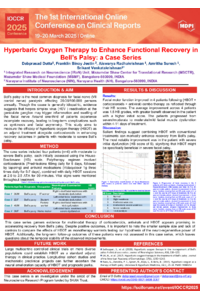
Bell's palsy is a neurological disorder characterized by sudden unilateral facial paralysis, primarily affecting individuals aged 15 to 40, with a lifetime risk of approximately 1 in 60. Symptoms include facial weakness, pain around the ear, and altered taste, often resulting from herpes simplex virus reactivation. Around one-third of patients may experience incomplete recovery, leading to long-term complications such as synkinesis and facial asymmetry. This study investigates the efficacy of hyperbaric oxygen therapy (HBOT) as an adjunct treatment alongside corticosteroids in enhancing recovery outcomes in patients with moderate to severe Bell's palsy.
Methods:
The case series included four patients (n=4) with moderate to severe Bell's palsy, each initially assessed using the House–Brackmann (HB) scale. Treatment involved corticosteroids (Prednisolone 60 mg daily for five days, followed by tapering) and antiviral medications (Valacyclovir 1 g three times daily for 5-7 days), combined with daily HBOT sessions at 2.0 to 2.5 ATA for 90 minutes. Vital signs were monitored throughout treatment.
Results:
The results indicated improvements in facial nerve function, measured using the HB scale. Specifically, patient scores improved from an initial range of 3 to 5 over treatment durations of 5 to 11 days. The average improvement across 4 patients was 1.5 HB grades, with greater benefits observed in the patient with a higher initial score.
Discussion:
The findings suggest that combining corticosteroids, antivirals, and HBOT can significantly enhance recovery from Bell's palsy. The most improvement was noted in the patient with severe initial dysfunction (HB score of 5), indicating that HBOT may be particularly beneficial in severe dysfunction.
Conclusion:
The combination of corticosteroids, antiviral therapy and HBOT appears promising in accelerating recovery from Bell's palsy, warranting further investigation through large multicentric controlled trials to establish HBOT as a standard adjunct therapy in clinical practice.
Keywords
Facial nerve palsy
hyperbaric medicine
Idiopathic peripheral facial palsy (IFP)
7th cranial nerve paralysis
Post Paralysis Facial Synkinesis (PPFS)
Poster
IOCCR 2025 Poster . Debprasad Dutta et. al., 2025.pdf
Paternal Teratogen Exposure and Risk of Congenital Heart Disease in Offspring: A Two-Year Retrospective Observational Study
Proteolyzed but not full-length galectin-9 in plasma predicts the prognosis of COVID-19