Event submissions
Published
This submission belongs to the session S2. Cancer of the event The 1st International Online Conference on Clinical Reports
Published date
17 Mar, 2025
Academic Editor
'%3e%3cpath%20d='M12.6657%2010.9104C12.4185%2010.325%2012.0599%209.79327%2011.6097%209.34482C11.1609%208.89508%2010.6293%208.5365%2010.0442%208.28888C10.0389%208.28626%2010.0337%208.28495%2010.0285%208.28233C10.8446%207.69279%2011.3752%206.73249%2011.3752%205.64904C11.3752%203.8542%209.92103%202.39999%208.1262%202.39999C6.33136%202.39999%204.87715%203.8542%204.87715%205.64904C4.87715%206.73249%205.40774%207.69279%206.22393%208.28364C6.21869%208.28626%206.21345%208.28757%206.20821%208.29019C5.62129%208.5378%205.09463%208.89284%204.64265%209.34613C4.1929%209.79493%203.83432%2010.3266%203.58671%2010.9117C3.34345%2011.4845%203.21226%2012.0987%203.20023%2012.7209C3.19988%2012.7349%203.20233%2012.7488%203.20744%2012.7619C3.21255%2012.7749%203.22022%2012.7867%203.22998%2012.7968C3.23975%2012.8068%203.25142%2012.8147%203.26431%2012.8202C3.2772%2012.8256%203.29105%2012.8284%203.30504%2012.8284H4.09109C4.14874%2012.8284%204.19459%2012.7825%204.1959%2012.7262C4.2221%2011.7148%204.62823%2010.7676%205.34617%2010.0497C6.08899%209.30683%207.0755%208.89808%208.1262%208.89808C9.17689%208.89808%2010.1634%209.30683%2010.9062%2010.0497C11.6242%2010.7676%2012.0303%2011.7148%2012.0565%2012.7262C12.0578%2012.7838%2012.1037%2012.8284%2012.1613%2012.8284H12.9474C12.9613%2012.8284%2012.9752%2012.8256%2012.9881%2012.8202C13.001%2012.8147%2013.0126%2012.8068%2013.0224%2012.7968C13.0322%2012.7867%2013.0398%2012.7749%2013.0449%2012.7619C13.0501%2012.7488%2013.0525%2012.7349%2013.0522%2012.7209C13.0391%2012.0947%2012.9094%2011.4855%2012.6657%2010.9104ZM8.1262%207.9024C7.52486%207.9024%206.9589%207.6679%206.53312%207.24211C6.10733%206.81633%205.87283%206.25037%205.87283%205.64904C5.87283%205.0477%206.10733%204.48174%206.53312%204.05596C6.9589%203.63018%207.52486%203.39567%208.1262%203.39567C8.72753%203.39567%209.29349%203.63018%209.71927%204.05596C10.1451%204.48174%2010.3796%205.0477%2010.3796%205.64904C10.3796%206.25037%2010.1451%206.81633%209.71927%207.24211C9.29349%207.6679%208.72753%207.9024%208.1262%207.9024Z'%20fill='%235D1EE1'/%3e%3c/g%3e%3c/svg%3e) Luca Bertolaccini
Luca BertolacciniCitation
Farhan Ikhtiar, Dr. Muhammad Aleem Ashraf, Rana Hissan Ullah, Laraib Zafar Iqbal, Ahmed Haider, Muhammad Faizan Qadir, Muhammad Usman Farooq, Association BetweenTFR2 Gene Variant rs7385804 and Hemochromatosis and Its Role in Iron-Related Carcinogenesis in Pakistani Population, in Proceedings of The 1st International Online Conference on Clinical Reports, 19 March–20 March 2025, MDPI: Basel, Switzerland
Share
Email
Facebook
Twitter
LinkedIn
Association BetweenTFR2 Gene Variant rs7385804 and Hemochromatosis and Its Role in Iron-Related Carcinogenesis in Pakistani Population

Farhan Ikhtiar 1

Dr. Muhammad Aleem Ashraf 2
'%3e%3cpath%20d='M12.6647%2010.9104C12.4176%2010.325%2012.0589%209.7933%2011.6088%209.34485C11.16%208.89511%2010.6283%208.53653%2010.0432%208.28891C10.038%208.28629%2010.0327%208.28498%2010.0275%208.28236C10.8437%207.69282%2011.3743%206.73252%2011.3743%205.64907C11.3743%203.85423%209.92005%202.40002%208.12522%202.40002C6.33038%202.40002%204.87618%203.85423%204.87618%205.64907C4.87618%206.73252%205.40677%207.69282%206.22296%208.28367C6.21772%208.28629%206.21248%208.2876%206.20724%208.29022C5.62031%208.53783%205.09365%208.89287%204.64167%209.34616C4.19192%209.79496%203.83334%2010.3266%203.58573%2010.9117C3.34247%2011.4846%203.21128%2012.0987%203.19925%2012.721C3.1989%2012.735%203.20135%2012.7489%203.20646%2012.7619C3.21157%2012.7749%203.21924%2012.7868%203.22901%2012.7968C3.23877%2012.8068%203.25045%2012.8148%203.26334%2012.8202C3.27623%2012.8256%203.29007%2012.8284%203.30406%2012.8284H4.09012C4.14776%2012.8284%204.19362%2012.7825%204.19493%2012.7262C4.22113%2011.7148%204.62726%2010.7676%205.34519%2010.0497C6.08802%209.30686%207.07452%208.89811%208.12522%208.89811C9.17592%208.89811%2010.1624%209.30686%2010.9052%2010.0497C11.6232%2010.7676%2012.0293%2011.7148%2012.0555%2012.7262C12.0568%2012.7839%2012.1027%2012.8284%2012.1603%2012.8284H12.9464C12.9604%2012.8284%2012.9742%2012.8256%2012.9871%2012.8202C13%2012.8148%2013.0117%2012.8068%2013.0214%2012.7968C13.0312%2012.7868%2013.0389%2012.7749%2013.044%2012.7619C13.0491%2012.7489%2013.0515%2012.735%2013.0512%2012.721C13.0381%2012.0947%2012.9084%2011.4856%2012.6647%2010.9104ZM8.12522%207.90243C7.52388%207.90243%206.95792%207.66793%206.53214%207.24215C6.10636%206.81636%205.87185%206.2504%205.87185%205.64907C5.87185%205.04773%206.10636%204.48177%206.53214%204.05599C6.95792%203.63021%207.52388%203.3957%208.12522%203.3957C8.72655%203.3957%209.29252%203.63021%209.7183%204.05599C10.1441%204.48177%2010.3786%205.04773%2010.3786%205.64907C10.3786%206.2504%2010.1441%206.81636%209.7183%207.24215C9.29252%207.66793%208.72655%207.90243%208.12522%207.90243Z'%20fill='%235D1EE1'/%3e%3c/g%3e%3c/svg%3e)
Rana Hissan Ullah 3
Laraib Zafar Iqbal 4
Ahmed Haider 5
Muhammad Faizan Qadir 6
Muhammad Usman Farooq 7
1. MS Biochemistry, University of Central Punjab, Lahore 60700, Pakistan
2. Department of Bioscience and Technology, Emerson University, Multan 60700, Pakistan
3. North East Forestry University of China, Harbin, Postal code: 150040, China
4. Bahauddin Zakariya University, Multan Postal code 60700, Pakistan
5. Bahauddin Zakariya University, Sydney, Postal code 2006, Pakistan
6. University of Central Punjab, Lahore, Postal code 60700, Pakistan
7. University of Education, Lahore, Multan, Postal code 60700, Pakistan
Abstract
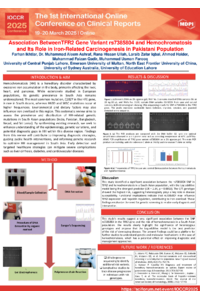
Hemochromatosis is an autosomal recessive iron overload disorder characterized by excessive iron accumulation, which can lead to various health complications, including liver fibrosis, cirrhosis, and an increased risk of hepatocellular carcinoma (HCC). Iron overload promotes oxidative stress, DNA damage, and cellular proliferation, all of which are implicated in carcinogenesis. The TFR2 gene variant rs7385804 has been implicated in hemochromatosis; however, its role in the Pakistani population and its potential link to cancer progression remain unexplored. This study aimed to investigate the association between the TFR2 gene variant rs7385804 and hemochromatosis in Pakistani individuals and assess its possible role in cancer-related mechanisms. We employed a case--control study design, recruiting 200 hemochromatosis patients and 200 healthy controls from the Pakistani population. Genomic DNA was extracted from peripheral blood samples using the phenol-chloroform method. Sanger sequencing and Tetra-ARMS PCR were used to detect the TFR2 gene variant rs7385804. Our results demonstrated a significant association between the TFR2 gene variant rs7385804 and hemochromatosis in the Pakistani population (p < 0.001). The frequency of the variant allele was higher in patients (35%) compared to controls (15%). Sanger sequencing confirmed the presence of the variant in 70% of patients, while Tetra-ARMS PCR showed 90% concordance with sequencing results. Iron overload, mediated by TFR2 dysregulation, can lead to oxidative stress and genomic instability, key drivers in the development of hepatocellular carcinoma and other malignancies. This study highlights the utility of Sanger sequencing and Tetra-ARMS PCR in detecting the TFR2 gene variant rs7385804 and provides evidence that this variant may serve as a genetic marker for hemochromatosis and a potential contributor to iron-related carcinogenesis in the Pakistani population. Further studies are required to validate these findings and elucidate the clinical implications of this association in cancer development.
Keywords
Hemojuveline
hepatocytes
hemochromatosis
hepcidin
ferroprotein
Poster
sciforum-112803 .pdf
Improving the Safety of Hormone Replacement Therapy (HRT) Prescribing in Primary Care
Extracorporeal therapy in critically ill patients: prospects for monitoring aromatic and mitochondrial metabolites