Event submissions
Published
This submission belongs to the session S3. Cardiovascular Diseases of the event The 1st International Online Conference on Clinical Reports
Published date
17 Mar, 2025
Academic Editor
'%3e%3cpath%20d='M12.6657%2010.9104C12.4185%2010.325%2012.0599%209.79327%2011.6097%209.34482C11.1609%208.89508%2010.6293%208.5365%2010.0442%208.28888C10.0389%208.28626%2010.0337%208.28495%2010.0285%208.28233C10.8446%207.69279%2011.3752%206.73249%2011.3752%205.64904C11.3752%203.8542%209.92103%202.39999%208.1262%202.39999C6.33136%202.39999%204.87715%203.8542%204.87715%205.64904C4.87715%206.73249%205.40774%207.69279%206.22393%208.28364C6.21869%208.28626%206.21345%208.28757%206.20821%208.29019C5.62129%208.5378%205.09463%208.89284%204.64265%209.34613C4.1929%209.79493%203.83432%2010.3266%203.58671%2010.9117C3.34345%2011.4845%203.21226%2012.0987%203.20023%2012.7209C3.19988%2012.7349%203.20233%2012.7488%203.20744%2012.7619C3.21255%2012.7749%203.22022%2012.7867%203.22998%2012.7968C3.23975%2012.8068%203.25142%2012.8147%203.26431%2012.8202C3.2772%2012.8256%203.29105%2012.8284%203.30504%2012.8284H4.09109C4.14874%2012.8284%204.19459%2012.7825%204.1959%2012.7262C4.2221%2011.7148%204.62823%2010.7676%205.34617%2010.0497C6.08899%209.30683%207.0755%208.89808%208.1262%208.89808C9.17689%208.89808%2010.1634%209.30683%2010.9062%2010.0497C11.6242%2010.7676%2012.0303%2011.7148%2012.0565%2012.7262C12.0578%2012.7838%2012.1037%2012.8284%2012.1613%2012.8284H12.9474C12.9613%2012.8284%2012.9752%2012.8256%2012.9881%2012.8202C13.001%2012.8147%2013.0126%2012.8068%2013.0224%2012.7968C13.0322%2012.7867%2013.0398%2012.7749%2013.0449%2012.7619C13.0501%2012.7488%2013.0525%2012.7349%2013.0522%2012.7209C13.0391%2012.0947%2012.9094%2011.4855%2012.6657%2010.9104ZM8.1262%207.9024C7.52486%207.9024%206.9589%207.6679%206.53312%207.24211C6.10733%206.81633%205.87283%206.25037%205.87283%205.64904C5.87283%205.0477%206.10733%204.48174%206.53312%204.05596C6.9589%203.63018%207.52486%203.39567%208.1262%203.39567C8.72753%203.39567%209.29349%203.63018%209.71927%204.05596C10.1451%204.48174%2010.3796%205.0477%2010.3796%205.64904C10.3796%206.25037%2010.1451%206.81633%209.71927%207.24211C9.29349%207.6679%208.72753%207.9024%208.1262%207.9024Z'%20fill='%235D1EE1'/%3e%3c/g%3e%3c/svg%3e) Takatoshi Kasai
Takatoshi KasaiCitation
Li Ma, ming liu, Association of sensitivity to thyroid hormone indices with 1-year all-cause mortality and readmission in hospitalized heart failure patients, in Proceedings of The 1st International Online Conference on Clinical Reports, 19 March–20 March 2025, MDPI: Basel, Switzerland
Share
Email
Facebook
Twitter
LinkedIn
Association of sensitivity to thyroid hormone indices with 1-year all-cause mortality and readmission in hospitalized heart failure patients
'%3e%3cpath%20d='M12.6647%2010.9104C12.4176%2010.325%2012.0589%209.7933%2011.6088%209.34485C11.16%208.89511%2010.6283%208.53653%2010.0432%208.28891C10.038%208.28629%2010.0327%208.28498%2010.0275%208.28236C10.8437%207.69282%2011.3743%206.73252%2011.3743%205.64907C11.3743%203.85423%209.92005%202.40002%208.12522%202.40002C6.33038%202.40002%204.87618%203.85423%204.87618%205.64907C4.87618%206.73252%205.40677%207.69282%206.22296%208.28367C6.21772%208.28629%206.21248%208.2876%206.20724%208.29022C5.62031%208.53783%205.09365%208.89287%204.64167%209.34616C4.19192%209.79496%203.83334%2010.3266%203.58573%2010.9117C3.34247%2011.4846%203.21128%2012.0987%203.19925%2012.721C3.1989%2012.735%203.20135%2012.7489%203.20646%2012.7619C3.21157%2012.7749%203.21924%2012.7868%203.22901%2012.7968C3.23877%2012.8068%203.25045%2012.8148%203.26334%2012.8202C3.27623%2012.8256%203.29007%2012.8284%203.30406%2012.8284H4.09012C4.14776%2012.8284%204.19362%2012.7825%204.19493%2012.7262C4.22113%2011.7148%204.62726%2010.7676%205.34519%2010.0497C6.08802%209.30686%207.07452%208.89811%208.12522%208.89811C9.17592%208.89811%2010.1624%209.30686%2010.9052%2010.0497C11.6232%2010.7676%2012.0293%2011.7148%2012.0555%2012.7262C12.0568%2012.7839%2012.1027%2012.8284%2012.1603%2012.8284H12.9464C12.9604%2012.8284%2012.9742%2012.8256%2012.9871%2012.8202C13%2012.8148%2013.0117%2012.8068%2013.0214%2012.7968C13.0312%2012.7868%2013.0389%2012.7749%2013.044%2012.7619C13.0491%2012.7489%2013.0515%2012.735%2013.0512%2012.721C13.0381%2012.0947%2012.9084%2011.4856%2012.6647%2010.9104ZM8.12522%207.90243C7.52388%207.90243%206.95792%207.66793%206.53214%207.24215C6.10636%206.81636%205.87185%206.2504%205.87185%205.64907C5.87185%205.04773%206.10636%204.48177%206.53214%204.05599C6.95792%203.63021%207.52388%203.3957%208.12522%203.3957C8.72655%203.3957%209.29252%203.63021%209.7183%204.05599C10.1441%204.48177%2010.3786%205.04773%2010.3786%205.64907C10.3786%206.2504%2010.1441%206.81636%209.7183%207.24215C9.29252%207.66793%208.72655%207.90243%208.12522%207.90243Z'%20fill='%235D1EE1'/%3e%3c/g%3e%3c/svg%3e)
Li Ma 1,2
ming liu 1
1. Department of Endocrinology and Metabolism, Tianjin Medical University General Hospital, Tianjin, 300052, China
2. Department of General Medicine, Heze Hospital affiliated to Shandong First Medical University, Shandong, 274000,China
Abstract
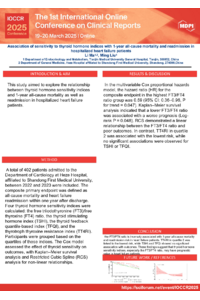
Introduction: This study aimed to explore the relationship between thyroid hormone sensitivity indices and 1-year all-cause mortality as well as readmission in hospitalized heart failure patients.
Methods: A total of 402 patients admitted to the Department of Cardiology at Heze Hospital, affiliated to Shandong First Medical University, between 2022 and 2023 were included. The composite primary endpoint was defined as all-cause mortality and heart failure readmission within one year after discharge. Four thyroid hormone sensitivity indices were calculated: the free triiodothyronine (FT3)/free thyroxine (FT4) ratio, the thyroid stimulating hormone index (TSHI), the thyroid feedback quantile-based index (TFQI), and the thyrotroph thyroxine resistance index (TT4RI). Participants were grouped based on the quartiles of these indices. The Cox model assessed the effect of thyroid sensitivity on outcomes, with Kaplan–Meier survival analysis and Restricted Cubic Spline (RCS) analysis for non-linear relationships.
Results: In the multivariable Cox proportional hazards model, the hazard ratio (HR) for the composite endpoint in the highest FT3/FT4 ratio group was 0.59 (95% CI: 0.36–0.96, P for trend = 0.047). Kaplan–Meier survival analysis indicated that a lower FT3/FT4 ratio was associated with a worse prognosis (Log-rank P = 0.048). RCS demonstrated a linear relationship between the FT3/FT4 ratio and poor outcomes. In contrast, TT4RI in quartile 2 was associated with the lowest risk, while no significant associations were observed for TSHI or TFQI.
Conclusions: The FT3/FT4 ratio is inversely associated with 1-year all-cause mortality and readmission risk in heart failure patients. TT4RI in quartile 2 was linked to the lowest risk, while TSHI and TFQI showed no significant association with outcomes. These findings suggest that thyroid hormone sensitivity indices, especially the FT3/FT4 ratio, may have prognostic value in heart failure patients.
Keywords
thyroid hormone
heart failure
all-cause mortality
readmission
Poster
Association of sensitivity to thyroid hormone indices with 1-year all-cause mortality and readmission in hospitalized heart failure patients.pdf
Cognitive training with double tasks to prevent cognitive decline after coronary artery bypass grafting
Association of thyroid feedback quantile-based index with 90-day all-cause mortality and readmission in patients hospitalized with heart failure