Event submissions
Published
This submission belongs to the session S3. Cardiovascular Diseases of the event The 1st International Online Conference on Clinical Reports
Published date
17 Mar, 2025
Academic Editor
'%3e%3cpath%20d='M12.6657%2010.9104C12.4185%2010.325%2012.0599%209.79327%2011.6097%209.34482C11.1609%208.89508%2010.6293%208.5365%2010.0442%208.28888C10.0389%208.28626%2010.0337%208.28495%2010.0285%208.28233C10.8446%207.69279%2011.3752%206.73249%2011.3752%205.64904C11.3752%203.8542%209.92103%202.39999%208.1262%202.39999C6.33136%202.39999%204.87715%203.8542%204.87715%205.64904C4.87715%206.73249%205.40774%207.69279%206.22393%208.28364C6.21869%208.28626%206.21345%208.28757%206.20821%208.29019C5.62129%208.5378%205.09463%208.89284%204.64265%209.34613C4.1929%209.79493%203.83432%2010.3266%203.58671%2010.9117C3.34345%2011.4845%203.21226%2012.0987%203.20023%2012.7209C3.19988%2012.7349%203.20233%2012.7488%203.20744%2012.7619C3.21255%2012.7749%203.22022%2012.7867%203.22998%2012.7968C3.23975%2012.8068%203.25142%2012.8147%203.26431%2012.8202C3.2772%2012.8256%203.29105%2012.8284%203.30504%2012.8284H4.09109C4.14874%2012.8284%204.19459%2012.7825%204.1959%2012.7262C4.2221%2011.7148%204.62823%2010.7676%205.34617%2010.0497C6.08899%209.30683%207.0755%208.89808%208.1262%208.89808C9.17689%208.89808%2010.1634%209.30683%2010.9062%2010.0497C11.6242%2010.7676%2012.0303%2011.7148%2012.0565%2012.7262C12.0578%2012.7838%2012.1037%2012.8284%2012.1613%2012.8284H12.9474C12.9613%2012.8284%2012.9752%2012.8256%2012.9881%2012.8202C13.001%2012.8147%2013.0126%2012.8068%2013.0224%2012.7968C13.0322%2012.7867%2013.0398%2012.7749%2013.0449%2012.7619C13.0501%2012.7488%2013.0525%2012.7349%2013.0522%2012.7209C13.0391%2012.0947%2012.9094%2011.4855%2012.6657%2010.9104ZM8.1262%207.9024C7.52486%207.9024%206.9589%207.6679%206.53312%207.24211C6.10733%206.81633%205.87283%206.25037%205.87283%205.64904C5.87283%205.0477%206.10733%204.48174%206.53312%204.05596C6.9589%203.63018%207.52486%203.39567%208.1262%203.39567C8.72753%203.39567%209.29349%203.63018%209.71927%204.05596C10.1451%204.48174%2010.3796%205.0477%2010.3796%205.64904C10.3796%206.25037%2010.1451%206.81633%209.71927%207.24211C9.29349%207.6679%208.72753%207.9024%208.1262%207.9024Z'%20fill='%235D1EE1'/%3e%3c/g%3e%3c/svg%3e) Takatoshi Kasai
Takatoshi KasaiCitation
Li Ma, ming liu, Association of thyroid feedback quantile-based index with 90-day all-cause mortality and readmission in patients hospitalized with heart failure, in Proceedings of The 1st International Online Conference on Clinical Reports, 19 March–20 March 2025, MDPI: Basel, Switzerland
Share
Email
Facebook
Twitter
LinkedIn
Association of thyroid feedback quantile-based index with 90-day all-cause mortality and readmission in patients hospitalized with heart failure
'%3e%3cpath%20d='M12.6647%2010.9104C12.4176%2010.325%2012.0589%209.7933%2011.6088%209.34485C11.16%208.89511%2010.6283%208.53653%2010.0432%208.28891C10.038%208.28629%2010.0327%208.28498%2010.0275%208.28236C10.8437%207.69282%2011.3743%206.73252%2011.3743%205.64907C11.3743%203.85423%209.92005%202.40002%208.12522%202.40002C6.33038%202.40002%204.87618%203.85423%204.87618%205.64907C4.87618%206.73252%205.40677%207.69282%206.22296%208.28367C6.21772%208.28629%206.21248%208.2876%206.20724%208.29022C5.62031%208.53783%205.09365%208.89287%204.64167%209.34616C4.19192%209.79496%203.83334%2010.3266%203.58573%2010.9117C3.34247%2011.4846%203.21128%2012.0987%203.19925%2012.721C3.1989%2012.735%203.20135%2012.7489%203.20646%2012.7619C3.21157%2012.7749%203.21924%2012.7868%203.22901%2012.7968C3.23877%2012.8068%203.25045%2012.8148%203.26334%2012.8202C3.27623%2012.8256%203.29007%2012.8284%203.30406%2012.8284H4.09012C4.14776%2012.8284%204.19362%2012.7825%204.19493%2012.7262C4.22113%2011.7148%204.62726%2010.7676%205.34519%2010.0497C6.08802%209.30686%207.07452%208.89811%208.12522%208.89811C9.17592%208.89811%2010.1624%209.30686%2010.9052%2010.0497C11.6232%2010.7676%2012.0293%2011.7148%2012.0555%2012.7262C12.0568%2012.7839%2012.1027%2012.8284%2012.1603%2012.8284H12.9464C12.9604%2012.8284%2012.9742%2012.8256%2012.9871%2012.8202C13%2012.8148%2013.0117%2012.8068%2013.0214%2012.7968C13.0312%2012.7868%2013.0389%2012.7749%2013.044%2012.7619C13.0491%2012.7489%2013.0515%2012.735%2013.0512%2012.721C13.0381%2012.0947%2012.9084%2011.4856%2012.6647%2010.9104ZM8.12522%207.90243C7.52388%207.90243%206.95792%207.66793%206.53214%207.24215C6.10636%206.81636%205.87185%206.2504%205.87185%205.64907C5.87185%205.04773%206.10636%204.48177%206.53214%204.05599C6.95792%203.63021%207.52388%203.3957%208.12522%203.3957C8.72655%203.3957%209.29252%203.63021%209.7183%204.05599C10.1441%204.48177%2010.3786%205.04773%2010.3786%205.64907C10.3786%206.2504%2010.1441%206.81636%209.7183%207.24215C9.29252%207.66793%208.72655%207.90243%208.12522%207.90243Z'%20fill='%235D1EE1'/%3e%3c/g%3e%3c/svg%3e)
Li Ma 1,2
ming liu 1
1. Department of Endocrinology and Metabolism, Tianjin Medical University General Hospital, Tianjin, 300052, China
2. Department of General Medicine, Heze Hospital affiliated to Shandong First Medical University, Shandong, 274000,China
Abstract
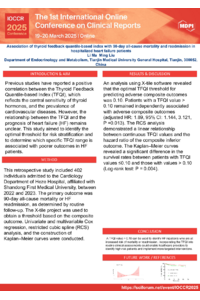
Introduction: Previous studies have reported a positive correlation between the Thyroid Feedback Quantile-based Index (TFQI), which reflects the central sensitivity of thyroid hormones, and the prevalence of cardiovascular diseases. However, the relationship between the TFQI and the prognosis of heart failure (HF) remains unclear. This study aimed to identify the optimal threshold for risk stratification and to determine which specific TFQI range is associated with poorer outcomes in HF patients.
Methods: This retrospective study included 402 individuals admitted to the Cardiology Department of Heze Hospital, affiliated with Shandong First Medical University, between 2022 and 2023. The primary outcome was 90-day all-cause mortality or HF readmission, as determined by routine follow-up. The X-tile project was used to obtain a threshold based on the composite outcome. Univariate and multivariable Cox regression, restricted cubic spline (RCS) analysis, and the construction of Kaplan–Meier curves were conducted.
Results: An analysis using X-tile software revealed that the optimal TFQI threshold for predicting adverse composite outcomes was 0.10. Patients with a TFQI value > 0.10 remained independently associated with adverse composite outcomes (adjusted HR: 1.89, 95% CI: 1.144, 3.121, P =0.013). The RCS analysis demonstrated a linear relationship between continuous TFQI values and the hazard ratio of the composite inferior outcome. The Kaplan–Meier curves revealed a significant difference in the survival rates between patients with TFQI values ≤0.10 and those with values > 0.10 (Log-rank test: P = 0.004).
Conclusions: A TFQI value > 0.10 can be used to identify HF inpatients who are at increased risk of mortality or readmission. Incorporating the TFQI into routine clinical assessments could enable healthcare providers to identify high-risk patients and implement more targeted interventions.
Keywords
Thyroid feedback quantile-based index
heart failure
all-cause mortality
readmission
Poster
Association of thyroid feedback quantile-based index with 90-day all-cause mortality and readmission in hospitalized heart failure patients.pdf
Association of sensitivity to thyroid hormone indices with 1-year all-cause mortality and readmission in hospitalized heart failure patients
Advancing Disaster and Climate Change Medicine: Bridging Health Resilience and Emergency