Event submissions
Published
This submission belongs to the session S2. Cancer of the event The 1st International Online Conference on Clinical Reports
Published date
17 Mar, 2025
Academic Editor
'%3e%3cpath%20d='M12.6657%2010.9104C12.4185%2010.325%2012.0599%209.79327%2011.6097%209.34482C11.1609%208.89508%2010.6293%208.5365%2010.0442%208.28888C10.0389%208.28626%2010.0337%208.28495%2010.0285%208.28233C10.8446%207.69279%2011.3752%206.73249%2011.3752%205.64904C11.3752%203.8542%209.92103%202.39999%208.1262%202.39999C6.33136%202.39999%204.87715%203.8542%204.87715%205.64904C4.87715%206.73249%205.40774%207.69279%206.22393%208.28364C6.21869%208.28626%206.21345%208.28757%206.20821%208.29019C5.62129%208.5378%205.09463%208.89284%204.64265%209.34613C4.1929%209.79493%203.83432%2010.3266%203.58671%2010.9117C3.34345%2011.4845%203.21226%2012.0987%203.20023%2012.7209C3.19988%2012.7349%203.20233%2012.7488%203.20744%2012.7619C3.21255%2012.7749%203.22022%2012.7867%203.22998%2012.7968C3.23975%2012.8068%203.25142%2012.8147%203.26431%2012.8202C3.2772%2012.8256%203.29105%2012.8284%203.30504%2012.8284H4.09109C4.14874%2012.8284%204.19459%2012.7825%204.1959%2012.7262C4.2221%2011.7148%204.62823%2010.7676%205.34617%2010.0497C6.08899%209.30683%207.0755%208.89808%208.1262%208.89808C9.17689%208.89808%2010.1634%209.30683%2010.9062%2010.0497C11.6242%2010.7676%2012.0303%2011.7148%2012.0565%2012.7262C12.0578%2012.7838%2012.1037%2012.8284%2012.1613%2012.8284H12.9474C12.9613%2012.8284%2012.9752%2012.8256%2012.9881%2012.8202C13.001%2012.8147%2013.0126%2012.8068%2013.0224%2012.7968C13.0322%2012.7867%2013.0398%2012.7749%2013.0449%2012.7619C13.0501%2012.7488%2013.0525%2012.7349%2013.0522%2012.7209C13.0391%2012.0947%2012.9094%2011.4855%2012.6657%2010.9104ZM8.1262%207.9024C7.52486%207.9024%206.9589%207.6679%206.53312%207.24211C6.10733%206.81633%205.87283%206.25037%205.87283%205.64904C5.87283%205.0477%206.10733%204.48174%206.53312%204.05596C6.9589%203.63018%207.52486%203.39567%208.1262%203.39567C8.72753%203.39567%209.29349%203.63018%209.71927%204.05596C10.1451%204.48174%2010.3796%205.0477%2010.3796%205.64904C10.3796%206.25037%2010.1451%206.81633%209.71927%207.24211C9.29349%207.6679%208.72753%207.9024%208.1262%207.9024Z'%20fill='%235D1EE1'/%3e%3c/g%3e%3c/svg%3e) Luca Bertolaccini
Luca BertolacciniCitation
Sanjeev Kulkarni, Parvesh Jain, Deepak Ganga, Colonic Stenting—Alternative to Diversion colostomy in advanced colonic carcinoma, in Proceedings of The 1st International Online Conference on Clinical Reports, 19 March–20 March 2025, MDPI: Basel, Switzerland
Share
Email
Facebook
Twitter
LinkedIn
Colonic Stenting—Alternative to Diversion colostomy in advanced colonic carcinoma
'%3e%3cpath%20d='M12.6647%2010.9104C12.4176%2010.325%2012.0589%209.7933%2011.6088%209.34485C11.16%208.89511%2010.6283%208.53653%2010.0432%208.28891C10.038%208.28629%2010.0327%208.28498%2010.0275%208.28236C10.8437%207.69282%2011.3743%206.73252%2011.3743%205.64907C11.3743%203.85423%209.92005%202.40002%208.12522%202.40002C6.33038%202.40002%204.87618%203.85423%204.87618%205.64907C4.87618%206.73252%205.40677%207.69282%206.22296%208.28367C6.21772%208.28629%206.21248%208.2876%206.20724%208.29022C5.62031%208.53783%205.09365%208.89287%204.64167%209.34616C4.19192%209.79496%203.83334%2010.3266%203.58573%2010.9117C3.34247%2011.4846%203.21128%2012.0987%203.19925%2012.721C3.1989%2012.735%203.20135%2012.7489%203.20646%2012.7619C3.21157%2012.7749%203.21924%2012.7868%203.22901%2012.7968C3.23877%2012.8068%203.25045%2012.8148%203.26334%2012.8202C3.27623%2012.8256%203.29007%2012.8284%203.30406%2012.8284H4.09012C4.14776%2012.8284%204.19362%2012.7825%204.19493%2012.7262C4.22113%2011.7148%204.62726%2010.7676%205.34519%2010.0497C6.08802%209.30686%207.07452%208.89811%208.12522%208.89811C9.17592%208.89811%2010.1624%209.30686%2010.9052%2010.0497C11.6232%2010.7676%2012.0293%2011.7148%2012.0555%2012.7262C12.0568%2012.7839%2012.1027%2012.8284%2012.1603%2012.8284H12.9464C12.9604%2012.8284%2012.9742%2012.8256%2012.9871%2012.8202C13%2012.8148%2013.0117%2012.8068%2013.0214%2012.7968C13.0312%2012.7868%2013.0389%2012.7749%2013.044%2012.7619C13.0491%2012.7489%2013.0515%2012.735%2013.0512%2012.721C13.0381%2012.0947%2012.9084%2011.4856%2012.6647%2010.9104ZM8.12522%207.90243C7.52388%207.90243%206.95792%207.66793%206.53214%207.24215C6.10636%206.81636%205.87185%206.2504%205.87185%205.64907C5.87185%205.04773%206.10636%204.48177%206.53214%204.05599C6.95792%203.63021%207.52388%203.3957%208.12522%203.3957C8.72655%203.3957%209.29252%203.63021%209.7183%204.05599C10.1441%204.48177%2010.3786%205.04773%2010.3786%205.64907C10.3786%206.2504%2010.1441%206.81636%209.7183%207.24215C9.29252%207.66793%208.72655%207.90243%208.12522%207.90243Z'%20fill='%235D1EE1'/%3e%3c/g%3e%3c/svg%3e)
Sanjeev Kulkarni 1
Parvesh Jain 1
Deepak Ganga 1
1. Department of Surgical Oncology, Sri Shankara Cancer Hospital And Research Centre, Shankara math Premises, 1st cross shankarapuram, Basavanagudi, Bangalore - 560004, India
Abstract
Background
Self-Expanding Metallic Stents (SEMSs) are an effective way to relieve malignant colonic obstruction. In those with incurable disease, stents may provide palliation and avoidance of surgery and its associated complications. Emergent surgery for colonic obstruction has historically had a high mortality rate of 10% to 30%. Colonic SEMSs can also decrease hospital stay and reduce hospital costs compared to emergency surgery and improve quality of life.
Methods
We retrospectively evaluated 16 patients with incurable cancer and colonic obstruction consecutively undergoing SEMS placement over a period of 18 months. All patients were diagnosed as having colorectal obstruction due to incurable CRC or extracolonic cancer. Major complications included events leading to surgical or endoscopic reintervention or requiring admission to the intensive care unit. Perforation, stent obstruction, and migration were considered to be major complications.
Results
During the study period, a total of 16 patients were treated endoscopically by placement of a colonic SEMS. The average age of the patient was 61 years. There were 4 patients with rectal cancer , 10 patients with sigmoid and recto-sigmoid growth, and 2 patients with anastomotic recurrence at Ileo-colic anastomosis after right hemicolectomy. In two patients, a stent could be placed on the 2nd attempt after a failed 1st attempt. We had two complications: one patient experiencedstent migration, following which the stent was retrieved and colostomy was performed; another patient experienced perforation, which was managed conservatively. The average survival time after stenting was less than 6 months. Colonic stents were maintained until death.
Conclusions
Colonic stenting offers a low-risk, high-success-rate alternative compared to surgery. It is also associated with shorter hospital stay and less severe complications. In a cohort whose life expectancy rarely exceeds 6 months, this may translate to better quality of life, earlier palliative chemotherapy commencement, and lower medical expenses. While SEMSs may induce lower acute complications and acute mortality rates, surgery may be associated with better long-term outcomes.
Keywords
Colonic stenting
Advanced colon Cancer
Colonic obstruction
Poster
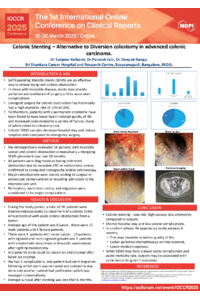
IOCCR 2025 - Poster Colonic Stenting.pdf
Raynaud’s Phenomenon-Associated Severe Hand Ischemia and Gangrene Salvaged with Concurrent Brachial–Radial–Ulnar Double Bypasses and A Multimodal Approach
Papillary thyroid cancer mimicking thyroid abscess