Event submissions
Published
This submission belongs to the session S2. Cancer of the event The 1st International Online Conference on Clinical Reports
Published date
17 Mar, 2025
Academic Editor
'%3e%3cpath%20d='M12.6657%2010.9104C12.4185%2010.325%2012.0599%209.79327%2011.6097%209.34482C11.1609%208.89508%2010.6293%208.5365%2010.0442%208.28888C10.0389%208.28626%2010.0337%208.28495%2010.0285%208.28233C10.8446%207.69279%2011.3752%206.73249%2011.3752%205.64904C11.3752%203.8542%209.92103%202.39999%208.1262%202.39999C6.33136%202.39999%204.87715%203.8542%204.87715%205.64904C4.87715%206.73249%205.40774%207.69279%206.22393%208.28364C6.21869%208.28626%206.21345%208.28757%206.20821%208.29019C5.62129%208.5378%205.09463%208.89284%204.64265%209.34613C4.1929%209.79493%203.83432%2010.3266%203.58671%2010.9117C3.34345%2011.4845%203.21226%2012.0987%203.20023%2012.7209C3.19988%2012.7349%203.20233%2012.7488%203.20744%2012.7619C3.21255%2012.7749%203.22022%2012.7867%203.22998%2012.7968C3.23975%2012.8068%203.25142%2012.8147%203.26431%2012.8202C3.2772%2012.8256%203.29105%2012.8284%203.30504%2012.8284H4.09109C4.14874%2012.8284%204.19459%2012.7825%204.1959%2012.7262C4.2221%2011.7148%204.62823%2010.7676%205.34617%2010.0497C6.08899%209.30683%207.0755%208.89808%208.1262%208.89808C9.17689%208.89808%2010.1634%209.30683%2010.9062%2010.0497C11.6242%2010.7676%2012.0303%2011.7148%2012.0565%2012.7262C12.0578%2012.7838%2012.1037%2012.8284%2012.1613%2012.8284H12.9474C12.9613%2012.8284%2012.9752%2012.8256%2012.9881%2012.8202C13.001%2012.8147%2013.0126%2012.8068%2013.0224%2012.7968C13.0322%2012.7867%2013.0398%2012.7749%2013.0449%2012.7619C13.0501%2012.7488%2013.0525%2012.7349%2013.0522%2012.7209C13.0391%2012.0947%2012.9094%2011.4855%2012.6657%2010.9104ZM8.1262%207.9024C7.52486%207.9024%206.9589%207.6679%206.53312%207.24211C6.10733%206.81633%205.87283%206.25037%205.87283%205.64904C5.87283%205.0477%206.10733%204.48174%206.53312%204.05596C6.9589%203.63018%207.52486%203.39567%208.1262%203.39567C8.72753%203.39567%209.29349%203.63018%209.71927%204.05596C10.1451%204.48174%2010.3796%205.0477%2010.3796%205.64904C10.3796%206.25037%2010.1451%206.81633%209.71927%207.24211C9.29349%207.6679%208.72753%207.9024%208.1262%207.9024Z'%20fill='%235D1EE1'/%3e%3c/g%3e%3c/svg%3e) Toshio Hattori
Toshio HattoriCitation
Vinayak Munirathnam, Thapashwi B G, Tapas Patra, Akhileshwar Namani, Management of Endocrine-Resistant, Recurrent Metastatic Hormone Receptor-Positive Breast Cancer: A Case Report, in Proceedings of The 1st International Online Conference on Clinical Reports, 19 March–20 March 2025, MDPI: Basel, Switzerland
Share
Email
Facebook
Twitter
LinkedIn
Management of Endocrine-Resistant, Recurrent Metastatic Hormone Receptor-Positive Breast Cancer: A Case Report
'%3e%3cpath%20d='M12.6647%2010.9104C12.4176%2010.325%2012.0589%209.7933%2011.6088%209.34485C11.16%208.89511%2010.6283%208.53653%2010.0432%208.28891C10.038%208.28629%2010.0327%208.28498%2010.0275%208.28236C10.8437%207.69282%2011.3743%206.73252%2011.3743%205.64907C11.3743%203.85423%209.92005%202.40002%208.12522%202.40002C6.33038%202.40002%204.87618%203.85423%204.87618%205.64907C4.87618%206.73252%205.40677%207.69282%206.22296%208.28367C6.21772%208.28629%206.21248%208.2876%206.20724%208.29022C5.62031%208.53783%205.09365%208.89287%204.64167%209.34616C4.19192%209.79496%203.83334%2010.3266%203.58573%2010.9117C3.34247%2011.4846%203.21128%2012.0987%203.19925%2012.721C3.1989%2012.735%203.20135%2012.7489%203.20646%2012.7619C3.21157%2012.7749%203.21924%2012.7868%203.22901%2012.7968C3.23877%2012.8068%203.25045%2012.8148%203.26334%2012.8202C3.27623%2012.8256%203.29007%2012.8284%203.30406%2012.8284H4.09012C4.14776%2012.8284%204.19362%2012.7825%204.19493%2012.7262C4.22113%2011.7148%204.62726%2010.7676%205.34519%2010.0497C6.08802%209.30686%207.07452%208.89811%208.12522%208.89811C9.17592%208.89811%2010.1624%209.30686%2010.9052%2010.0497C11.6232%2010.7676%2012.0293%2011.7148%2012.0555%2012.7262C12.0568%2012.7839%2012.1027%2012.8284%2012.1603%2012.8284H12.9464C12.9604%2012.8284%2012.9742%2012.8256%2012.9871%2012.8202C13%2012.8148%2013.0117%2012.8068%2013.0214%2012.7968C13.0312%2012.7868%2013.0389%2012.7749%2013.044%2012.7619C13.0491%2012.7489%2013.0515%2012.735%2013.0512%2012.721C13.0381%2012.0947%2012.9084%2011.4856%2012.6647%2010.9104ZM8.12522%207.90243C7.52388%207.90243%206.95792%207.66793%206.53214%207.24215C6.10636%206.81636%205.87185%206.2504%205.87185%205.64907C5.87185%205.04773%206.10636%204.48177%206.53214%204.05599C6.95792%203.63021%207.52388%203.3957%208.12522%203.3957C8.72655%203.3957%209.29252%203.63021%209.7183%204.05599C10.1441%204.48177%2010.3786%205.04773%2010.3786%205.64907C10.3786%206.2504%2010.1441%206.81636%209.7183%207.24215C9.29252%207.66793%208.72655%207.90243%208.12522%207.90243Z'%20fill='%235D1EE1'/%3e%3c/g%3e%3c/svg%3e)
Vinayak Munirathnam 1
Thapashwi B G 1
Tapas Patra 2
Akhileshwar Namani 2
1. Department of Medical Oncology, Sri Shankara Cancer Hospital and Research Centre, Bangalore 560004, India
2. Department of Molecular Oncology, Sri Shankara National Centre for Cancer Prevention and Research, Sri Shankara Cancer Foundation, Bangalore 560004, India
Abstract
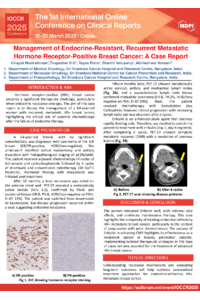
Hormone receptor-positive (HR+) breast cancer represents a therapeutic challenge, particularly with endocrine resistance and progression despite multiple lines of therapy. A 64-year-old woman with no significant comorbidities was diagnosed with carcinoma of the left breast (ER/PR positive, HER2/neu negative). She underwent modified radical mastectomy and axillary dissection with histopathological staging of pT2N2aM0. The patient received adjuvant chemotherapy (4 cycles of Adriamycin and cyclophosphamide followed by 4 cycles of docetaxel) and conventional radiotherapy (40 Gy/15 fractions). Hormonal therapy with Anastrozole was initiated post-treatment. After 18 months, a local recurrence was noted on the anterior chest wall. PET-CT revealed a metabolically active nodule (SUV 6.2), confirmed by FNAC and excisional biopsy (ER-8, PR-8, HER2/neu negative on FISH, Ki-67 12%). The patient was switched from Anastrozole to Exemestane, but disease progression occurred within a year, suggesting endocrine resistance. Fifteen months later, PET-CT showed metabolically active cervical, axillary, and mediastinal lymph nodes, and a supraclavicular lymph node biopsy confirmed metastatic carcinoma (ER-0, PR-2%, HER2/neu negative on FISH, Ki-67 20%). Next, the patient received chemotherapy with Gemcitabine plus Carboplatin; however, clinical progression with increasing lymph node size was observed after 2 cycles. Eribulin is an antimicrotubule agent that destroys rapidly dividing cells. Therefore, we decided to switch the patient to treatment with eribulin (day 1, day 8 regimen). After completing 6 cycles, PET-CT showed complete metabolic response (CMR) with a resolution of previous lesions. The patient tolerated Eribulin well, with minimal side effects, and continues maintenance therapy. This case highlights the complexity of treating endocrine-refractory HR+ metastatic breast cancer, particularly in the context of progression with prior chemotherapy. The success of Eribulin in achieving CMR highlights its effectiveness as a treatment option in heavily pretreated patients. Implementing tailored therapeutic strategies in this type of cases remains essential for the treatment of advanced HR+ breast cancer.
Keywords
Breast cancer
Endocrine resistance
Metastatic carcinoma
Eribulin
Gemcitabine-carboplatin
Complete metabolic response
Poster
Poster-V2.pdf
Clinical Presentation and Assessment of Medical Treatments for Ischemic Stroke: A Case Study from Thailand