Event submissions
Published
This submission belongs to the session Session B. Neural Cell Biology of the event The 3rd International Online Conference on Cells
Published date
21 Mar, 2025
Academic Editor
'%3e%3cpath%20d='M12.6657%2010.9104C12.4185%2010.325%2012.0599%209.79327%2011.6097%209.34482C11.1609%208.89508%2010.6293%208.5365%2010.0442%208.28888C10.0389%208.28626%2010.0337%208.28495%2010.0285%208.28233C10.8446%207.69279%2011.3752%206.73249%2011.3752%205.64904C11.3752%203.8542%209.92103%202.39999%208.1262%202.39999C6.33136%202.39999%204.87715%203.8542%204.87715%205.64904C4.87715%206.73249%205.40774%207.69279%206.22393%208.28364C6.21869%208.28626%206.21345%208.28757%206.20821%208.29019C5.62129%208.5378%205.09463%208.89284%204.64265%209.34613C4.1929%209.79493%203.83432%2010.3266%203.58671%2010.9117C3.34345%2011.4845%203.21226%2012.0987%203.20023%2012.7209C3.19988%2012.7349%203.20233%2012.7488%203.20744%2012.7619C3.21255%2012.7749%203.22022%2012.7867%203.22998%2012.7968C3.23975%2012.8068%203.25142%2012.8147%203.26431%2012.8202C3.2772%2012.8256%203.29105%2012.8284%203.30504%2012.8284H4.09109C4.14874%2012.8284%204.19459%2012.7825%204.1959%2012.7262C4.2221%2011.7148%204.62823%2010.7676%205.34617%2010.0497C6.08899%209.30683%207.0755%208.89808%208.1262%208.89808C9.17689%208.89808%2010.1634%209.30683%2010.9062%2010.0497C11.6242%2010.7676%2012.0303%2011.7148%2012.0565%2012.7262C12.0578%2012.7838%2012.1037%2012.8284%2012.1613%2012.8284H12.9474C12.9613%2012.8284%2012.9752%2012.8256%2012.9881%2012.8202C13.001%2012.8147%2013.0126%2012.8068%2013.0224%2012.7968C13.0322%2012.7867%2013.0398%2012.7749%2013.0449%2012.7619C13.0501%2012.7488%2013.0525%2012.7349%2013.0522%2012.7209C13.0391%2012.0947%2012.9094%2011.4855%2012.6657%2010.9104ZM8.1262%207.9024C7.52486%207.9024%206.9589%207.6679%206.53312%207.24211C6.10733%206.81633%205.87283%206.25037%205.87283%205.64904C5.87283%205.0477%206.10733%204.48174%206.53312%204.05596C6.9589%203.63018%207.52486%203.39567%208.1262%203.39567C8.72753%203.39567%209.29349%203.63018%209.71927%204.05596C10.1451%204.48174%2010.3796%205.0477%2010.3796%205.64904C10.3796%206.25037%2010.1451%206.81633%209.71927%207.24211C9.29349%207.6679%208.72753%207.9024%208.1262%207.9024Z'%20fill='%235D1EE1'/%3e%3c/g%3e%3c/svg%3e) George Smith
George SmithCitation
Parisa Gazerani, Unlocking the Potential of Non-Neuronal Cell-Derived Extracellular Vesicles in Pain Relief and Neuroprotection , in Proceedings of The 3rd International Online Conference on Cells, 25 March–27 March 2025, MDPI: Basel, Switzerland
Share
Email
Facebook
Twitter
LinkedIn
Unlocking the Potential of Non-Neuronal Cell-Derived Extracellular Vesicles in Pain Relief and Neuroprotection

Parisa Gazerani 1
1. Department of Life Sciences and Health, Oslo Metropolitan University, Pilestredet 50, Oslo, 0167, Norway
Abstract
Introduction
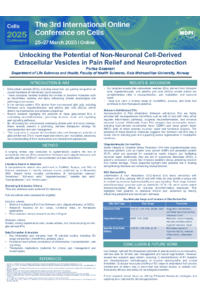
Extracellular vesicles (EVs), including exosomes, are emerging as key mediators of intercellular communication, transferring bioactive molecules such as microRNAs, proteins, and lipids. Among non-neuronal cells, Schwann cells, oligodendrocytes, and satellite glial cells (SGCs) release EVs with distinct neuroprotective and pain-relieving properties. These EVs play critical roles in modulating inflammation, supporting neuronal repair, and regulating pain pathways, offering innovative therapeutic avenues for chronic pain management and neural repair.
Methods
A scoping review was conducted by systematically searching the PubMed, Scopus, and Web of Science databases. Studies published up to November 2024 were screened to identify evidence on Schwann cell-, oligodendrocyte-, and SGC-derived EVs. A total of 15 key studies were included, focusing on their cargo, functional mechanisms, and therapeutic applications.
Results
Schwann cell-derived EVs are enriched with neuroprotective microRNAs such as miR-21 and miR-146a, which reduce pain by regulating inflammation and promoting neuronal survival. They also carry proteins like brain-derived neurotrophic factor (BDNF) and nerve growth factor (NGF), enhancing neuronal repair. Oligodendrocyte-derived EVs deliver proteins such as myelin basic protein (MBP) and proteolipid protein (PLP), which are essential for neuronal stability and repair, as well as superoxide dismutase (SOD), which mitigates oxidative stress. SGC-derived EVs, while also carrying miR-21 and miR-146a, modulate neuronal hyperexcitability and inflammation uniquely through cytokines such as interleukin-10 (IL-10), amplifying their pain-relieving effects.
Conclusion
This review highlights the distinctive roles of Schwann cell-, oligodendrocyte-, and SGC-derived EVs in alleviating pain and supporting neural health. It identifies key research gaps, including the need for standardized methodologies and deeper characterization of EV cargo. These findings emphasize the therapeutic potential of EVs as innovative tools for chronic pain treatment and neural regeneration, underscoring their translational value for future research and clinical applications.
Keywords
Extracellular vesicles
Non-neuronal cells
Neuroprotection
Pain modulation
Schwann cells
Oligodendrocytes
Satellite glial cells
MicroRNAs
Neural repair
Inflammation
Poster
Poster Parisa Gazerani 23-02-2025.pdf
Cockayne syndrome mice reflect human kidney disease and are defective in de novo NAD biosynthesis
(Phospho-)proteomic Signaling Responses of Human Male Germ Cell Lines to Simulated Microgravity and Hypogravity.