Event submissions
Published
This submission belongs to the session Session E. Cellular Signaling of the event The 3rd International Online Conference on Cells
Published date
21 Mar, 2025
Academic Editor
'%3e%3cpath%20d='M12.6657%2010.9104C12.4185%2010.325%2012.0599%209.79327%2011.6097%209.34482C11.1609%208.89508%2010.6293%208.5365%2010.0442%208.28888C10.0389%208.28626%2010.0337%208.28495%2010.0285%208.28233C10.8446%207.69279%2011.3752%206.73249%2011.3752%205.64904C11.3752%203.8542%209.92103%202.39999%208.1262%202.39999C6.33136%202.39999%204.87715%203.8542%204.87715%205.64904C4.87715%206.73249%205.40774%207.69279%206.22393%208.28364C6.21869%208.28626%206.21345%208.28757%206.20821%208.29019C5.62129%208.5378%205.09463%208.89284%204.64265%209.34613C4.1929%209.79493%203.83432%2010.3266%203.58671%2010.9117C3.34345%2011.4845%203.21226%2012.0987%203.20023%2012.7209C3.19988%2012.7349%203.20233%2012.7488%203.20744%2012.7619C3.21255%2012.7749%203.22022%2012.7867%203.22998%2012.7968C3.23975%2012.8068%203.25142%2012.8147%203.26431%2012.8202C3.2772%2012.8256%203.29105%2012.8284%203.30504%2012.8284H4.09109C4.14874%2012.8284%204.19459%2012.7825%204.1959%2012.7262C4.2221%2011.7148%204.62823%2010.7676%205.34617%2010.0497C6.08899%209.30683%207.0755%208.89808%208.1262%208.89808C9.17689%208.89808%2010.1634%209.30683%2010.9062%2010.0497C11.6242%2010.7676%2012.0303%2011.7148%2012.0565%2012.7262C12.0578%2012.7838%2012.1037%2012.8284%2012.1613%2012.8284H12.9474C12.9613%2012.8284%2012.9752%2012.8256%2012.9881%2012.8202C13.001%2012.8147%2013.0126%2012.8068%2013.0224%2012.7968C13.0322%2012.7867%2013.0398%2012.7749%2013.0449%2012.7619C13.0501%2012.7488%2013.0525%2012.7349%2013.0522%2012.7209C13.0391%2012.0947%2012.9094%2011.4855%2012.6657%2010.9104ZM8.1262%207.9024C7.52486%207.9024%206.9589%207.6679%206.53312%207.24211C6.10733%206.81633%205.87283%206.25037%205.87283%205.64904C5.87283%205.0477%206.10733%204.48174%206.53312%204.05596C6.9589%203.63018%207.52486%203.39567%208.1262%203.39567C8.72753%203.39567%209.29349%203.63018%209.71927%204.05596C10.1451%204.48174%2010.3796%205.0477%2010.3796%205.64904C10.3796%206.25037%2010.1451%206.81633%209.71927%207.24211C9.29349%207.6679%208.72753%207.9024%208.1262%207.9024Z'%20fill='%235D1EE1'/%3e%3c/g%3e%3c/svg%3e) MOHAMMAD ASIM
MOHAMMAD ASIMCitation
Marianna Talia, Francesca Cirillo, Domenica Scordamaglia, Salvatore De Rosis, Azzurra Zicarelli, Marika Di Dio, Rosamaria Lappano, Marcello Maggiolini, The silencing of the G protein-coupled estrogen receptor (GPER) drives apoptotic death in triple-negative breast cancer cells, in Proceedings of The 3rd International Online Conference on Cells, 25 March–27 March 2025, MDPI: Basel, Switzerland
Share
Email
Facebook
Twitter
LinkedIn
The silencing of the G protein-coupled estrogen receptor (GPER) drives apoptotic death in triple-negative breast cancer cells
'%3e%3cpath%20d='M12.6647%2010.9104C12.4176%2010.325%2012.0589%209.7933%2011.6088%209.34485C11.16%208.89511%2010.6283%208.53653%2010.0432%208.28891C10.038%208.28629%2010.0327%208.28498%2010.0275%208.28236C10.8437%207.69282%2011.3743%206.73252%2011.3743%205.64907C11.3743%203.85423%209.92005%202.40002%208.12522%202.40002C6.33038%202.40002%204.87618%203.85423%204.87618%205.64907C4.87618%206.73252%205.40677%207.69282%206.22296%208.28367C6.21772%208.28629%206.21248%208.2876%206.20724%208.29022C5.62031%208.53783%205.09365%208.89287%204.64167%209.34616C4.19192%209.79496%203.83334%2010.3266%203.58573%2010.9117C3.34247%2011.4846%203.21128%2012.0987%203.19925%2012.721C3.1989%2012.735%203.20135%2012.7489%203.20646%2012.7619C3.21157%2012.7749%203.21924%2012.7868%203.22901%2012.7968C3.23877%2012.8068%203.25045%2012.8148%203.26334%2012.8202C3.27623%2012.8256%203.29007%2012.8284%203.30406%2012.8284H4.09012C4.14776%2012.8284%204.19362%2012.7825%204.19493%2012.7262C4.22113%2011.7148%204.62726%2010.7676%205.34519%2010.0497C6.08802%209.30686%207.07452%208.89811%208.12522%208.89811C9.17592%208.89811%2010.1624%209.30686%2010.9052%2010.0497C11.6232%2010.7676%2012.0293%2011.7148%2012.0555%2012.7262C12.0568%2012.7839%2012.1027%2012.8284%2012.1603%2012.8284H12.9464C12.9604%2012.8284%2012.9742%2012.8256%2012.9871%2012.8202C13%2012.8148%2013.0117%2012.8068%2013.0214%2012.7968C13.0312%2012.7868%2013.0389%2012.7749%2013.044%2012.7619C13.0491%2012.7489%2013.0515%2012.735%2013.0512%2012.721C13.0381%2012.0947%2012.9084%2011.4856%2012.6647%2010.9104ZM8.12522%207.90243C7.52388%207.90243%206.95792%207.66793%206.53214%207.24215C6.10636%206.81636%205.87185%206.2504%205.87185%205.64907C5.87185%205.04773%206.10636%204.48177%206.53214%204.05599C6.95792%203.63021%207.52388%203.3957%208.12522%203.3957C8.72655%203.3957%209.29252%203.63021%209.7183%204.05599C10.1441%204.48177%2010.3786%205.04773%2010.3786%205.64907C10.3786%206.2504%2010.1441%206.81636%209.7183%207.24215C9.29252%207.66793%208.72655%207.90243%208.12522%207.90243Z'%20fill='%235D1EE1'/%3e%3c/g%3e%3c/svg%3e)
Marianna Talia 1
Francesca Cirillo 1
Domenica Scordamaglia 1
Salvatore De Rosis 1
Azzurra Zicarelli 1
Marika Di Dio 1

Rosamaria Lappano 1

Marcello Maggiolini 1
1. Department of Pharmacy, Health and Nutritional Sciences, University of Calabria, 87036, Rende, Italy
Abstract
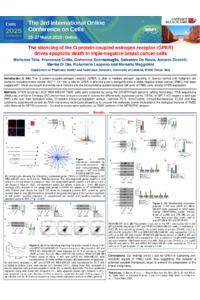
Introduction. The G protein-coupled estrogen receptor (GPER) is known for its ability to mediate rapid estrogen signaling in diverse normal and malignant cell contexts, including breast cancer (BC). Of note, the role of the GPER in promoting pro-tumorigenic traits in triple-negative breast cancer (TNBC) has been suggested. In this study, we sought to provide novel insights into the transcriptionally guided biological behavior of TNBC cells lacking GPER expression.
Methods. GPER knock-out (KO) MDA-MB-231 TNBC cells were obtained using the CRISPR/Cas9 genome editing technology. RNA sequencing (RNA-seq) and Gene Ontology (GO) enrichment analyses served to assess the differentially expressed genes (DEGs) between the GPER KO and wild-type (WT) cells and their biological role. Chromatin immunoprecipitation assays, real-time PCR, immunoblots, immunofluorescence, ELISA, and flow cytometric experiments, as well as the use of RNA interference techniques, allowed us to uncover the molecular routes implicated in the biological features triggered by GPER silencing in the TNBC cells. Survival analyses were performed on TNBC patients ffrom the Molecular Taxonomy of Breast Cancer International Consortium (METABRIC) dataset.
Results. The RNA-seq data revealed that GPER silencing in MDA-MB-231 cells induces a pro-apoptotic gene signature. Accordingly, the biological assays demonstrated that GPER KO cells exhibit enhanced mitochondria-dependent apoptotic death with respect to these levels in WT cells. Mechanistically, we found that reduced cAMP levels in GPER KO cells may trigger the activation of the pro-apoptotic JNK/c-Jun/p53/Noxa pathway. In accordance with these results, the bioinformatics analyses on the TNBC patients revealed that high NOXA gene expression levels are associated with better outcomes.
Conclusions. Collectively, our findings unveil the role of the GPER in sustaining anti-apoptotic signals in TNBC cells, thus suggesting this receptor as a potential valuable therapeutic target for preventing the progression of this malignancy.
Keywords
triple negative breast cancer
GPER
RNA-sequencing
Poster
poster Cells 2025 MT.pdf
Photoactivated Aluminium Phthalocyanine Drives Oxidative Stress and Apoptosis in Human Oesophageal Cancer Stem Cells
Preliminary Investigation of Cerebellar Alterations induced by Cachexia and Endurance Training in C26 Tumor-Bearing Mouse Model