Event submissions
Published
This submission belongs to the session Session E. Cellular Signaling of the event The 3rd International Online Conference on Cells
Published date
21 Mar, 2025
Academic Editor
'%3e%3cpath%20d='M12.6657%2010.9104C12.4185%2010.325%2012.0599%209.79327%2011.6097%209.34482C11.1609%208.89508%2010.6293%208.5365%2010.0442%208.28888C10.0389%208.28626%2010.0337%208.28495%2010.0285%208.28233C10.8446%207.69279%2011.3752%206.73249%2011.3752%205.64904C11.3752%203.8542%209.92103%202.39999%208.1262%202.39999C6.33136%202.39999%204.87715%203.8542%204.87715%205.64904C4.87715%206.73249%205.40774%207.69279%206.22393%208.28364C6.21869%208.28626%206.21345%208.28757%206.20821%208.29019C5.62129%208.5378%205.09463%208.89284%204.64265%209.34613C4.1929%209.79493%203.83432%2010.3266%203.58671%2010.9117C3.34345%2011.4845%203.21226%2012.0987%203.20023%2012.7209C3.19988%2012.7349%203.20233%2012.7488%203.20744%2012.7619C3.21255%2012.7749%203.22022%2012.7867%203.22998%2012.7968C3.23975%2012.8068%203.25142%2012.8147%203.26431%2012.8202C3.2772%2012.8256%203.29105%2012.8284%203.30504%2012.8284H4.09109C4.14874%2012.8284%204.19459%2012.7825%204.1959%2012.7262C4.2221%2011.7148%204.62823%2010.7676%205.34617%2010.0497C6.08899%209.30683%207.0755%208.89808%208.1262%208.89808C9.17689%208.89808%2010.1634%209.30683%2010.9062%2010.0497C11.6242%2010.7676%2012.0303%2011.7148%2012.0565%2012.7262C12.0578%2012.7838%2012.1037%2012.8284%2012.1613%2012.8284H12.9474C12.9613%2012.8284%2012.9752%2012.8256%2012.9881%2012.8202C13.001%2012.8147%2013.0126%2012.8068%2013.0224%2012.7968C13.0322%2012.7867%2013.0398%2012.7749%2013.0449%2012.7619C13.0501%2012.7488%2013.0525%2012.7349%2013.0522%2012.7209C13.0391%2012.0947%2012.9094%2011.4855%2012.6657%2010.9104ZM8.1262%207.9024C7.52486%207.9024%206.9589%207.6679%206.53312%207.24211C6.10733%206.81633%205.87283%206.25037%205.87283%205.64904C5.87283%205.0477%206.10733%204.48174%206.53312%204.05596C6.9589%203.63018%207.52486%203.39567%208.1262%203.39567C8.72753%203.39567%209.29349%203.63018%209.71927%204.05596C10.1451%204.48174%2010.3796%205.0477%2010.3796%205.64904C10.3796%206.25037%2010.1451%206.81633%209.71927%207.24211C9.29349%207.6679%208.72753%207.9024%208.1262%207.9024Z'%20fill='%235D1EE1'/%3e%3c/g%3e%3c/svg%3e) Alexander E. Kalyuzhny
Alexander E. KalyuzhnyCitation
Azzurra Zicarelli, Marianna Talia, Eugenio Cesario, Francesca Cirillo, Domenica Scordamaglia, Adelina Assunta Mondino, Marika Di Dio, Salvatore De Rosis, Michele Di Dio, Anna Maria Miglietta, Marcello Maggiolini, Rosamaria Lappano, Assessment of gene signature deriving from prostate cancer-associated fibroblasts (CAFs), in Proceedings of The 3rd International Online Conference on Cells, 25 March–27 March 2025, MDPI: Basel, Switzerland
Share
Email
Facebook
Twitter
LinkedIn
Assessment of gene signature deriving from prostate cancer-associated fibroblasts (CAFs)
'%3e%3cpath%20d='M12.6647%2010.9104C12.4176%2010.325%2012.0589%209.7933%2011.6088%209.34485C11.16%208.89511%2010.6283%208.53653%2010.0432%208.28891C10.038%208.28629%2010.0327%208.28498%2010.0275%208.28236C10.8437%207.69282%2011.3743%206.73252%2011.3743%205.64907C11.3743%203.85423%209.92005%202.40002%208.12522%202.40002C6.33038%202.40002%204.87618%203.85423%204.87618%205.64907C4.87618%206.73252%205.40677%207.69282%206.22296%208.28367C6.21772%208.28629%206.21248%208.2876%206.20724%208.29022C5.62031%208.53783%205.09365%208.89287%204.64167%209.34616C4.19192%209.79496%203.83334%2010.3266%203.58573%2010.9117C3.34247%2011.4846%203.21128%2012.0987%203.19925%2012.721C3.1989%2012.735%203.20135%2012.7489%203.20646%2012.7619C3.21157%2012.7749%203.21924%2012.7868%203.22901%2012.7968C3.23877%2012.8068%203.25045%2012.8148%203.26334%2012.8202C3.27623%2012.8256%203.29007%2012.8284%203.30406%2012.8284H4.09012C4.14776%2012.8284%204.19362%2012.7825%204.19493%2012.7262C4.22113%2011.7148%204.62726%2010.7676%205.34519%2010.0497C6.08802%209.30686%207.07452%208.89811%208.12522%208.89811C9.17592%208.89811%2010.1624%209.30686%2010.9052%2010.0497C11.6232%2010.7676%2012.0293%2011.7148%2012.0555%2012.7262C12.0568%2012.7839%2012.1027%2012.8284%2012.1603%2012.8284H12.9464C12.9604%2012.8284%2012.9742%2012.8256%2012.9871%2012.8202C13%2012.8148%2013.0117%2012.8068%2013.0214%2012.7968C13.0312%2012.7868%2013.0389%2012.7749%2013.044%2012.7619C13.0491%2012.7489%2013.0515%2012.735%2013.0512%2012.721C13.0381%2012.0947%2012.9084%2011.4856%2012.6647%2010.9104ZM8.12522%207.90243C7.52388%207.90243%206.95792%207.66793%206.53214%207.24215C6.10636%206.81636%205.87185%206.2504%205.87185%205.64907C5.87185%205.04773%206.10636%204.48177%206.53214%204.05599C6.95792%203.63021%207.52388%203.3957%208.12522%203.3957C8.72655%203.3957%209.29252%203.63021%209.7183%204.05599C10.1441%204.48177%2010.3786%205.04773%2010.3786%205.64907C10.3786%206.2504%2010.1441%206.81636%209.7183%207.24215C9.29252%207.66793%208.72655%207.90243%208.12522%207.90243Z'%20fill='%235D1EE1'/%3e%3c/g%3e%3c/svg%3e)
Azzurra Zicarelli 1
Marianna Talia 1
Eugenio Cesario 2
Francesca Cirillo 1
Domenica Scordamaglia 1
Adelina Assunta Mondino 1
Marika Di Dio 1
Salvatore De Rosis 1

Michele Di Dio 3
Anna Maria Miglietta 4

Marcello Maggiolini 1

Rosamaria Lappano 1
1. Department of Pharmacy, Health and Nutritional Sciences, University of Calabria, 87036 Rende, Italy
2. Department of Cultures, Education and Society Department, University of Calabria, 87036 Rende, Italy
3. Division of Urology, Department of Surgery, Annunziata Hospital, Cosenza, 87100, Italy
4. Breast and General Surgery Unit, Annunziata Hospital Cosenza, Cosenza, 87100, Italy
Abstract
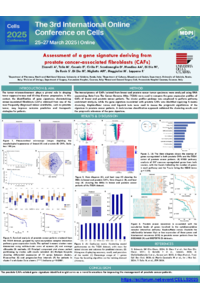
Background: The tumor microenvironment plays a pivotal role in shaping tumor aggressiveness and driving disease progression. In this context, the identification of gene signatures characterizing cancer-associated fibroblasts (CAFs) obtained from the two most frequently diagnosed cancers worldwide, such as breast and prostate tumors, may improve outcome prediction and therapeutic strategies for patients.
Methods: The transcriptomes of CAFs isolated from breast and prostate cancer biopsies were analyzed using RNA sequencing. Data from The Cancer Genome Atlas (TCGA) were used to compare the gene expression profiles of CAFs with those of breast and prostate cancer patients. The clusterProfiler package was employed to perform pathway enrichment analysis, while the gene signature associated withprostate CAFs was identified by applying K-means clustering. Kaplan--Meier curves and log-rank tests were used to assess the prognostic significance of the signature in prostate cancer patients. A decision-tree classification approach validated the clustering results and the prognostic relevance of the gene signature.
Results: The comparisons of either breast and prostate CAFs transcriptomes or the gene expression landscapes of breast and prostate cancer patients allowed us to construct a gene signature counting 11 genes (IL13RA2, GDF7, IL33, CXCL1, TNFRSF19, CXCL6, LIFR, CXCL5, IL7, TSLP, and TNFSF15) with clinical implications in prostate cancer. Notably, the aforementioned genes are implicated in immune-related transduction pathways. Thereafter, clustering and classification analyses revealed that prostate cancer patients exhibiting low expression levels of these 11 genes are characterized by a worse prognosis with a high prediction accuracy.
Conclusions: The prostate CAFs-related gene signature identified here might serve as a prognostic indicator and might offer a valuable set of biomarkers for improving the management of prostate cancer patients.
Keywords
Prostate cancer
Cancer-associated fibroblasts (CAFs)
Gene signature
K-means clustering
Poster
poster cells conference - Azzurra Zicarelli.pdf
Modulation of Cathepsin D expression drives the growth of neuroblastoma cells in 2D or 3D cultures in response to EGF: analysis in a bona fide model mimicking tumor heterogeneity and metastatic progression
Dysfunctional Cellular Energy Metabolism is a Premorbid Characteristic of Late-Onset Alzheimer’s disease