Event submissions
Published
This submission belongs to the session Session A. Cellular Pathology of Cancers of the event The 3rd International Online Conference on Cells
Published date
21 Mar, 2025
Academic Editor
'%3e%3cpath%20d='M12.6657%2010.9104C12.4185%2010.325%2012.0599%209.79327%2011.6097%209.34482C11.1609%208.89508%2010.6293%208.5365%2010.0442%208.28888C10.0389%208.28626%2010.0337%208.28495%2010.0285%208.28233C10.8446%207.69279%2011.3752%206.73249%2011.3752%205.64904C11.3752%203.8542%209.92103%202.39999%208.1262%202.39999C6.33136%202.39999%204.87715%203.8542%204.87715%205.64904C4.87715%206.73249%205.40774%207.69279%206.22393%208.28364C6.21869%208.28626%206.21345%208.28757%206.20821%208.29019C5.62129%208.5378%205.09463%208.89284%204.64265%209.34613C4.1929%209.79493%203.83432%2010.3266%203.58671%2010.9117C3.34345%2011.4845%203.21226%2012.0987%203.20023%2012.7209C3.19988%2012.7349%203.20233%2012.7488%203.20744%2012.7619C3.21255%2012.7749%203.22022%2012.7867%203.22998%2012.7968C3.23975%2012.8068%203.25142%2012.8147%203.26431%2012.8202C3.2772%2012.8256%203.29105%2012.8284%203.30504%2012.8284H4.09109C4.14874%2012.8284%204.19459%2012.7825%204.1959%2012.7262C4.2221%2011.7148%204.62823%2010.7676%205.34617%2010.0497C6.08899%209.30683%207.0755%208.89808%208.1262%208.89808C9.17689%208.89808%2010.1634%209.30683%2010.9062%2010.0497C11.6242%2010.7676%2012.0303%2011.7148%2012.0565%2012.7262C12.0578%2012.7838%2012.1037%2012.8284%2012.1613%2012.8284H12.9474C12.9613%2012.8284%2012.9752%2012.8256%2012.9881%2012.8202C13.001%2012.8147%2013.0126%2012.8068%2013.0224%2012.7968C13.0322%2012.7867%2013.0398%2012.7749%2013.0449%2012.7619C13.0501%2012.7488%2013.0525%2012.7349%2013.0522%2012.7209C13.0391%2012.0947%2012.9094%2011.4855%2012.6657%2010.9104ZM8.1262%207.9024C7.52486%207.9024%206.9589%207.6679%206.53312%207.24211C6.10733%206.81633%205.87283%206.25037%205.87283%205.64904C5.87283%205.0477%206.10733%204.48174%206.53312%204.05596C6.9589%203.63018%207.52486%203.39567%208.1262%203.39567C8.72753%203.39567%209.29349%203.63018%209.71927%204.05596C10.1451%204.48174%2010.3796%205.0477%2010.3796%205.64904C10.3796%206.25037%2010.1451%206.81633%209.71927%207.24211C9.29349%207.6679%208.72753%207.9024%208.1262%207.9024Z'%20fill='%235D1EE1'/%3e%3c/g%3e%3c/svg%3e) Srinivasan Madhusudan
Srinivasan MadhusudanCitation
Zongxiang Zhang, Barkha Saraswat, Zhongming Gao, Ankitha Vadi Velu, Ying Tong, Mitsuko Masutani, Research on the identification of effective radiosensitization target genes in cancer cells, in Proceedings of The 3rd International Online Conference on Cells, 25 March–27 March 2025, MDPI: Basel, Switzerland
Share
Email
Facebook
Twitter
LinkedIn
Research on the identification of effective radiosensitization target genes in cancer cells
'%3e%3cpath%20d='M12.6647%2010.9104C12.4176%2010.325%2012.0589%209.7933%2011.6088%209.34485C11.16%208.89511%2010.6283%208.53653%2010.0432%208.28891C10.038%208.28629%2010.0327%208.28498%2010.0275%208.28236C10.8437%207.69282%2011.3743%206.73252%2011.3743%205.64907C11.3743%203.85423%209.92005%202.40002%208.12522%202.40002C6.33038%202.40002%204.87618%203.85423%204.87618%205.64907C4.87618%206.73252%205.40677%207.69282%206.22296%208.28367C6.21772%208.28629%206.21248%208.2876%206.20724%208.29022C5.62031%208.53783%205.09365%208.89287%204.64167%209.34616C4.19192%209.79496%203.83334%2010.3266%203.58573%2010.9117C3.34247%2011.4846%203.21128%2012.0987%203.19925%2012.721C3.1989%2012.735%203.20135%2012.7489%203.20646%2012.7619C3.21157%2012.7749%203.21924%2012.7868%203.22901%2012.7968C3.23877%2012.8068%203.25045%2012.8148%203.26334%2012.8202C3.27623%2012.8256%203.29007%2012.8284%203.30406%2012.8284H4.09012C4.14776%2012.8284%204.19362%2012.7825%204.19493%2012.7262C4.22113%2011.7148%204.62726%2010.7676%205.34519%2010.0497C6.08802%209.30686%207.07452%208.89811%208.12522%208.89811C9.17592%208.89811%2010.1624%209.30686%2010.9052%2010.0497C11.6232%2010.7676%2012.0293%2011.7148%2012.0555%2012.7262C12.0568%2012.7839%2012.1027%2012.8284%2012.1603%2012.8284H12.9464C12.9604%2012.8284%2012.9742%2012.8256%2012.9871%2012.8202C13%2012.8148%2013.0117%2012.8068%2013.0214%2012.7968C13.0312%2012.7868%2013.0389%2012.7749%2013.044%2012.7619C13.0491%2012.7489%2013.0515%2012.735%2013.0512%2012.721C13.0381%2012.0947%2012.9084%2011.4856%2012.6647%2010.9104ZM8.12522%207.90243C7.52388%207.90243%206.95792%207.66793%206.53214%207.24215C6.10636%206.81636%205.87185%206.2504%205.87185%205.64907C5.87185%205.04773%206.10636%204.48177%206.53214%204.05599C6.95792%203.63021%207.52388%203.3957%208.12522%203.3957C8.72655%203.3957%209.29252%203.63021%209.7183%204.05599C10.1441%204.48177%2010.3786%205.04773%2010.3786%205.64907C10.3786%206.2504%2010.1441%206.81636%209.7183%207.24215C9.29252%207.66793%208.72655%207.90243%208.12522%207.90243Z'%20fill='%235D1EE1'/%3e%3c/g%3e%3c/svg%3e)
Zongxiang Zhang 1

Barkha Saraswat 1
Zhongming Gao 1

Ankitha Vadi Velu 1
Ying Tong 1
Mitsuko Masutani 1
1. Dept. of Molecular and Genomic Biomedicine, CBMM, Graduate School of Biomedical Sciences, Nagasaki University, Nagasaki, 852-8523, Japan
Abstract
The development of radiation sensitization methods for cancer cells with low toxicity to normal cells is considered to contribute to improving cancer radiotherapy. To date, a comprehensive approach using an shRNA library has been employed to identify candidate genes for γ-ray sensitization in cancer cells, with a focus on the BACE1 (β-site of amyloid precursor protein (APP)-cleaving enzyme 1) gene. The BACE1 gene mutation has been observed in lung cancer, bone tumors, ovarian cancer, and esophageal cancer. Meanwhile, the effect of inhibiting BACE2 on radiosensitivity, which functions similarly to BACE1 and is upregulated in cancer cells, has not been investigated.
It has previously been reported that the inhibition of BACE1 leads to an increase in γ-H2AX foci, a marker of DNA strand breaks, suggesting its involvement in the early response to DNA damage. To investigate this possibility, BACE1 was knocked down using siRNA in cancer cell lines, and their sensitivity to gamma-irradiation was examined. Also, using siRNA, we evaluated the radiosensitization effect of BACE2 inhibition on cancer cells, which show high BACE2 expression levels.
BACE1 knockdown showed an increased sensitivity to γ-ray irradiation in the cancer cell lines Trex-HeLa, MDA-MB-231, SAOS, U2OS, HeLa, and T98G, whereas BACE1 knockdown did not show a sensitization effect on the normal fibroblast cell line WI-38. BACE1 knockdown showed a greater radiosensitizing effect in HeLa and SAOS cells, which have dysfunctional p53, compared to U2OS cells with normal p53 function. BACE2 knockdown did not exert a radiosensitization effect in cancer cells. These results suggest that BACE1 may be a potential target for radiosensitization in certain cancer cells.
Keywords
cancer cells
radiosensitization
BACE1
BACE2
Poster
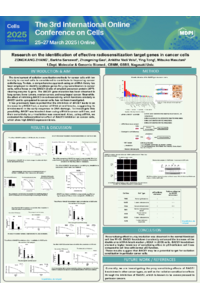
20250318zhang poster ver 7.0.pdf
Development of an evaluation model of flow cytometry for combined effects of anti-cancer drugs using machine learning
Clinicopathological significance of DNA damage signalling and repair (DDR) regulating E3 ubiquitin ligases and de-ubiquitinases in ovarian cancer