Event submissions
Published
This submission belongs to the session Session A. Cellular Pathology of Cancers of the event The 3rd International Online Conference on Cells
Published date
21 Mar, 2025
Academic Editor
'%3e%3cpath%20d='M12.6657%2010.9104C12.4185%2010.325%2012.0599%209.79327%2011.6097%209.34482C11.1609%208.89508%2010.6293%208.5365%2010.0442%208.28888C10.0389%208.28626%2010.0337%208.28495%2010.0285%208.28233C10.8446%207.69279%2011.3752%206.73249%2011.3752%205.64904C11.3752%203.8542%209.92103%202.39999%208.1262%202.39999C6.33136%202.39999%204.87715%203.8542%204.87715%205.64904C4.87715%206.73249%205.40774%207.69279%206.22393%208.28364C6.21869%208.28626%206.21345%208.28757%206.20821%208.29019C5.62129%208.5378%205.09463%208.89284%204.64265%209.34613C4.1929%209.79493%203.83432%2010.3266%203.58671%2010.9117C3.34345%2011.4845%203.21226%2012.0987%203.20023%2012.7209C3.19988%2012.7349%203.20233%2012.7488%203.20744%2012.7619C3.21255%2012.7749%203.22022%2012.7867%203.22998%2012.7968C3.23975%2012.8068%203.25142%2012.8147%203.26431%2012.8202C3.2772%2012.8256%203.29105%2012.8284%203.30504%2012.8284H4.09109C4.14874%2012.8284%204.19459%2012.7825%204.1959%2012.7262C4.2221%2011.7148%204.62823%2010.7676%205.34617%2010.0497C6.08899%209.30683%207.0755%208.89808%208.1262%208.89808C9.17689%208.89808%2010.1634%209.30683%2010.9062%2010.0497C11.6242%2010.7676%2012.0303%2011.7148%2012.0565%2012.7262C12.0578%2012.7838%2012.1037%2012.8284%2012.1613%2012.8284H12.9474C12.9613%2012.8284%2012.9752%2012.8256%2012.9881%2012.8202C13.001%2012.8147%2013.0126%2012.8068%2013.0224%2012.7968C13.0322%2012.7867%2013.0398%2012.7749%2013.0449%2012.7619C13.0501%2012.7488%2013.0525%2012.7349%2013.0522%2012.7209C13.0391%2012.0947%2012.9094%2011.4855%2012.6657%2010.9104ZM8.1262%207.9024C7.52486%207.9024%206.9589%207.6679%206.53312%207.24211C6.10733%206.81633%205.87283%206.25037%205.87283%205.64904C5.87283%205.0477%206.10733%204.48174%206.53312%204.05596C6.9589%203.63018%207.52486%203.39567%208.1262%203.39567C8.72753%203.39567%209.29349%203.63018%209.71927%204.05596C10.1451%204.48174%2010.3796%205.0477%2010.3796%205.64904C10.3796%206.25037%2010.1451%206.81633%209.71927%207.24211C9.29349%207.6679%208.72753%207.9024%208.1262%207.9024Z'%20fill='%235D1EE1'/%3e%3c/g%3e%3c/svg%3e) Natália Cruz-Martins
Natália Cruz-MartinsCitation
amera sheha, Emad Rakha, Srinivasan Madhusudan, Clinicopathological significance of DNA damage signalling and repair (DDR) regulating E3 ubiquitin ligases and de-ubiquitinases in ovarian cancer, in Proceedings of The 3rd International Online Conference on Cells, 25 March–27 March 2025, MDPI: Basel, Switzerland
Share
Email
Facebook
Twitter
LinkedIn
Clinicopathological significance of DNA damage signalling and repair (DDR) regulating E3 ubiquitin ligases and de-ubiquitinases in ovarian cancer
'%3e%3cpath%20d='M12.6647%2010.9104C12.4176%2010.325%2012.0589%209.7933%2011.6088%209.34485C11.16%208.89511%2010.6283%208.53653%2010.0432%208.28891C10.038%208.28629%2010.0327%208.28498%2010.0275%208.28236C10.8437%207.69282%2011.3743%206.73252%2011.3743%205.64907C11.3743%203.85423%209.92005%202.40002%208.12522%202.40002C6.33038%202.40002%204.87618%203.85423%204.87618%205.64907C4.87618%206.73252%205.40677%207.69282%206.22296%208.28367C6.21772%208.28629%206.21248%208.2876%206.20724%208.29022C5.62031%208.53783%205.09365%208.89287%204.64167%209.34616C4.19192%209.79496%203.83334%2010.3266%203.58573%2010.9117C3.34247%2011.4846%203.21128%2012.0987%203.19925%2012.721C3.1989%2012.735%203.20135%2012.7489%203.20646%2012.7619C3.21157%2012.7749%203.21924%2012.7868%203.22901%2012.7968C3.23877%2012.8068%203.25045%2012.8148%203.26334%2012.8202C3.27623%2012.8256%203.29007%2012.8284%203.30406%2012.8284H4.09012C4.14776%2012.8284%204.19362%2012.7825%204.19493%2012.7262C4.22113%2011.7148%204.62726%2010.7676%205.34519%2010.0497C6.08802%209.30686%207.07452%208.89811%208.12522%208.89811C9.17592%208.89811%2010.1624%209.30686%2010.9052%2010.0497C11.6232%2010.7676%2012.0293%2011.7148%2012.0555%2012.7262C12.0568%2012.7839%2012.1027%2012.8284%2012.1603%2012.8284H12.9464C12.9604%2012.8284%2012.9742%2012.8256%2012.9871%2012.8202C13%2012.8148%2013.0117%2012.8068%2013.0214%2012.7968C13.0312%2012.7868%2013.0389%2012.7749%2013.044%2012.7619C13.0491%2012.7489%2013.0515%2012.735%2013.0512%2012.721C13.0381%2012.0947%2012.9084%2011.4856%2012.6647%2010.9104ZM8.12522%207.90243C7.52388%207.90243%206.95792%207.66793%206.53214%207.24215C6.10636%206.81636%205.87185%206.2504%205.87185%205.64907C5.87185%205.04773%206.10636%204.48177%206.53214%204.05599C6.95792%203.63021%207.52388%203.3957%208.12522%203.3957C8.72655%203.3957%209.29252%203.63021%209.7183%204.05599C10.1441%204.48177%2010.3786%205.04773%2010.3786%205.64907C10.3786%206.2504%2010.1441%206.81636%209.7183%207.24215C9.29252%207.66793%208.72655%207.90243%208.12522%207.90243Z'%20fill='%235D1EE1'/%3e%3c/g%3e%3c/svg%3e)
amera sheha 1,2,3

Emad Rakha 1,2
Srinivasan Madhusudan 1,4
1. Naaz-Coker Ovarian Cancer Research Centre, Biodiscovery Institute, School of Medicine, University of Nottingham, Nottingham, NG7 2UH, UK
2. Department of Pathology, Nottingham University Hospitals, Nottingham, NG5 1PB, UK
3. Histopathology Department, South Egypt Cancer Institute, Assiut University, Assiut, 71515, Egypt
4. Department of Oncology, Nottingham University Hospitals, Nottingham, NG5 1PB, UK
Abstract
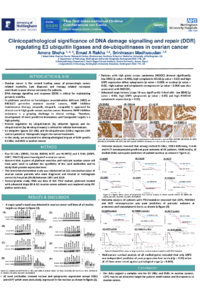
Introduction: E3 ubiquitin ligases (EUL) and de-ubiquitinases (DUB) that regulate DDR proteins may influence ovarian cancer pathogenesis. We evaluated DDR-regulating EULs and DUBs in ovarian cancers.
Methods: EULs (DDB2, CUL4A, HLTF, RAD18 and HUWE1) and DUBs (USP5, USP7, USP11 and PSMD14) were immunohistochemically profiled in 331 tumours, and the clinicopathological outcome were analysed. Transcriptomic analysis was completed on a publicly available data set (n=424).
Results: DDB2, USP7 and USP11 expression was nuclear. CUL4A, HLTF, RAD18, HUWE1, USP5 and PSMD14 showed both nuclear and cytoplasmic expression. EULs [low nuclear DDB2 and CUL4A cytoplasmic overexpression] and DUBs [USP5 (nuclear and cytoplasmic) overexpression] were associated with high-grade serous carcinoma (p = 0.02, 0.003, <0.001, 0.03, respectively). EULs [low DDB2 nuclear expression (p = 0.01) and CUL4A nuclear overexpression (p = 0.05)] and DUBs [USP5 cytoplasmic overexpression (p = 0.05) and PSMD14 cytoplasmic overexpression (p = 0.02)] were associated with advanced-stage tumours. In terms of survival outcomes, EULs [nuclear and cytoplasmic CUL4A (p = 0.05, <0.001, respectively), nuclear HLTF (p = 0.003) and low-nuclear DDB2 (p = 0.01)] and DUBs [overexpression of USP7 (p = 0.005), nuclear and cytoplasmic USP5 overexpression (p = 0.004, 0.04, respectively), cytoplasmic PSMD14 overexpression (p = 0.01), nuclear USP11 overexpression (p = 0.006)] were associated with poor progression-free survival (PFS). In a multivariate analysis, advanced stage, cytoplasmic CUL4A overexpression and nuclear USP5 overexpression remain independently associated with worse PFS (p = 0.02, 0.03, respectively). At the transcriptomic level, in p53 mutant advanced-stage tumours that received platinum-based chemotherapy (n=424), high USP5 remains associated with poor PFS.
Conclusion: Our data suggest a complex role of EULs and DUBs in ovarian cancers. USP5 may be an attractive target for patient stratification and therapeutics in ovarian cancer.
Keywords
DNA damage signalling
E3 ubiquitin ligases
de-ubiquitinases
ovarian cancer
Poster
Cells Poster.pdf
Research on the identification of effective radiosensitization target genes in cancer cells
Non-Genomic Action of Androgen Receptor in Colorectal Cancer