Event submissions
Published
This submission belongs to the session Session G. Cellular Metabolism of the event The 3rd International Online Conference on Cells
Published date
21 Mar, 2025
Academic Editor
'%3e%3cpath%20d='M12.6657%2010.9104C12.4185%2010.325%2012.0599%209.79327%2011.6097%209.34482C11.1609%208.89508%2010.6293%208.5365%2010.0442%208.28888C10.0389%208.28626%2010.0337%208.28495%2010.0285%208.28233C10.8446%207.69279%2011.3752%206.73249%2011.3752%205.64904C11.3752%203.8542%209.92103%202.39999%208.1262%202.39999C6.33136%202.39999%204.87715%203.8542%204.87715%205.64904C4.87715%206.73249%205.40774%207.69279%206.22393%208.28364C6.21869%208.28626%206.21345%208.28757%206.20821%208.29019C5.62129%208.5378%205.09463%208.89284%204.64265%209.34613C4.1929%209.79493%203.83432%2010.3266%203.58671%2010.9117C3.34345%2011.4845%203.21226%2012.0987%203.20023%2012.7209C3.19988%2012.7349%203.20233%2012.7488%203.20744%2012.7619C3.21255%2012.7749%203.22022%2012.7867%203.22998%2012.7968C3.23975%2012.8068%203.25142%2012.8147%203.26431%2012.8202C3.2772%2012.8256%203.29105%2012.8284%203.30504%2012.8284H4.09109C4.14874%2012.8284%204.19459%2012.7825%204.1959%2012.7262C4.2221%2011.7148%204.62823%2010.7676%205.34617%2010.0497C6.08899%209.30683%207.0755%208.89808%208.1262%208.89808C9.17689%208.89808%2010.1634%209.30683%2010.9062%2010.0497C11.6242%2010.7676%2012.0303%2011.7148%2012.0565%2012.7262C12.0578%2012.7838%2012.1037%2012.8284%2012.1613%2012.8284H12.9474C12.9613%2012.8284%2012.9752%2012.8256%2012.9881%2012.8202C13.001%2012.8147%2013.0126%2012.8068%2013.0224%2012.7968C13.0322%2012.7867%2013.0398%2012.7749%2013.0449%2012.7619C13.0501%2012.7488%2013.0525%2012.7349%2013.0522%2012.7209C13.0391%2012.0947%2012.9094%2011.4855%2012.6657%2010.9104ZM8.1262%207.9024C7.52486%207.9024%206.9589%207.6679%206.53312%207.24211C6.10733%206.81633%205.87283%206.25037%205.87283%205.64904C5.87283%205.0477%206.10733%204.48174%206.53312%204.05596C6.9589%203.63018%207.52486%203.39567%208.1262%203.39567C8.72753%203.39567%209.29349%203.63018%209.71927%204.05596C10.1451%204.48174%2010.3796%205.0477%2010.3796%205.64904C10.3796%206.25037%2010.1451%206.81633%209.71927%207.24211C9.29349%207.6679%208.72753%207.9024%208.1262%207.9024Z'%20fill='%235D1EE1'/%3e%3c/g%3e%3c/svg%3e) Roger Schneiter
Roger SchneiterCitation
Michela Varone, Giuseppe Scavo, Mayra Colardo, Noemi Martella, Daniele Pensabene, Emanuele Bisesto, Francesca Cavicchia, Marco Segatto, p75NTR modulation restores redox metabolism and blunts inflammation in a cell model of Rett syndrome, in Proceedings of The 3rd International Online Conference on Cells, 25 March–27 March 2025, MDPI: Basel, Switzerland
Share
Email
Facebook
Twitter
LinkedIn
p75NTR modulation restores redox metabolism and blunts inflammation in a cell model of Rett syndrome
'%3e%3cpath%20d='M12.6647%2010.9104C12.4176%2010.325%2012.0589%209.7933%2011.6088%209.34485C11.16%208.89511%2010.6283%208.53653%2010.0432%208.28891C10.038%208.28629%2010.0327%208.28498%2010.0275%208.28236C10.8437%207.69282%2011.3743%206.73252%2011.3743%205.64907C11.3743%203.85423%209.92005%202.40002%208.12522%202.40002C6.33038%202.40002%204.87618%203.85423%204.87618%205.64907C4.87618%206.73252%205.40677%207.69282%206.22296%208.28367C6.21772%208.28629%206.21248%208.2876%206.20724%208.29022C5.62031%208.53783%205.09365%208.89287%204.64167%209.34616C4.19192%209.79496%203.83334%2010.3266%203.58573%2010.9117C3.34247%2011.4846%203.21128%2012.0987%203.19925%2012.721C3.1989%2012.735%203.20135%2012.7489%203.20646%2012.7619C3.21157%2012.7749%203.21924%2012.7868%203.22901%2012.7968C3.23877%2012.8068%203.25045%2012.8148%203.26334%2012.8202C3.27623%2012.8256%203.29007%2012.8284%203.30406%2012.8284H4.09012C4.14776%2012.8284%204.19362%2012.7825%204.19493%2012.7262C4.22113%2011.7148%204.62726%2010.7676%205.34519%2010.0497C6.08802%209.30686%207.07452%208.89811%208.12522%208.89811C9.17592%208.89811%2010.1624%209.30686%2010.9052%2010.0497C11.6232%2010.7676%2012.0293%2011.7148%2012.0555%2012.7262C12.0568%2012.7839%2012.1027%2012.8284%2012.1603%2012.8284H12.9464C12.9604%2012.8284%2012.9742%2012.8256%2012.9871%2012.8202C13%2012.8148%2013.0117%2012.8068%2013.0214%2012.7968C13.0312%2012.7868%2013.0389%2012.7749%2013.044%2012.7619C13.0491%2012.7489%2013.0515%2012.735%2013.0512%2012.721C13.0381%2012.0947%2012.9084%2011.4856%2012.6647%2010.9104ZM8.12522%207.90243C7.52388%207.90243%206.95792%207.66793%206.53214%207.24215C6.10636%206.81636%205.87185%206.2504%205.87185%205.64907C5.87185%205.04773%206.10636%204.48177%206.53214%204.05599C6.95792%203.63021%207.52388%203.3957%208.12522%203.3957C8.72655%203.3957%209.29252%203.63021%209.7183%204.05599C10.1441%204.48177%2010.3786%205.04773%2010.3786%205.64907C10.3786%206.2504%2010.1441%206.81636%209.7183%207.24215C9.29252%207.66793%208.72655%207.90243%208.12522%207.90243Z'%20fill='%235D1EE1'/%3e%3c/g%3e%3c/svg%3e)
Michela Varone 1
Giuseppe Scavo 1
Mayra Colardo 1
Noemi Martella 1
Daniele Pensabene 1,2
Emanuele Bisesto 1
Francesca Cavicchia 1

Marco Segatto 1
1. Department of Biosciences and Territory, University of Molise, Fonte Lappone, 86090 Pesche, Italy
2. Department of Science, University Roma Tre, Viale Guglielmo Marconi 446, 00146 Rome, Italy
Abstract
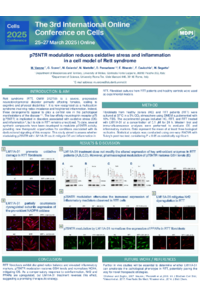
Rett syndrome (RTT) is a neurological disorder with an early onset, primarily affecting females, and is characterized by severe cognitive and physical impairments. RTT is no longer regarded as an exclusively neurological disease; rather, it is now considered a multisystem syndrome that affects the brain and several other tissues/organs. Recent research suggests that disruptions in redox homeostasis and heightened inflammatory responses are of pivotal importance with regard to the disease’s clinical manifestations. Notably, emerging evidence points to the p75 neurotrophin receptor (p75NTR) as a regulator of oxidative stress (OS) and inflammation.
The objective of this study is to explore the impact of modulating p75NTR through the use of the small molecule LM11A-31 on fibroblasts derived from RTT patients. Fibroblasts were treated with 0.1 μM of LM11A-31 for 24 hours, and analyses were conducted through qPCR, immunofluorescence, ELISA, and Western blotting.
The results reveal that LM11A-31 significantly mitigates OS markers in RTT fibroblasts. Specifically, p75NTR modulation restored protein glutathionylation and reduced the expression of the pro-oxidant enzyme NADPH-oxidase 4 (NOX4). Moreover, LM11A-31 blunted the expression of pro-inflammatory mediators while simultaneously normalizing transcription factors involved in antioxidant response and inflammatory response.
These results suggest that targeting p75NTR with LM11A-31 may offer a potential therapeutic avenue for restoring redox balance and alleviating inflammation in RTT patients. The use of a p75NTR modulator, such as LM11A-31, could be more effective for treating RTT by targeting key processes, addressing multiple aspects of the disease simultaneously. Further research should be directed towards a more detailed investigation of the molecular mechanisms and the corroboration of these findings in in vivo models.
Keywords
Rett syndrome
neurodevelopmental disorder
cellular metabolism
oxidative damage
redox imbalance
inflammation
neurotrophins
LM11A-31.
Poster
p75NTR modulation reduces oxidative stress and inflammation in a cell model of Rett syndrome_CELLS2025_Varone.pdf
p75NTR modulation reverses oxidative stress and metabolic derangements in a cell model of Parkinson’s disease
Therapeutic properties of pequi lipophilic fraction (Caryocar brasiliense) in skin wound repair: modulation of inflammatory and proliferative phases