Event submissions
Published
This submission belongs to the session Session A. Cellular Pathology of Cancers of the event The 3rd International Online Conference on Cells
Published date
21 Mar, 2025
Academic Editor
'%3e%3cpath%20d='M12.6657%2010.9104C12.4185%2010.325%2012.0599%209.79327%2011.6097%209.34482C11.1609%208.89508%2010.6293%208.5365%2010.0442%208.28888C10.0389%208.28626%2010.0337%208.28495%2010.0285%208.28233C10.8446%207.69279%2011.3752%206.73249%2011.3752%205.64904C11.3752%203.8542%209.92103%202.39999%208.1262%202.39999C6.33136%202.39999%204.87715%203.8542%204.87715%205.64904C4.87715%206.73249%205.40774%207.69279%206.22393%208.28364C6.21869%208.28626%206.21345%208.28757%206.20821%208.29019C5.62129%208.5378%205.09463%208.89284%204.64265%209.34613C4.1929%209.79493%203.83432%2010.3266%203.58671%2010.9117C3.34345%2011.4845%203.21226%2012.0987%203.20023%2012.7209C3.19988%2012.7349%203.20233%2012.7488%203.20744%2012.7619C3.21255%2012.7749%203.22022%2012.7867%203.22998%2012.7968C3.23975%2012.8068%203.25142%2012.8147%203.26431%2012.8202C3.2772%2012.8256%203.29105%2012.8284%203.30504%2012.8284H4.09109C4.14874%2012.8284%204.19459%2012.7825%204.1959%2012.7262C4.2221%2011.7148%204.62823%2010.7676%205.34617%2010.0497C6.08899%209.30683%207.0755%208.89808%208.1262%208.89808C9.17689%208.89808%2010.1634%209.30683%2010.9062%2010.0497C11.6242%2010.7676%2012.0303%2011.7148%2012.0565%2012.7262C12.0578%2012.7838%2012.1037%2012.8284%2012.1613%2012.8284H12.9474C12.9613%2012.8284%2012.9752%2012.8256%2012.9881%2012.8202C13.001%2012.8147%2013.0126%2012.8068%2013.0224%2012.7968C13.0322%2012.7867%2013.0398%2012.7749%2013.0449%2012.7619C13.0501%2012.7488%2013.0525%2012.7349%2013.0522%2012.7209C13.0391%2012.0947%2012.9094%2011.4855%2012.6657%2010.9104ZM8.1262%207.9024C7.52486%207.9024%206.9589%207.6679%206.53312%207.24211C6.10733%206.81633%205.87283%206.25037%205.87283%205.64904C5.87283%205.0477%206.10733%204.48174%206.53312%204.05596C6.9589%203.63018%207.52486%203.39567%208.1262%203.39567C8.72753%203.39567%209.29349%203.63018%209.71927%204.05596C10.1451%204.48174%2010.3796%205.0477%2010.3796%205.64904C10.3796%206.25037%2010.1451%206.81633%209.71927%207.24211C9.29349%207.6679%208.72753%207.9024%208.1262%207.9024Z'%20fill='%235D1EE1'/%3e%3c/g%3e%3c/svg%3e) Srinivasan Madhusudan
Srinivasan MadhusudanCitation
Gaia Giannitti, Alyssa Julia Jennifer Paganoni, Sara Marchesi, Riccardo Garavaglia, Ivan Preosto, Fabrizio Fontana, Impact of MCT1-Mediated Lactate Uptake on Melanoma Cancer Stem Cells, in Proceedings of The 3rd International Online Conference on Cells, 25 March–27 March 2025, MDPI: Basel, Switzerland
Share
Email
Facebook
Twitter
LinkedIn
Impact of MCT1-Mediated Lactate Uptake on Melanoma Cancer Stem Cells
'%3e%3cpath%20d='M12.6647%2010.9104C12.4176%2010.325%2012.0589%209.7933%2011.6088%209.34485C11.16%208.89511%2010.6283%208.53653%2010.0432%208.28891C10.038%208.28629%2010.0327%208.28498%2010.0275%208.28236C10.8437%207.69282%2011.3743%206.73252%2011.3743%205.64907C11.3743%203.85423%209.92005%202.40002%208.12522%202.40002C6.33038%202.40002%204.87618%203.85423%204.87618%205.64907C4.87618%206.73252%205.40677%207.69282%206.22296%208.28367C6.21772%208.28629%206.21248%208.2876%206.20724%208.29022C5.62031%208.53783%205.09365%208.89287%204.64167%209.34616C4.19192%209.79496%203.83334%2010.3266%203.58573%2010.9117C3.34247%2011.4846%203.21128%2012.0987%203.19925%2012.721C3.1989%2012.735%203.20135%2012.7489%203.20646%2012.7619C3.21157%2012.7749%203.21924%2012.7868%203.22901%2012.7968C3.23877%2012.8068%203.25045%2012.8148%203.26334%2012.8202C3.27623%2012.8256%203.29007%2012.8284%203.30406%2012.8284H4.09012C4.14776%2012.8284%204.19362%2012.7825%204.19493%2012.7262C4.22113%2011.7148%204.62726%2010.7676%205.34519%2010.0497C6.08802%209.30686%207.07452%208.89811%208.12522%208.89811C9.17592%208.89811%2010.1624%209.30686%2010.9052%2010.0497C11.6232%2010.7676%2012.0293%2011.7148%2012.0555%2012.7262C12.0568%2012.7839%2012.1027%2012.8284%2012.1603%2012.8284H12.9464C12.9604%2012.8284%2012.9742%2012.8256%2012.9871%2012.8202C13%2012.8148%2013.0117%2012.8068%2013.0214%2012.7968C13.0312%2012.7868%2013.0389%2012.7749%2013.044%2012.7619C13.0491%2012.7489%2013.0515%2012.735%2013.0512%2012.721C13.0381%2012.0947%2012.9084%2011.4856%2012.6647%2010.9104ZM8.12522%207.90243C7.52388%207.90243%206.95792%207.66793%206.53214%207.24215C6.10636%206.81636%205.87185%206.2504%205.87185%205.64907C5.87185%205.04773%206.10636%204.48177%206.53214%204.05599C6.95792%203.63021%207.52388%203.3957%208.12522%203.3957C8.72655%203.3957%209.29252%203.63021%209.7183%204.05599C10.1441%204.48177%2010.3786%205.04773%2010.3786%205.64907C10.3786%206.2504%2010.1441%206.81636%209.7183%207.24215C9.29252%207.66793%208.72655%207.90243%208.12522%207.90243Z'%20fill='%235D1EE1'/%3e%3c/g%3e%3c/svg%3e)
Gaia Giannitti 1

Alyssa Julia Jennifer Paganoni 1
Sara Marchesi 1
Riccardo Garavaglia 1
Ivan Preosto 1

Fabrizio Fontana 1
1. Department of Pharmacological and Biomolecular Sciences "Rodolfo Paoletti", University of Milan, 20133, Italy
Abstract
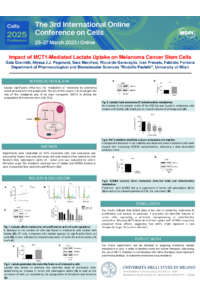
Introduction: Lactate significantly influences the metabolism of melanoma by promoting tumor development and progression. However, the role of this metabolite and its main transporter MCT-1 in driving the propagation of melanoma cancer stem cells (CSCs) still needs to be elucidated.
Methods: Experiments were conducted on the A375 and WM115 melanoma cell lines. Cell quiescence was assessed by a proliferation and colony formation assay, cell-cycle and survival analysis (flow cytometry), and Western blotting. The spherogenic ability of tumor cells was evaluated through sphere formation and a propagation assay. The metabolic effects of lactate and AZ3965 treatment were analyzed by flow cytometry and Western blotting.
Results: We found that lactate-treated cells exhibited a quiescent state characterized by reduced proliferation, G1 cell-cycle phase arrest, and P27 upregulation; however, no changes in cell survival or clonogenic efficiency were found, suggesting that this quiescent state was not associated with cell death. More importantly, lactate treatment significantly increased melanoma cells' spherogenic ability and ABCG2 enrichment, two common CSC traits. Mechanistically, lactate was observed to activate PCG1-alpha, leading to enhanced OXPHOS protein expression and mitochondrial mass. Of note, treatment with AZ3965, a specific inhibitor of the lactate transporter MCT-1, significantly suppressed melanoma CSC expansion via PGC1-alpha downregulation.
Conclusions: Lactate plays a key role in sustaining melanoma CSC proliferation and survival. Targeting lactate metabolism via MCT1 inhibition holds promise for novel anti-cancer therapies.
Keywords
Melanoma
Cancer Stem Cells
Lactate
MCT1
Metabolism
Poster
poster cells.pdf
Methylation Dynamics of Mitochondrial Stress Response Genes in Retinal Pigment Epithelium under Oxidative Stress Conditions
Dissecting the role of extracellular vesicles in melanoma microenvironment