Event submissions
Published
This submission belongs to the session Session A. Cellular Pathology of Cancers of the event The 3rd International Online Conference on Cells
Published date
21 Mar, 2025
Academic Editor
'%3e%3cpath%20d='M12.6657%2010.9104C12.4185%2010.325%2012.0599%209.79327%2011.6097%209.34482C11.1609%208.89508%2010.6293%208.5365%2010.0442%208.28888C10.0389%208.28626%2010.0337%208.28495%2010.0285%208.28233C10.8446%207.69279%2011.3752%206.73249%2011.3752%205.64904C11.3752%203.8542%209.92103%202.39999%208.1262%202.39999C6.33136%202.39999%204.87715%203.8542%204.87715%205.64904C4.87715%206.73249%205.40774%207.69279%206.22393%208.28364C6.21869%208.28626%206.21345%208.28757%206.20821%208.29019C5.62129%208.5378%205.09463%208.89284%204.64265%209.34613C4.1929%209.79493%203.83432%2010.3266%203.58671%2010.9117C3.34345%2011.4845%203.21226%2012.0987%203.20023%2012.7209C3.19988%2012.7349%203.20233%2012.7488%203.20744%2012.7619C3.21255%2012.7749%203.22022%2012.7867%203.22998%2012.7968C3.23975%2012.8068%203.25142%2012.8147%203.26431%2012.8202C3.2772%2012.8256%203.29105%2012.8284%203.30504%2012.8284H4.09109C4.14874%2012.8284%204.19459%2012.7825%204.1959%2012.7262C4.2221%2011.7148%204.62823%2010.7676%205.34617%2010.0497C6.08899%209.30683%207.0755%208.89808%208.1262%208.89808C9.17689%208.89808%2010.1634%209.30683%2010.9062%2010.0497C11.6242%2010.7676%2012.0303%2011.7148%2012.0565%2012.7262C12.0578%2012.7838%2012.1037%2012.8284%2012.1613%2012.8284H12.9474C12.9613%2012.8284%2012.9752%2012.8256%2012.9881%2012.8202C13.001%2012.8147%2013.0126%2012.8068%2013.0224%2012.7968C13.0322%2012.7867%2013.0398%2012.7749%2013.0449%2012.7619C13.0501%2012.7488%2013.0525%2012.7349%2013.0522%2012.7209C13.0391%2012.0947%2012.9094%2011.4855%2012.6657%2010.9104ZM8.1262%207.9024C7.52486%207.9024%206.9589%207.6679%206.53312%207.24211C6.10733%206.81633%205.87283%206.25037%205.87283%205.64904C5.87283%205.0477%206.10733%204.48174%206.53312%204.05596C6.9589%203.63018%207.52486%203.39567%208.1262%203.39567C8.72753%203.39567%209.29349%203.63018%209.71927%204.05596C10.1451%204.48174%2010.3796%205.0477%2010.3796%205.64904C10.3796%206.25037%2010.1451%206.81633%209.71927%207.24211C9.29349%207.6679%208.72753%207.9024%208.1262%207.9024Z'%20fill='%235D1EE1'/%3e%3c/g%3e%3c/svg%3e) Srinivasan Madhusudan
Srinivasan MadhusudanCitation
Zhongming Gao, Ying Tong, Barkha Saraswat, Shoji Imamichi, Lichao Chen, Yu Sanada, Minoru Suzuki, Masamichi Ishiai, Shinichiro Masunaga, Mitsuko Masutani, Function of SNHG12 in early response to boron neutron capture therapy (BNCT) in tumor cells, in Proceedings of The 3rd International Online Conference on Cells, 25 March–27 March 2025, MDPI: Basel, Switzerland
Share
Email
Facebook
Twitter
LinkedIn
Function of SNHG12 in early response to boron neutron capture therapy (BNCT) in tumor cells
'%3e%3cpath%20d='M12.6647%2010.9104C12.4176%2010.325%2012.0589%209.7933%2011.6088%209.34485C11.16%208.89511%2010.6283%208.53653%2010.0432%208.28891C10.038%208.28629%2010.0327%208.28498%2010.0275%208.28236C10.8437%207.69282%2011.3743%206.73252%2011.3743%205.64907C11.3743%203.85423%209.92005%202.40002%208.12522%202.40002C6.33038%202.40002%204.87618%203.85423%204.87618%205.64907C4.87618%206.73252%205.40677%207.69282%206.22296%208.28367C6.21772%208.28629%206.21248%208.2876%206.20724%208.29022C5.62031%208.53783%205.09365%208.89287%204.64167%209.34616C4.19192%209.79496%203.83334%2010.3266%203.58573%2010.9117C3.34247%2011.4846%203.21128%2012.0987%203.19925%2012.721C3.1989%2012.735%203.20135%2012.7489%203.20646%2012.7619C3.21157%2012.7749%203.21924%2012.7868%203.22901%2012.7968C3.23877%2012.8068%203.25045%2012.8148%203.26334%2012.8202C3.27623%2012.8256%203.29007%2012.8284%203.30406%2012.8284H4.09012C4.14776%2012.8284%204.19362%2012.7825%204.19493%2012.7262C4.22113%2011.7148%204.62726%2010.7676%205.34519%2010.0497C6.08802%209.30686%207.07452%208.89811%208.12522%208.89811C9.17592%208.89811%2010.1624%209.30686%2010.9052%2010.0497C11.6232%2010.7676%2012.0293%2011.7148%2012.0555%2012.7262C12.0568%2012.7839%2012.1027%2012.8284%2012.1603%2012.8284H12.9464C12.9604%2012.8284%2012.9742%2012.8256%2012.9871%2012.8202C13%2012.8148%2013.0117%2012.8068%2013.0214%2012.7968C13.0312%2012.7868%2013.0389%2012.7749%2013.044%2012.7619C13.0491%2012.7489%2013.0515%2012.735%2013.0512%2012.721C13.0381%2012.0947%2012.9084%2011.4856%2012.6647%2010.9104ZM8.12522%207.90243C7.52388%207.90243%206.95792%207.66793%206.53214%207.24215C6.10636%206.81636%205.87185%206.2504%205.87185%205.64907C5.87185%205.04773%206.10636%204.48177%206.53214%204.05599C6.95792%203.63021%207.52388%203.3957%208.12522%203.3957C8.72655%203.3957%209.29252%203.63021%209.7183%204.05599C10.1441%204.48177%2010.3786%205.04773%2010.3786%205.64907C10.3786%206.2504%2010.1441%206.81636%209.7183%207.24215C9.29252%207.66793%208.72655%207.90243%208.12522%207.90243Z'%20fill='%235D1EE1'/%3e%3c/g%3e%3c/svg%3e)
Zhongming Gao 1
Ying Tong 1,2

Barkha Saraswat 1
Shoji Imamichi 1,2,3
Lichao Chen 1
Yu Sanada 4
Minoru Suzuki 4
Masamichi Ishiai 2,3
Shinichiro Masunaga 4
Mitsuko Masutani 1,2,3
1. Dept. Molecular and Genomic Biomedicine & CBMM, Grad. Sch. Biomed. Sci., Nagasaki Univ., 852-8523, Nagasaki, Japan.
2. Central Radioisotope Div. Natl. Cancer Ctr. Res. Inst. 104-0045, Tokyo, Japan
3. Div. BNCT, EPOC, National Cancer Center, 104-0045, Tokyo, Japan
4. Institute for Integrated Radiation and Nuclear Science, Kyoto University, 590-0494, Osaka, Japan
Abstract
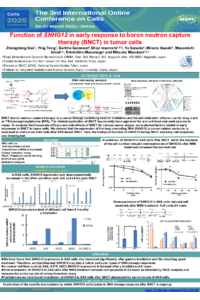
BNCT (boron neutron capture therapy) is a cancer therapy combining neutron irradiation and the administration of boron carrier drug, such as 10B-boronophenylalanine (BPA). The clinical application of BNCT has recently been approved for oral and head-and-neck cancers in Japan. To evaluate the therapeutic efficacy and side effects of BNCT for various cancer stages, we evaluated factors related to early responses to BNCT in tumor cells. We showed that the expression of the long noncoding RNA SNHG12, a cancer-related molecule, is increased in oral cancer SAS cells after BPA-based BNCT. Here, the biological function of SNHG12 during BNCT and early cell responses was investigated. We showed that SNHG12 expression in SAS cells increased significantly after gamma irradiation and treatment with an alkylating agent, methylmethanesulfonate, within 24 hrs. SNHG12 overexpression triggered a decrease in the sub-G1 apoptotic fraction and increase in S-phase population. We thus hypothesized that SNHG12 may have a supportive role for cell survival in particular types of DNA damage responses. Furthermore, colony formation assay of SAS cells after BNCT irradiation showed that SNHG12 knockdown increased the sensitivity of SAS cells to BNCT. Knockdown of SNHG12 in SAS cells after gamma irradiation decreased the mRNA expression of IAP family protein within 24 hrs. The mechanisms by which SNHG12 is involved in the early cell response after BNCT will be discussed.
Keywords
BNCT,lncRNA
Poster
poster Cells 20250319 GAO@ .pdf
Dissecting the role of extracellular vesicles in melanoma microenvironment
HIGH CHOLESTEROL LEVELS PROMOTE TNF-α-DEPENDENT NECROPTOSIS IN ALZHEIMER’S DISEASE