Event submissions
Published
This submission belongs to the session Session B. Neural Cell Biology of the event The 3rd International Online Conference on Cells
Published date
21 Mar, 2025
Academic Editor
'%3e%3cpath%20d='M12.6657%2010.9104C12.4185%2010.325%2012.0599%209.79327%2011.6097%209.34482C11.1609%208.89508%2010.6293%208.5365%2010.0442%208.28888C10.0389%208.28626%2010.0337%208.28495%2010.0285%208.28233C10.8446%207.69279%2011.3752%206.73249%2011.3752%205.64904C11.3752%203.8542%209.92103%202.39999%208.1262%202.39999C6.33136%202.39999%204.87715%203.8542%204.87715%205.64904C4.87715%206.73249%205.40774%207.69279%206.22393%208.28364C6.21869%208.28626%206.21345%208.28757%206.20821%208.29019C5.62129%208.5378%205.09463%208.89284%204.64265%209.34613C4.1929%209.79493%203.83432%2010.3266%203.58671%2010.9117C3.34345%2011.4845%203.21226%2012.0987%203.20023%2012.7209C3.19988%2012.7349%203.20233%2012.7488%203.20744%2012.7619C3.21255%2012.7749%203.22022%2012.7867%203.22998%2012.7968C3.23975%2012.8068%203.25142%2012.8147%203.26431%2012.8202C3.2772%2012.8256%203.29105%2012.8284%203.30504%2012.8284H4.09109C4.14874%2012.8284%204.19459%2012.7825%204.1959%2012.7262C4.2221%2011.7148%204.62823%2010.7676%205.34617%2010.0497C6.08899%209.30683%207.0755%208.89808%208.1262%208.89808C9.17689%208.89808%2010.1634%209.30683%2010.9062%2010.0497C11.6242%2010.7676%2012.0303%2011.7148%2012.0565%2012.7262C12.0578%2012.7838%2012.1037%2012.8284%2012.1613%2012.8284H12.9474C12.9613%2012.8284%2012.9752%2012.8256%2012.9881%2012.8202C13.001%2012.8147%2013.0126%2012.8068%2013.0224%2012.7968C13.0322%2012.7867%2013.0398%2012.7749%2013.0449%2012.7619C13.0501%2012.7488%2013.0525%2012.7349%2013.0522%2012.7209C13.0391%2012.0947%2012.9094%2011.4855%2012.6657%2010.9104ZM8.1262%207.9024C7.52486%207.9024%206.9589%207.6679%206.53312%207.24211C6.10733%206.81633%205.87283%206.25037%205.87283%205.64904C5.87283%205.0477%206.10733%204.48174%206.53312%204.05596C6.9589%203.63018%207.52486%203.39567%208.1262%203.39567C8.72753%203.39567%209.29349%203.63018%209.71927%204.05596C10.1451%204.48174%2010.3796%205.0477%2010.3796%205.64904C10.3796%206.25037%2010.1451%206.81633%209.71927%207.24211C9.29349%207.6679%208.72753%207.9024%208.1262%207.9024Z'%20fill='%235D1EE1'/%3e%3c/g%3e%3c/svg%3e) George Smith
George SmithCitation
Xenia Abadin Calaf, Marlene Zubillaga, Elia Ivars, Ramón Trullás, Andrea Stavoe, Anna Colell Riera, HIGH CHOLESTEROL LEVELS PROMOTE TNF-α-DEPENDENT NECROPTOSIS IN ALZHEIMER’S DISEASE, in Proceedings of The 3rd International Online Conference on Cells, 25 March–27 March 2025, MDPI: Basel, Switzerland
Share
Email
Facebook
Twitter
LinkedIn
HIGH CHOLESTEROL LEVELS PROMOTE TNF-α-DEPENDENT NECROPTOSIS IN ALZHEIMER’S DISEASE
'%3e%3cpath%20d='M12.6647%2010.9104C12.4176%2010.325%2012.0589%209.7933%2011.6088%209.34485C11.16%208.89511%2010.6283%208.53653%2010.0432%208.28891C10.038%208.28629%2010.0327%208.28498%2010.0275%208.28236C10.8437%207.69282%2011.3743%206.73252%2011.3743%205.64907C11.3743%203.85423%209.92005%202.40002%208.12522%202.40002C6.33038%202.40002%204.87618%203.85423%204.87618%205.64907C4.87618%206.73252%205.40677%207.69282%206.22296%208.28367C6.21772%208.28629%206.21248%208.2876%206.20724%208.29022C5.62031%208.53783%205.09365%208.89287%204.64167%209.34616C4.19192%209.79496%203.83334%2010.3266%203.58573%2010.9117C3.34247%2011.4846%203.21128%2012.0987%203.19925%2012.721C3.1989%2012.735%203.20135%2012.7489%203.20646%2012.7619C3.21157%2012.7749%203.21924%2012.7868%203.22901%2012.7968C3.23877%2012.8068%203.25045%2012.8148%203.26334%2012.8202C3.27623%2012.8256%203.29007%2012.8284%203.30406%2012.8284H4.09012C4.14776%2012.8284%204.19362%2012.7825%204.19493%2012.7262C4.22113%2011.7148%204.62726%2010.7676%205.34519%2010.0497C6.08802%209.30686%207.07452%208.89811%208.12522%208.89811C9.17592%208.89811%2010.1624%209.30686%2010.9052%2010.0497C11.6232%2010.7676%2012.0293%2011.7148%2012.0555%2012.7262C12.0568%2012.7839%2012.1027%2012.8284%2012.1603%2012.8284H12.9464C12.9604%2012.8284%2012.9742%2012.8256%2012.9871%2012.8202C13%2012.8148%2013.0117%2012.8068%2013.0214%2012.7968C13.0312%2012.7868%2013.0389%2012.7749%2013.044%2012.7619C13.0491%2012.7489%2013.0515%2012.735%2013.0512%2012.721C13.0381%2012.0947%2012.9084%2011.4856%2012.6647%2010.9104ZM8.12522%207.90243C7.52388%207.90243%206.95792%207.66793%206.53214%207.24215C6.10636%206.81636%205.87185%206.2504%205.87185%205.64907C5.87185%205.04773%206.10636%204.48177%206.53214%204.05599C6.95792%203.63021%207.52388%203.3957%208.12522%203.3957C8.72655%203.3957%209.29252%203.63021%209.7183%204.05599C10.1441%204.48177%2010.3786%205.04773%2010.3786%205.64907C10.3786%206.2504%2010.1441%206.81636%209.7183%207.24215C9.29252%207.66793%208.72655%207.90243%208.12522%207.90243Z'%20fill='%235D1EE1'/%3e%3c/g%3e%3c/svg%3e)
Xenia Abadin Calaf 1
Marlene Zubillaga 1
Elia Ivars 1

Ramón Trullás 1
Andrea Stavoe 2

Anna Colell Riera 1
1. Department of Cell Death and Proliferation, Biomedical Research Institute of Barcelona (IIBB), Spanish National Research Council (CSIC), August Pi i Sunyer Biomedical Research Institute (IDIBAPS), Biomedical Research Center, Barcelona, 08036, Spain
2. Department of Neurobiology & Anatomy, McGovern Medical School, University of Texas Health Science Center at Houston, Houston, TX 77030, USA
Abstract
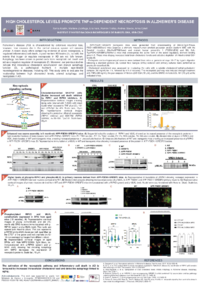
Necroptosis has been reported in post-mortem AD brains; however, the events that regulate this type of inflammatory cell death in AD are not fully understood. Autophagy has been shown to protect cells from necroptotic cell death and act as a negative regulator of necroptosis. Moreover, our previous studies indicate that intracellular cholesterol accumulation can disrupt autophagy function, a pathological hallmark in multiple age-related neurodegenerative diseases, including AD. This study aims to evaluate the relationship between high cholesterol levels, altered autophagy, and necroptosis in AD, using primary neurons isolated from APP-PSEN1 mice overexpressing the cholesterol-related transcription factor SREBF2 and dorsal root ganglion neurons (DRGs). Methods: Cholesterol enrichment was assessed by incubating the cells with a soluble cholesterol/methyl-cyclodextrin complex (50 mg/ml) for 1h, followed by 4h of recovery. The necroptotic pathway was induced through treatment with TZL (TNFα (60 ng/ml)) plus the SMAC mimetic (LCL-161, 10 mM) and the pan-caspase inhibitor zVAD (10 mM) for different durations. Results: Brains from APP-PSEN1-SREBF2 mice exhibited an up-regulated expression of necroptosis-related proteins, specifically RIPK1, RIPK3, and MLKL, which accumulated in the urea-soluble fraction, indicating necrosome assembly. Also, SREBF2 overexpression resulted in increased levels of active phosphorylated RIPK3 and MLKL. Similarly, phospho-RIPK3 and phospho-MLKL levels were significantly elevated in primary neurons derived from the APP-PSEN1-SREBF2 mice compared to wild-type (WT) neurons, even without necroptosis induction. In vitro cholesterol enrichment increased cell death following TZL exposure, which was mitigated by RIPK1 and RIPK3 inhibitors (Necrostatin and GSK’872, respectively). In DRG neurons, phosphorylated RIPK3 and MLKL were constitutively expressed in aged neurons with compromised autophagy. The induction of the necroptotic pathway was prevented by restoring the autophagy function in old neurons. Conclusions: Overall, these findings indicate that the activation of the necroptotic pathway and inflammatory cell death in AD may be favored by the increased intracellular cholesterol load and defective autophagy associated with aging.
Keywords
Alzheimer
necroptosis
cell death
autophagy
aging
Poster
Poster_IOCC_Online_2025_80x60_Corrected.pdf
Function of SNHG12 in early response to boron neutron capture therapy (BNCT) in tumor cells
Synergistic Interaction Between Copper Overload and Aβ Peptide enhances Microglial Pro-Inflammatory Response