Event submissions
Published
This submission belongs to the session Session H. Protein Quality Control, Proteasomal Degradation and Autophagy of the event The 3rd International Online Conference on Cells
Published date
21 Mar, 2025
Academic Editor
'%3e%3cpath%20d='M12.6657%2010.9104C12.4185%2010.325%2012.0599%209.79327%2011.6097%209.34482C11.1609%208.89508%2010.6293%208.5365%2010.0442%208.28888C10.0389%208.28626%2010.0337%208.28495%2010.0285%208.28233C10.8446%207.69279%2011.3752%206.73249%2011.3752%205.64904C11.3752%203.8542%209.92103%202.39999%208.1262%202.39999C6.33136%202.39999%204.87715%203.8542%204.87715%205.64904C4.87715%206.73249%205.40774%207.69279%206.22393%208.28364C6.21869%208.28626%206.21345%208.28757%206.20821%208.29019C5.62129%208.5378%205.09463%208.89284%204.64265%209.34613C4.1929%209.79493%203.83432%2010.3266%203.58671%2010.9117C3.34345%2011.4845%203.21226%2012.0987%203.20023%2012.7209C3.19988%2012.7349%203.20233%2012.7488%203.20744%2012.7619C3.21255%2012.7749%203.22022%2012.7867%203.22998%2012.7968C3.23975%2012.8068%203.25142%2012.8147%203.26431%2012.8202C3.2772%2012.8256%203.29105%2012.8284%203.30504%2012.8284H4.09109C4.14874%2012.8284%204.19459%2012.7825%204.1959%2012.7262C4.2221%2011.7148%204.62823%2010.7676%205.34617%2010.0497C6.08899%209.30683%207.0755%208.89808%208.1262%208.89808C9.17689%208.89808%2010.1634%209.30683%2010.9062%2010.0497C11.6242%2010.7676%2012.0303%2011.7148%2012.0565%2012.7262C12.0578%2012.7838%2012.1037%2012.8284%2012.1613%2012.8284H12.9474C12.9613%2012.8284%2012.9752%2012.8256%2012.9881%2012.8202C13.001%2012.8147%2013.0126%2012.8068%2013.0224%2012.7968C13.0322%2012.7867%2013.0398%2012.7749%2013.0449%2012.7619C13.0501%2012.7488%2013.0525%2012.7349%2013.0522%2012.7209C13.0391%2012.0947%2012.9094%2011.4855%2012.6657%2010.9104ZM8.1262%207.9024C7.52486%207.9024%206.9589%207.6679%206.53312%207.24211C6.10733%206.81633%205.87283%206.25037%205.87283%205.64904C5.87283%205.0477%206.10733%204.48174%206.53312%204.05596C6.9589%203.63018%207.52486%203.39567%208.1262%203.39567C8.72753%203.39567%209.29349%203.63018%209.71927%204.05596C10.1451%204.48174%2010.3796%205.0477%2010.3796%205.64904C10.3796%206.25037%2010.1451%206.81633%209.71927%207.24211C9.29349%207.6679%208.72753%207.9024%208.1262%207.9024Z'%20fill='%235D1EE1'/%3e%3c/g%3e%3c/svg%3e) Prof. Dr. Fulvio Mario Reggiori
Prof. Dr. Fulvio Mario ReggioriCitation
DEEPAK CHAURASIYA, Intrinsic Disorder in Autophagy-Related Proteins: Insights for Therapeutic Development, in Proceedings of The 3rd International Online Conference on Cells, 25 March–27 March 2025, MDPI: Basel, Switzerland
Share
Email
Facebook
Twitter
LinkedIn
Intrinsic Disorder in Autophagy-Related Proteins: Insights for Therapeutic Development
'%3e%3cpath%20d='M12.6647%2010.9104C12.4176%2010.325%2012.0589%209.7933%2011.6088%209.34485C11.16%208.89511%2010.6283%208.53653%2010.0432%208.28891C10.038%208.28629%2010.0327%208.28498%2010.0275%208.28236C10.8437%207.69282%2011.3743%206.73252%2011.3743%205.64907C11.3743%203.85423%209.92005%202.40002%208.12522%202.40002C6.33038%202.40002%204.87618%203.85423%204.87618%205.64907C4.87618%206.73252%205.40677%207.69282%206.22296%208.28367C6.21772%208.28629%206.21248%208.2876%206.20724%208.29022C5.62031%208.53783%205.09365%208.89287%204.64167%209.34616C4.19192%209.79496%203.83334%2010.3266%203.58573%2010.9117C3.34247%2011.4846%203.21128%2012.0987%203.19925%2012.721C3.1989%2012.735%203.20135%2012.7489%203.20646%2012.7619C3.21157%2012.7749%203.21924%2012.7868%203.22901%2012.7968C3.23877%2012.8068%203.25045%2012.8148%203.26334%2012.8202C3.27623%2012.8256%203.29007%2012.8284%203.30406%2012.8284H4.09012C4.14776%2012.8284%204.19362%2012.7825%204.19493%2012.7262C4.22113%2011.7148%204.62726%2010.7676%205.34519%2010.0497C6.08802%209.30686%207.07452%208.89811%208.12522%208.89811C9.17592%208.89811%2010.1624%209.30686%2010.9052%2010.0497C11.6232%2010.7676%2012.0293%2011.7148%2012.0555%2012.7262C12.0568%2012.7839%2012.1027%2012.8284%2012.1603%2012.8284H12.9464C12.9604%2012.8284%2012.9742%2012.8256%2012.9871%2012.8202C13%2012.8148%2013.0117%2012.8068%2013.0214%2012.7968C13.0312%2012.7868%2013.0389%2012.7749%2013.044%2012.7619C13.0491%2012.7489%2013.0515%2012.735%2013.0512%2012.721C13.0381%2012.0947%2012.9084%2011.4856%2012.6647%2010.9104ZM8.12522%207.90243C7.52388%207.90243%206.95792%207.66793%206.53214%207.24215C6.10636%206.81636%205.87185%206.2504%205.87185%205.64907C5.87185%205.04773%206.10636%204.48177%206.53214%204.05599C6.95792%203.63021%207.52388%203.3957%208.12522%203.3957C8.72655%203.3957%209.29252%203.63021%209.7183%204.05599C10.1441%204.48177%2010.3786%205.04773%2010.3786%205.64907C10.3786%206.2504%2010.1441%206.81636%209.7183%207.24215C9.29252%207.66793%208.72655%207.90243%208.12522%207.90243Z'%20fill='%235D1EE1'/%3e%3c/g%3e%3c/svg%3e)
DEEPAK CHAURASIYA 1
1. India Institute of Information Technology, Allahabad, 211010, India
Abstract
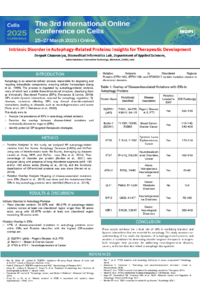
Autophagy is a crucial cellular process that maintains homeostasis by degrading and recycling intracellular components. A network of autophagy-related proteins orchestrates this process, many of which exhibit intrinsic disorder. Intrinsically disordered proteins (IDPs), lacking stable three-dimensional structures, possess structural flexibility, which enables dynamic interactions and diverse biological functions.
In this study, we analyzed 95 autophagy-related proteins from the Human Autophagy Database (HADb) and UniProt using sets of bioinformatics tools like ESpritz and leveraging datasets trained on X-ray, NMR, and DisProt. Our findings revealed that these proteins are significantly enriched with intrinsically disordered protein regions (IDPRs), particularly in key functional roles such as cargo recognition (e.g., SQSTM1, NBR1), autophagosome formation (e.g., ATG8, ATG12, WIPI1), and lysosomal degradation. Remarkably, proteins such as Beclin-1, LC3, and ATG9 exhibited high levels of intrinsic disorder, underscoring their critical regulatory roles.
The statistical analysis demonstrated that 80.21% of autophagy-related proteins contain at least one disordered region longer than 30 amino acids, and 65.97% have regions exceeding 50 amino acids. A total of 159 long disordered regions (greater than 30 amino acids) and 100 very long disordered regions (greater than 50 amino acids) were identified, emphasizing their functional relevance. Proteins like SPO95817 and SPP35638 showed extreme levels of disorder, with a mean percentage disorder above 90%, while others, such as SPP51809, exhibited minimal disorder, highlighting the variability within the autophagy-related proteome.
These results reinforce the critical role of IDPs in mediating transient and dynamic interactions that are essential for autophagy. This study advances our understanding of the molecular dynamics of autophagy-related proteins and provides a foundation for developing disorder-targeted therapeutic strategies. Such strategies hold potential for addressing neurodegenerative diseases, cancers, and other disorders linked to autophagic dysregulation.
Keywords
Autophagy
Autophagy-Related Proteins
Intrinsically disordered proteins
Poster
sciforum_115084_Session_H_slides_Autophagy_Deepak_IIITA.pdf
The role of the MICOS in modulating mitochondrial dynamics and structural changes in the brain
Design of a Nasal Prophylactic for Targeting SARS-CoV-2 Variants with B-escin and Nanoparticles