Event submissions
Published
This submission belongs to the session S1. Microbial Characterization and Bioprocess of the event The 3rd International Electronic Conference on Microbiology
Published date
31 Mar, 2025
Academic Editor
'%3e%3cpath%20d='M12.6657%2010.9104C12.4185%2010.325%2012.0599%209.79327%2011.6097%209.34482C11.1609%208.89508%2010.6293%208.5365%2010.0442%208.28888C10.0389%208.28626%2010.0337%208.28495%2010.0285%208.28233C10.8446%207.69279%2011.3752%206.73249%2011.3752%205.64904C11.3752%203.8542%209.92103%202.39999%208.1262%202.39999C6.33136%202.39999%204.87715%203.8542%204.87715%205.64904C4.87715%206.73249%205.40774%207.69279%206.22393%208.28364C6.21869%208.28626%206.21345%208.28757%206.20821%208.29019C5.62129%208.5378%205.09463%208.89284%204.64265%209.34613C4.1929%209.79493%203.83432%2010.3266%203.58671%2010.9117C3.34345%2011.4845%203.21226%2012.0987%203.20023%2012.7209C3.19988%2012.7349%203.20233%2012.7488%203.20744%2012.7619C3.21255%2012.7749%203.22022%2012.7867%203.22998%2012.7968C3.23975%2012.8068%203.25142%2012.8147%203.26431%2012.8202C3.2772%2012.8256%203.29105%2012.8284%203.30504%2012.8284H4.09109C4.14874%2012.8284%204.19459%2012.7825%204.1959%2012.7262C4.2221%2011.7148%204.62823%2010.7676%205.34617%2010.0497C6.08899%209.30683%207.0755%208.89808%208.1262%208.89808C9.17689%208.89808%2010.1634%209.30683%2010.9062%2010.0497C11.6242%2010.7676%2012.0303%2011.7148%2012.0565%2012.7262C12.0578%2012.7838%2012.1037%2012.8284%2012.1613%2012.8284H12.9474C12.9613%2012.8284%2012.9752%2012.8256%2012.9881%2012.8202C13.001%2012.8147%2013.0126%2012.8068%2013.0224%2012.7968C13.0322%2012.7867%2013.0398%2012.7749%2013.0449%2012.7619C13.0501%2012.7488%2013.0525%2012.7349%2013.0522%2012.7209C13.0391%2012.0947%2012.9094%2011.4855%2012.6657%2010.9104ZM8.1262%207.9024C7.52486%207.9024%206.9589%207.6679%206.53312%207.24211C6.10733%206.81633%205.87283%206.25037%205.87283%205.64904C5.87283%205.0477%206.10733%204.48174%206.53312%204.05596C6.9589%203.63018%207.52486%203.39567%208.1262%203.39567C8.72753%203.39567%209.29349%203.63018%209.71927%204.05596C10.1451%204.48174%2010.3796%205.0477%2010.3796%205.64904C10.3796%206.25037%2010.1451%206.81633%209.71927%207.24211C9.29349%207.6679%208.72753%207.9024%208.1262%207.9024Z'%20fill='%235D1EE1'/%3e%3c/g%3e%3c/svg%3e) Nico Jehmlich
Nico JehmlichCitation
Ana S.S. Sousa, Ana T. Oliveira, Paula M.L. Castro, Catarina L. Amorim, Meat Processing Wastewater Valorised through Microalgae Production, in Proceedings of The 3rd International Electronic Conference on Microbiology, 1 April–3 April 2025, MDPI: Basel, Switzerland
Share
Email
Facebook
Twitter
LinkedIn
Meat Processing Wastewater Valorised through Microalgae Production
'%3e%3cpath%20d='M12.6647%2010.9104C12.4176%2010.325%2012.0589%209.7933%2011.6088%209.34485C11.16%208.89511%2010.6283%208.53653%2010.0432%208.28891C10.038%208.28629%2010.0327%208.28498%2010.0275%208.28236C10.8437%207.69282%2011.3743%206.73252%2011.3743%205.64907C11.3743%203.85423%209.92005%202.40002%208.12522%202.40002C6.33038%202.40002%204.87618%203.85423%204.87618%205.64907C4.87618%206.73252%205.40677%207.69282%206.22296%208.28367C6.21772%208.28629%206.21248%208.2876%206.20724%208.29022C5.62031%208.53783%205.09365%208.89287%204.64167%209.34616C4.19192%209.79496%203.83334%2010.3266%203.58573%2010.9117C3.34247%2011.4846%203.21128%2012.0987%203.19925%2012.721C3.1989%2012.735%203.20135%2012.7489%203.20646%2012.7619C3.21157%2012.7749%203.21924%2012.7868%203.22901%2012.7968C3.23877%2012.8068%203.25045%2012.8148%203.26334%2012.8202C3.27623%2012.8256%203.29007%2012.8284%203.30406%2012.8284H4.09012C4.14776%2012.8284%204.19362%2012.7825%204.19493%2012.7262C4.22113%2011.7148%204.62726%2010.7676%205.34519%2010.0497C6.08802%209.30686%207.07452%208.89811%208.12522%208.89811C9.17592%208.89811%2010.1624%209.30686%2010.9052%2010.0497C11.6232%2010.7676%2012.0293%2011.7148%2012.0555%2012.7262C12.0568%2012.7839%2012.1027%2012.8284%2012.1603%2012.8284H12.9464C12.9604%2012.8284%2012.9742%2012.8256%2012.9871%2012.8202C13%2012.8148%2013.0117%2012.8068%2013.0214%2012.7968C13.0312%2012.7868%2013.0389%2012.7749%2013.044%2012.7619C13.0491%2012.7489%2013.0515%2012.735%2013.0512%2012.721C13.0381%2012.0947%2012.9084%2011.4856%2012.6647%2010.9104ZM8.12522%207.90243C7.52388%207.90243%206.95792%207.66793%206.53214%207.24215C6.10636%206.81636%205.87185%206.2504%205.87185%205.64907C5.87185%205.04773%206.10636%204.48177%206.53214%204.05599C6.95792%203.63021%207.52388%203.3957%208.12522%203.3957C8.72655%203.3957%209.29252%203.63021%209.7183%204.05599C10.1441%204.48177%2010.3786%205.04773%2010.3786%205.64907C10.3786%206.2504%2010.1441%206.81636%209.7183%207.24215C9.29252%207.66793%208.72655%207.90243%208.12522%207.90243Z'%20fill='%235D1EE1'/%3e%3c/g%3e%3c/svg%3e)
Ana S.S. Sousa 1

Ana T. Oliveira 1
Paula M.L. Castro 1

Catarina L. Amorim 1
1. Universidade Católica Portuguesa, CBQF - Centro de Biotecnologia e Química Fina – Laboratório Associado, Escola Superior de Biotecnologia, Porto, Portugal
Abstract
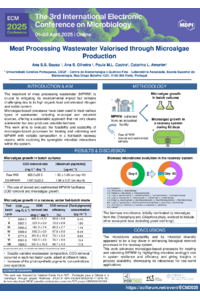
The treatment of meat processing wastewater (MPWW) is crucial to mitigating its environmental impact but remains challenging due to its high organic content and contents of nitrogen and solids.
The novelty of this work lies in evaluating the treatment and valorization of real MPWW with variable composition, as well as the process scalability, in a fed-batch raceway reactor while exploring the synergistic microbial interactions within the system. A microalgae-based consortium with proven bioremediation capacity was used as biomass. In batch assays, the microalgae-based biomass thrived in raw MPWW, demonstrating synergistic interactions with the native wastewater microbiome that facilitated organic carbon and total nitrogen removal. In sieved and sedimented MPWW, the COD removal rates were higher (1097.5±22.2 mg L⁻¹ day⁻¹) than in raw MPWW (828.5±60.5 mg L⁻¹ day⁻¹), and the microalgae growth rate also improved. In a laboratory-scale raceway reactor, in fed-batch mode, COD removal rates ranging from 181.3 to 806.3 mg L⁻¹ day⁻¹ were achieved, despite variable wastewater composition. The nitrogen mass balance indicated that ammonium, nitrate, and nitrite were consumed. The increase in photosynthetic pigments’ concentration throughout operation, from 0.4 to 17.9 µg mL⁻¹, demonstrated robust microalgae growth under variable wastewater compositions. The biomass microbiome, initially dominated by microalgae from the Chlorophyta and Ciliophora phyla, evolved to include other eukaryotic taxa (including yeast and fungi) and likely bacteria. The microbiome's adaptability and its microbial diversity appeared to be key drivers in enhancing biological removal processes.
This work advances microalgae-based processes for treating and valorising MPWW by highlighting microbial ecology’s role in system resilience and efficiency and giving insights in process scalability, showcasing its robustness for real-world applications.
Acknowledgments: This work was supported by National Funds from FCT—Fundação para a Ciência e a Tecnologia—through the project MobFood (POCI-01-0247-FEDER-024524/SI-47-2016-10). The authors thank the CBQF scientific collaboration under FCT project UIDB/50016/2020.
Keywords
Microalgae-based biomass
Wastewater treatment
Biomass production
Waste valorisation
Bioprocessing.
Poster
Sousa et al._IECM2025.pdf
Evaluating the Efficacy of Dielectric Barrier Discharge Plasma Against Planktonic and Biofilm Cultures of Staphylococcus aureus