Event submissions
Published
This submission belongs to the session S7. Microbe-Plant Interactions of the event The 3rd International Electronic Conference on Microbiology
Published date
31 Mar, 2025
Academic Editor
'%3e%3cpath%20d='M12.6657%2010.9104C12.4185%2010.325%2012.0599%209.79327%2011.6097%209.34482C11.1609%208.89508%2010.6293%208.5365%2010.0442%208.28888C10.0389%208.28626%2010.0337%208.28495%2010.0285%208.28233C10.8446%207.69279%2011.3752%206.73249%2011.3752%205.64904C11.3752%203.8542%209.92103%202.39999%208.1262%202.39999C6.33136%202.39999%204.87715%203.8542%204.87715%205.64904C4.87715%206.73249%205.40774%207.69279%206.22393%208.28364C6.21869%208.28626%206.21345%208.28757%206.20821%208.29019C5.62129%208.5378%205.09463%208.89284%204.64265%209.34613C4.1929%209.79493%203.83432%2010.3266%203.58671%2010.9117C3.34345%2011.4845%203.21226%2012.0987%203.20023%2012.7209C3.19988%2012.7349%203.20233%2012.7488%203.20744%2012.7619C3.21255%2012.7749%203.22022%2012.7867%203.22998%2012.7968C3.23975%2012.8068%203.25142%2012.8147%203.26431%2012.8202C3.2772%2012.8256%203.29105%2012.8284%203.30504%2012.8284H4.09109C4.14874%2012.8284%204.19459%2012.7825%204.1959%2012.7262C4.2221%2011.7148%204.62823%2010.7676%205.34617%2010.0497C6.08899%209.30683%207.0755%208.89808%208.1262%208.89808C9.17689%208.89808%2010.1634%209.30683%2010.9062%2010.0497C11.6242%2010.7676%2012.0303%2011.7148%2012.0565%2012.7262C12.0578%2012.7838%2012.1037%2012.8284%2012.1613%2012.8284H12.9474C12.9613%2012.8284%2012.9752%2012.8256%2012.9881%2012.8202C13.001%2012.8147%2013.0126%2012.8068%2013.0224%2012.7968C13.0322%2012.7867%2013.0398%2012.7749%2013.0449%2012.7619C13.0501%2012.7488%2013.0525%2012.7349%2013.0522%2012.7209C13.0391%2012.0947%2012.9094%2011.4855%2012.6657%2010.9104ZM8.1262%207.9024C7.52486%207.9024%206.9589%207.6679%206.53312%207.24211C6.10733%206.81633%205.87283%206.25037%205.87283%205.64904C5.87283%205.0477%206.10733%204.48174%206.53312%204.05596C6.9589%203.63018%207.52486%203.39567%208.1262%203.39567C8.72753%203.39567%209.29349%203.63018%209.71927%204.05596C10.1451%204.48174%2010.3796%205.0477%2010.3796%205.64904C10.3796%206.25037%2010.1451%206.81633%209.71927%207.24211C9.29349%207.6679%208.72753%207.9024%208.1262%207.9024Z'%20fill='%235D1EE1'/%3e%3c/g%3e%3c/svg%3e) Nico Jehmlich
Nico JehmlichCitation
Savanah Senn, Arianna Bozzolo, Brianna Zimmerman, PLFA Analysis of Soil Microbial Communities: Key Insights from Organic Artichoke Cropping Systems , in Proceedings of The 3rd International Electronic Conference on Microbiology, 1 April–3 April 2025, MDPI: Basel, Switzerland
Share
Email
Facebook
Twitter
LinkedIn
PLFA Analysis of Soil Microbial Communities: Key Insights from Organic Artichoke Cropping Systems
'%3e%3cpath%20d='M12.6647%2010.9104C12.4176%2010.325%2012.0589%209.7933%2011.6088%209.34485C11.16%208.89511%2010.6283%208.53653%2010.0432%208.28891C10.038%208.28629%2010.0327%208.28498%2010.0275%208.28236C10.8437%207.69282%2011.3743%206.73252%2011.3743%205.64907C11.3743%203.85423%209.92005%202.40002%208.12522%202.40002C6.33038%202.40002%204.87618%203.85423%204.87618%205.64907C4.87618%206.73252%205.40677%207.69282%206.22296%208.28367C6.21772%208.28629%206.21248%208.2876%206.20724%208.29022C5.62031%208.53783%205.09365%208.89287%204.64167%209.34616C4.19192%209.79496%203.83334%2010.3266%203.58573%2010.9117C3.34247%2011.4846%203.21128%2012.0987%203.19925%2012.721C3.1989%2012.735%203.20135%2012.7489%203.20646%2012.7619C3.21157%2012.7749%203.21924%2012.7868%203.22901%2012.7968C3.23877%2012.8068%203.25045%2012.8148%203.26334%2012.8202C3.27623%2012.8256%203.29007%2012.8284%203.30406%2012.8284H4.09012C4.14776%2012.8284%204.19362%2012.7825%204.19493%2012.7262C4.22113%2011.7148%204.62726%2010.7676%205.34519%2010.0497C6.08802%209.30686%207.07452%208.89811%208.12522%208.89811C9.17592%208.89811%2010.1624%209.30686%2010.9052%2010.0497C11.6232%2010.7676%2012.0293%2011.7148%2012.0555%2012.7262C12.0568%2012.7839%2012.1027%2012.8284%2012.1603%2012.8284H12.9464C12.9604%2012.8284%2012.9742%2012.8256%2012.9871%2012.8202C13%2012.8148%2013.0117%2012.8068%2013.0214%2012.7968C13.0312%2012.7868%2013.0389%2012.7749%2013.044%2012.7619C13.0491%2012.7489%2013.0515%2012.735%2013.0512%2012.721C13.0381%2012.0947%2012.9084%2011.4856%2012.6647%2010.9104ZM8.12522%207.90243C7.52388%207.90243%206.95792%207.66793%206.53214%207.24215C6.10636%206.81636%205.87185%206.2504%205.87185%205.64907C5.87185%205.04773%206.10636%204.48177%206.53214%204.05599C6.95792%203.63021%207.52388%203.3957%208.12522%203.3957C8.72655%203.3957%209.29252%203.63021%209.7183%204.05599C10.1441%204.48177%2010.3786%205.04773%2010.3786%205.64907C10.3786%206.2504%2010.1441%206.81636%209.7183%207.24215C9.29252%207.66793%208.72655%207.90243%208.12522%207.90243Z'%20fill='%235D1EE1'/%3e%3c/g%3e%3c/svg%3e)
Savanah Senn 1
Arianna Bozzolo 2
Brianna Zimmerman 1
1. Los Angeles Pierce College Department of Agriculture Sciences, Plant Science program, Woodland Hills, CA 91371
2. Rodale Organic Institute, California Organic Center, Camarillo, CA 93010
Abstract
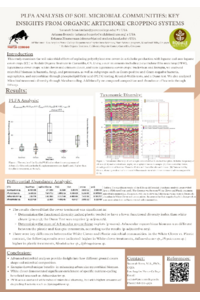
The effects of replacing polyethylene row covers in artichoke production with legume and non-legume cover crops were investigated at Rodale Organic Institute in Camarillo, CA. The treatments included plastic film mulching (PFM) and cover crops: Buckwheat, Kurapia, Crimson Clover, and White Clover with four replicates. While various studies have established the benefits of PFM versus bare soil and cover cropping versus bare soil in agriculture, few studies have directly compared plastic with legume and non-legume cover crops.
The phospholipid fatty acid (PLFA) test on soil provides a generalized community profile. Microbial biomass is measured; bacteria, fungi, and protozoans can be differentiated, along with subgroups such as Gram-positive and Gram-negative bacteria, saprophytes, and mycorrhizae. Functional Diversity Analysis is provided. The PLFA analysis was performed by Trace Genomics during year 2 post production. Kruskal–Wallis tests were performed for the response variables to determine if cover cropping treatments were comparable to the control. A positive Kruskal–Wallis Chi-square test was followed up with the Dunn test used for multiple comparisons between groups, using the Holm correction.
There was a trend toward the plastic treatment having the lowest total bacteria biomass, the lowest fungi–bacteria ratio, lower levels of saprophytes, and less total microbial biomass in the plastic treatment. The results showed that the treatment was significant in determining the functional diversity index; plastic tended to have a lower functional diversity index than white clover (p=0.015); the Dunn Test was negative (p-adj=0.076). The treatment was significant in determining the mass of Arbuscular mycorrhizae in plots (p=0.010). Arbuscular mycorrhizae biomass was different between the plastic and Kurapia treatments, according to the results (p-adjusted=0.023).
The main result of the PLFA analysis showed that Arbuscular mycorrhizae biomass was significantly higher in the Kurapia treatments than the plastic controls. These results, combined with soil fertility analysis, will inform growers on best practices in organic artichoke cropping.
Keywords
Mycorrhizae
Phospolipid Fatty Acids Test
Soil Microbes
Cover crops
Poster
PLFA ANALYSIS POSTER .pdf
Fungal Pathogenesis in Bovine (Bos Taurus indicus) Mastitis: Therapeutic Protocol With Ethno Veterinary Formulation
Gestational toxoplasmosis: An analysis of cases over the last 5 years in Brazil according to clinical evolution