Event submissions
Published
This submission belongs to the session S6. Microbiome and Soil Science of the event The 3rd International Electronic Conference on Microbiology
Published date
31 Mar, 2025
Academic Editor
'%3e%3cpath%20d='M12.6657%2010.9104C12.4185%2010.325%2012.0599%209.79327%2011.6097%209.34482C11.1609%208.89508%2010.6293%208.5365%2010.0442%208.28888C10.0389%208.28626%2010.0337%208.28495%2010.0285%208.28233C10.8446%207.69279%2011.3752%206.73249%2011.3752%205.64904C11.3752%203.8542%209.92103%202.39999%208.1262%202.39999C6.33136%202.39999%204.87715%203.8542%204.87715%205.64904C4.87715%206.73249%205.40774%207.69279%206.22393%208.28364C6.21869%208.28626%206.21345%208.28757%206.20821%208.29019C5.62129%208.5378%205.09463%208.89284%204.64265%209.34613C4.1929%209.79493%203.83432%2010.3266%203.58671%2010.9117C3.34345%2011.4845%203.21226%2012.0987%203.20023%2012.7209C3.19988%2012.7349%203.20233%2012.7488%203.20744%2012.7619C3.21255%2012.7749%203.22022%2012.7867%203.22998%2012.7968C3.23975%2012.8068%203.25142%2012.8147%203.26431%2012.8202C3.2772%2012.8256%203.29105%2012.8284%203.30504%2012.8284H4.09109C4.14874%2012.8284%204.19459%2012.7825%204.1959%2012.7262C4.2221%2011.7148%204.62823%2010.7676%205.34617%2010.0497C6.08899%209.30683%207.0755%208.89808%208.1262%208.89808C9.17689%208.89808%2010.1634%209.30683%2010.9062%2010.0497C11.6242%2010.7676%2012.0303%2011.7148%2012.0565%2012.7262C12.0578%2012.7838%2012.1037%2012.8284%2012.1613%2012.8284H12.9474C12.9613%2012.8284%2012.9752%2012.8256%2012.9881%2012.8202C13.001%2012.8147%2013.0126%2012.8068%2013.0224%2012.7968C13.0322%2012.7867%2013.0398%2012.7749%2013.0449%2012.7619C13.0501%2012.7488%2013.0525%2012.7349%2013.0522%2012.7209C13.0391%2012.0947%2012.9094%2011.4855%2012.6657%2010.9104ZM8.1262%207.9024C7.52486%207.9024%206.9589%207.6679%206.53312%207.24211C6.10733%206.81633%205.87283%206.25037%205.87283%205.64904C5.87283%205.0477%206.10733%204.48174%206.53312%204.05596C6.9589%203.63018%207.52486%203.39567%208.1262%203.39567C8.72753%203.39567%209.29349%203.63018%209.71927%204.05596C10.1451%204.48174%2010.3796%205.0477%2010.3796%205.64904C10.3796%206.25037%2010.1451%206.81633%209.71927%207.24211C9.29349%207.6679%208.72753%207.9024%208.1262%207.9024Z'%20fill='%235D1EE1'/%3e%3c/g%3e%3c/svg%3e) Nico Jehmlich
Nico JehmlichCitation
Laura Sala-Comorera, Pedro Blanco-Picazo, Gloria Vique, Pablo Quirós, María Dolores Ramos-Barbero, Clara Gómez-Gómez, Lorena Rodriguez-Rubio, Tula Yance-Chávez, Ignasi Salaet, Maite Muniesa, Phage-based biocontrol of nitrification in agricultural soil, in Proceedings of The 3rd International Electronic Conference on Microbiology, 1 April–3 April 2025, MDPI: Basel, Switzerland
Share
Email
Facebook
Twitter
LinkedIn
Phage-based biocontrol of nitrification in agricultural soil
'%3e%3cpath%20d='M12.6647%2010.9104C12.4176%2010.325%2012.0589%209.7933%2011.6088%209.34485C11.16%208.89511%2010.6283%208.53653%2010.0432%208.28891C10.038%208.28629%2010.0327%208.28498%2010.0275%208.28236C10.8437%207.69282%2011.3743%206.73252%2011.3743%205.64907C11.3743%203.85423%209.92005%202.40002%208.12522%202.40002C6.33038%202.40002%204.87618%203.85423%204.87618%205.64907C4.87618%206.73252%205.40677%207.69282%206.22296%208.28367C6.21772%208.28629%206.21248%208.2876%206.20724%208.29022C5.62031%208.53783%205.09365%208.89287%204.64167%209.34616C4.19192%209.79496%203.83334%2010.3266%203.58573%2010.9117C3.34247%2011.4846%203.21128%2012.0987%203.19925%2012.721C3.1989%2012.735%203.20135%2012.7489%203.20646%2012.7619C3.21157%2012.7749%203.21924%2012.7868%203.22901%2012.7968C3.23877%2012.8068%203.25045%2012.8148%203.26334%2012.8202C3.27623%2012.8256%203.29007%2012.8284%203.30406%2012.8284H4.09012C4.14776%2012.8284%204.19362%2012.7825%204.19493%2012.7262C4.22113%2011.7148%204.62726%2010.7676%205.34519%2010.0497C6.08802%209.30686%207.07452%208.89811%208.12522%208.89811C9.17592%208.89811%2010.1624%209.30686%2010.9052%2010.0497C11.6232%2010.7676%2012.0293%2011.7148%2012.0555%2012.7262C12.0568%2012.7839%2012.1027%2012.8284%2012.1603%2012.8284H12.9464C12.9604%2012.8284%2012.9742%2012.8256%2012.9871%2012.8202C13%2012.8148%2013.0117%2012.8068%2013.0214%2012.7968C13.0312%2012.7868%2013.0389%2012.7749%2013.044%2012.7619C13.0491%2012.7489%2013.0515%2012.735%2013.0512%2012.721C13.0381%2012.0947%2012.9084%2011.4856%2012.6647%2010.9104ZM8.12522%207.90243C7.52388%207.90243%206.95792%207.66793%206.53214%207.24215C6.10636%206.81636%205.87185%206.2504%205.87185%205.64907C5.87185%205.04773%206.10636%204.48177%206.53214%204.05599C6.95792%203.63021%207.52388%203.3957%208.12522%203.3957C8.72655%203.3957%209.29252%203.63021%209.7183%204.05599C10.1441%204.48177%2010.3786%205.04773%2010.3786%205.64907C10.3786%206.2504%2010.1441%206.81636%209.7183%207.24215C9.29252%207.66793%208.72655%207.90243%208.12522%207.90243Z'%20fill='%235D1EE1'/%3e%3c/g%3e%3c/svg%3e)
Laura Sala-Comorera 1
Pedro Blanco-Picazo 1
Gloria Vique 1
Pablo Quirós 2
María Dolores Ramos-Barbero 1
Clara Gómez-Gómez 1
Lorena Rodriguez-Rubio 1
Tula Yance-Chávez 2
Ignasi Salaet 2
Maite Muniesa 1
1. Departament de Genètica, Microbiologia i Estadística. Universitat de Barcelona
2. Departamento de I+D+i de Fertinagro Biotech S.L., Teruel, Spain
Abstract
Introduction
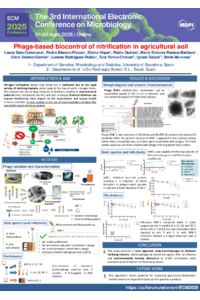
Nitrogen fertilization boosts crop yields but is inefficient due to the rapid activity of nitrifying bacteria, which leads to the loss of useful nitrogen forms. This requires the use of large amounts of fertilizers, leading to environmental pollution from compounds like NO₃ and N₂O. Although chemical inhibitors can improve fertilization, their impact on the environment and human health remains uncertain. A new strategy involves the use of bacteriophages (phages) that specifically target nitrifying bacteria.
Methods
Bacteriophages were isolated from sewage samples. The inhibition of nitrifying activity was tested in AOB medium and soil to monitor nitrite production with a colorimetric assay. The increase in bacteriophage particles during infection was assessed with qPCR. Controls without the addition of bacteriophages or bacteria were included for in vitro and soil samples. The persistence of infectious bacteriophages was analyzed in water suspensions and soil under different pH levels (3, 5, 6, 7, 8) and temperatures (4, 15, 22, 37 ◦C) over 6 months.
Results
We isolated a bacteriophage (FNF-1) capable of infecting four species of Nitrosomonas. FNF-1 inhibited bacterial growth, resulting in a reduction in nitrite formation in phage-treated samples, both in vitro and in the soil. Meanwhile, FNF-1 increased by 2-log10 units within 48 hours. Infectious FNF-1 remained stable in water suspensions for 6 months at 4, 15, 22, and 37 ◦C and at pHs 6, 7, and 8 but was inactivated when exposed to pHs 3 and 5. In soils, FNF-1 infectivity showed a 2-log10 reduction over 6 months.
Conclusions
This study presents a novel approach using bacteriophages to eliminate nitrifying bacteria. Bacteriophages as biocontrol agents offer an effective and environmentally friendly alternative to inhibit nitrification while overcoming the limitations of chemical products. While their application shows potential for improving agricultural fertilization, further research is required to scale up and optimize a product.
Keywords
nitrification
bacteriophages
ammonia-oxidizing bacteria
Nitrosomonas
biocontrol
Poster
ECM Congress sciforum-114742.pdf
Spectral Efficacy: The Role of UV-C Light Frequency in Viral Inactivation and Disinfection
Gut microbiota-supporting beverage: Kombucha’s activity against Gram-positive bacteria