Event submissions
Published
This submission belongs to the session S3. Antimicrobial Agents and Resistance of the event The 3rd International Electronic Conference on Microbiology
Published date
31 Mar, 2025
Academic Editor
'%3e%3cpath%20d='M12.6657%2010.9104C12.4185%2010.325%2012.0599%209.79327%2011.6097%209.34482C11.1609%208.89508%2010.6293%208.5365%2010.0442%208.28888C10.0389%208.28626%2010.0337%208.28495%2010.0285%208.28233C10.8446%207.69279%2011.3752%206.73249%2011.3752%205.64904C11.3752%203.8542%209.92103%202.39999%208.1262%202.39999C6.33136%202.39999%204.87715%203.8542%204.87715%205.64904C4.87715%206.73249%205.40774%207.69279%206.22393%208.28364C6.21869%208.28626%206.21345%208.28757%206.20821%208.29019C5.62129%208.5378%205.09463%208.89284%204.64265%209.34613C4.1929%209.79493%203.83432%2010.3266%203.58671%2010.9117C3.34345%2011.4845%203.21226%2012.0987%203.20023%2012.7209C3.19988%2012.7349%203.20233%2012.7488%203.20744%2012.7619C3.21255%2012.7749%203.22022%2012.7867%203.22998%2012.7968C3.23975%2012.8068%203.25142%2012.8147%203.26431%2012.8202C3.2772%2012.8256%203.29105%2012.8284%203.30504%2012.8284H4.09109C4.14874%2012.8284%204.19459%2012.7825%204.1959%2012.7262C4.2221%2011.7148%204.62823%2010.7676%205.34617%2010.0497C6.08899%209.30683%207.0755%208.89808%208.1262%208.89808C9.17689%208.89808%2010.1634%209.30683%2010.9062%2010.0497C11.6242%2010.7676%2012.0303%2011.7148%2012.0565%2012.7262C12.0578%2012.7838%2012.1037%2012.8284%2012.1613%2012.8284H12.9474C12.9613%2012.8284%2012.9752%2012.8256%2012.9881%2012.8202C13.001%2012.8147%2013.0126%2012.8068%2013.0224%2012.7968C13.0322%2012.7867%2013.0398%2012.7749%2013.0449%2012.7619C13.0501%2012.7488%2013.0525%2012.7349%2013.0522%2012.7209C13.0391%2012.0947%2012.9094%2011.4855%2012.6657%2010.9104ZM8.1262%207.9024C7.52486%207.9024%206.9589%207.6679%206.53312%207.24211C6.10733%206.81633%205.87283%206.25037%205.87283%205.64904C5.87283%205.0477%206.10733%204.48174%206.53312%204.05596C6.9589%203.63018%207.52486%203.39567%208.1262%203.39567C8.72753%203.39567%209.29349%203.63018%209.71927%204.05596C10.1451%204.48174%2010.3796%205.0477%2010.3796%205.64904C10.3796%206.25037%2010.1451%206.81633%209.71927%207.24211C9.29349%207.6679%208.72753%207.9024%208.1262%207.9024Z'%20fill='%235D1EE1'/%3e%3c/g%3e%3c/svg%3e) Nico Jehmlich
Nico JehmlichCitation
Gracielle Rodrigues Pereira, Marcelo Luiz Lima Brandão, Ana Beatriz Portes, Bernardete Ferraz Spisso, Extended-spectrum β-lactamase-encoding genes in the pig production chain in Brazil, in Proceedings of The 3rd International Electronic Conference on Microbiology, 1 April–3 April 2025, MDPI: Basel, Switzerland
Share
Email
Facebook
Twitter
LinkedIn
Extended-spectrum β-lactamase-encoding genes in the pig production chain in Brazil
'%3e%3cpath%20d='M12.6647%2010.9104C12.4176%2010.325%2012.0589%209.7933%2011.6088%209.34485C11.16%208.89511%2010.6283%208.53653%2010.0432%208.28891C10.038%208.28629%2010.0327%208.28498%2010.0275%208.28236C10.8437%207.69282%2011.3743%206.73252%2011.3743%205.64907C11.3743%203.85423%209.92005%202.40002%208.12522%202.40002C6.33038%202.40002%204.87618%203.85423%204.87618%205.64907C4.87618%206.73252%205.40677%207.69282%206.22296%208.28367C6.21772%208.28629%206.21248%208.2876%206.20724%208.29022C5.62031%208.53783%205.09365%208.89287%204.64167%209.34616C4.19192%209.79496%203.83334%2010.3266%203.58573%2010.9117C3.34247%2011.4846%203.21128%2012.0987%203.19925%2012.721C3.1989%2012.735%203.20135%2012.7489%203.20646%2012.7619C3.21157%2012.7749%203.21924%2012.7868%203.22901%2012.7968C3.23877%2012.8068%203.25045%2012.8148%203.26334%2012.8202C3.27623%2012.8256%203.29007%2012.8284%203.30406%2012.8284H4.09012C4.14776%2012.8284%204.19362%2012.7825%204.19493%2012.7262C4.22113%2011.7148%204.62726%2010.7676%205.34519%2010.0497C6.08802%209.30686%207.07452%208.89811%208.12522%208.89811C9.17592%208.89811%2010.1624%209.30686%2010.9052%2010.0497C11.6232%2010.7676%2012.0293%2011.7148%2012.0555%2012.7262C12.0568%2012.7839%2012.1027%2012.8284%2012.1603%2012.8284H12.9464C12.9604%2012.8284%2012.9742%2012.8256%2012.9871%2012.8202C13%2012.8148%2013.0117%2012.8068%2013.0214%2012.7968C13.0312%2012.7868%2013.0389%2012.7749%2013.044%2012.7619C13.0491%2012.7489%2013.0515%2012.735%2013.0512%2012.721C13.0381%2012.0947%2012.9084%2011.4856%2012.6647%2010.9104ZM8.12522%207.90243C7.52388%207.90243%206.95792%207.66793%206.53214%207.24215C6.10636%206.81636%205.87185%206.2504%205.87185%205.64907C5.87185%205.04773%206.10636%204.48177%206.53214%204.05599C6.95792%203.63021%207.52388%203.3957%208.12522%203.3957C8.72655%203.3957%209.29252%203.63021%209.7183%204.05599C10.1441%204.48177%2010.3786%205.04773%2010.3786%205.64907C10.3786%206.2504%2010.1441%206.81636%209.7183%207.24215C9.29252%207.66793%208.72655%207.90243%208.12522%207.90243Z'%20fill='%235D1EE1'/%3e%3c/g%3e%3c/svg%3e)
Gracielle Rodrigues Pereira 1
Marcelo Luiz Lima Brandão 2
Ana Beatriz Portes 3,4
Bernardete Ferraz Spisso 5
1. Oswaldo Cruz Foundation
2. Instituto de Tecnologia em Imunobiológicos/ Fundação Oswaldo Cruz (BioManguinhos/Fiocruz), Rio de Janeiro, Brazil
3. Instituto de Microbiologia Paulo de Góes/ Universidade Federal do Rio de Janeiro (IMPG/UFRJ), Rio de Janeiro, Brazil
4. Laboratory of Advanced Analysis in Biochemistry and Molecular Biology (LAABBM), Department of Biochemistry, Federal University of Rio de Janeiro (UFRJ), RJ, Brazil
5. Instituto Nacional de Controle de Qualidade em Saúde/ Fundação Oswaldo Cruz (INCQS/Fiocruz), Rio de Janeiro, Brazil
Abstract
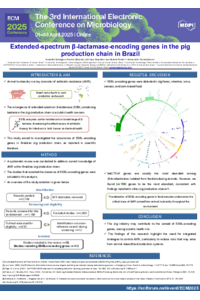
Animal husbandry is a key promoter of antibiotic resistance (AMR) and contributes to the spread of AMR genes throughout the environment and food supply. The pig industry is one of the leading sectors in animal-based food production worldwide, with Brazil ranking fourth in terms of pork production and export. The emergence of extended-spectrum β-lactamase (ESBL)-producing bacteria in this sector represents a significant public health concern. These enzymes confer resistance to a broad range of β-lactams, threatening the effectiveness of antibiotic therapy for infections in both humans and animals. A systematic review was conducted to address the current knowledge of AMR within the Brazilian pig production chain. The presence of ESBL-encoding genes in bacteria isolated from pig feces, intestine, carcass, and urine, as well as pork-based food, was investigated. TEM-type genes were detected in 11 of the 12 studies, including blaTEM-1A (n=33 strains) and blaTEM-1B (n=44 strains). Both genes were found in Salmonella isolated from all sample categories. Additionally, blaTEM-1 was detected in E. coli (n=4 strains from feces) and Salmonella spp. (n=2 from carcass; n=5 from feces). CTX-type genes were detected in Proteus mirabilis (blaCTX-M-65; n=6 from food) and Salmonella (blaCTX-M-8; n=1 from feces; n=1 from pig carcass). blaCMY-2 was detected in Salmonella from feces (n=1) and carcass (n=1), whereas blaCMY-M2 was detected in E. coli (n=5) from pig feces. blaPSE-1 and blaSHV-1 genes were investigated using PCR in E. coli strains isolated from pig feces; however, these were not detected. In conclusion, the pig industry may contribute to the spread of ESBL-encoding genes, posing a public health risk. Data reveal a significant presence of blaTEM genes across various samples, alongside other ESBL-encoding gene types in the Brazilian pig production chain. These findings highlight the need for integrated strategies to control AMR, particularly to reduce risks that may arise from animal -based food production systems.
Keywords
Antimicrobial resistance
ESBL
food safety
pork
Poster
Poster.pdf
Gut microbiota-supporting beverage: Kombucha’s activity against Gram-positive bacteria
Deciphering microbiome dynamics and antibiotic resistome profiles in anaerobic bioreactors treating swine wastewater containing different sulfonamides