Event submissions
Published
This submission belongs to the session S2. Gut Microbiota and Health Disease of the event The 3rd International Electronic Conference on Microbiology
Published date
31 Mar, 2025
Academic Editor
'%3e%3cpath%20d='M12.6657%2010.9104C12.4185%2010.325%2012.0599%209.79327%2011.6097%209.34482C11.1609%208.89508%2010.6293%208.5365%2010.0442%208.28888C10.0389%208.28626%2010.0337%208.28495%2010.0285%208.28233C10.8446%207.69279%2011.3752%206.73249%2011.3752%205.64904C11.3752%203.8542%209.92103%202.39999%208.1262%202.39999C6.33136%202.39999%204.87715%203.8542%204.87715%205.64904C4.87715%206.73249%205.40774%207.69279%206.22393%208.28364C6.21869%208.28626%206.21345%208.28757%206.20821%208.29019C5.62129%208.5378%205.09463%208.89284%204.64265%209.34613C4.1929%209.79493%203.83432%2010.3266%203.58671%2010.9117C3.34345%2011.4845%203.21226%2012.0987%203.20023%2012.7209C3.19988%2012.7349%203.20233%2012.7488%203.20744%2012.7619C3.21255%2012.7749%203.22022%2012.7867%203.22998%2012.7968C3.23975%2012.8068%203.25142%2012.8147%203.26431%2012.8202C3.2772%2012.8256%203.29105%2012.8284%203.30504%2012.8284H4.09109C4.14874%2012.8284%204.19459%2012.7825%204.1959%2012.7262C4.2221%2011.7148%204.62823%2010.7676%205.34617%2010.0497C6.08899%209.30683%207.0755%208.89808%208.1262%208.89808C9.17689%208.89808%2010.1634%209.30683%2010.9062%2010.0497C11.6242%2010.7676%2012.0303%2011.7148%2012.0565%2012.7262C12.0578%2012.7838%2012.1037%2012.8284%2012.1613%2012.8284H12.9474C12.9613%2012.8284%2012.9752%2012.8256%2012.9881%2012.8202C13.001%2012.8147%2013.0126%2012.8068%2013.0224%2012.7968C13.0322%2012.7867%2013.0398%2012.7749%2013.0449%2012.7619C13.0501%2012.7488%2013.0525%2012.7349%2013.0522%2012.7209C13.0391%2012.0947%2012.9094%2011.4855%2012.6657%2010.9104ZM8.1262%207.9024C7.52486%207.9024%206.9589%207.6679%206.53312%207.24211C6.10733%206.81633%205.87283%206.25037%205.87283%205.64904C5.87283%205.0477%206.10733%204.48174%206.53312%204.05596C6.9589%203.63018%207.52486%203.39567%208.1262%203.39567C8.72753%203.39567%209.29349%203.63018%209.71927%204.05596C10.1451%204.48174%2010.3796%205.0477%2010.3796%205.64904C10.3796%206.25037%2010.1451%206.81633%209.71927%207.24211C9.29349%207.6679%208.72753%207.9024%208.1262%207.9024Z'%20fill='%235D1EE1'/%3e%3c/g%3e%3c/svg%3e) Ionut Spatar
Ionut SpatarCitation
Joana Monteiro Marques, Nicolau Fialho, Maria do Mar Duarte, Maria Teresa Barreto Crespo, Teresa Semedo-Lemsaddek, Dissemination of Enterococcus spp. across One Health Settings: Insights from fingerprinting analysis, in Proceedings of The 3rd International Electronic Conference on Microbiology, 1 April–3 April 2025, MDPI: Basel, Switzerland
Share
Email
Facebook
Twitter
LinkedIn
Dissemination of Enterococcus spp. across One Health Settings: Insights from fingerprinting analysis
'%3e%3cpath%20d='M12.6647%2010.9104C12.4176%2010.325%2012.0589%209.7933%2011.6088%209.34485C11.16%208.89511%2010.6283%208.53653%2010.0432%208.28891C10.038%208.28629%2010.0327%208.28498%2010.0275%208.28236C10.8437%207.69282%2011.3743%206.73252%2011.3743%205.64907C11.3743%203.85423%209.92005%202.40002%208.12522%202.40002C6.33038%202.40002%204.87618%203.85423%204.87618%205.64907C4.87618%206.73252%205.40677%207.69282%206.22296%208.28367C6.21772%208.28629%206.21248%208.2876%206.20724%208.29022C5.62031%208.53783%205.09365%208.89287%204.64167%209.34616C4.19192%209.79496%203.83334%2010.3266%203.58573%2010.9117C3.34247%2011.4846%203.21128%2012.0987%203.19925%2012.721C3.1989%2012.735%203.20135%2012.7489%203.20646%2012.7619C3.21157%2012.7749%203.21924%2012.7868%203.22901%2012.7968C3.23877%2012.8068%203.25045%2012.8148%203.26334%2012.8202C3.27623%2012.8256%203.29007%2012.8284%203.30406%2012.8284H4.09012C4.14776%2012.8284%204.19362%2012.7825%204.19493%2012.7262C4.22113%2011.7148%204.62726%2010.7676%205.34519%2010.0497C6.08802%209.30686%207.07452%208.89811%208.12522%208.89811C9.17592%208.89811%2010.1624%209.30686%2010.9052%2010.0497C11.6232%2010.7676%2012.0293%2011.7148%2012.0555%2012.7262C12.0568%2012.7839%2012.1027%2012.8284%2012.1603%2012.8284H12.9464C12.9604%2012.8284%2012.9742%2012.8256%2012.9871%2012.8202C13%2012.8148%2013.0117%2012.8068%2013.0214%2012.7968C13.0312%2012.7868%2013.0389%2012.7749%2013.044%2012.7619C13.0491%2012.7489%2013.0515%2012.735%2013.0512%2012.721C13.0381%2012.0947%2012.9084%2011.4856%2012.6647%2010.9104ZM8.12522%207.90243C7.52388%207.90243%206.95792%207.66793%206.53214%207.24215C6.10636%206.81636%205.87185%206.2504%205.87185%205.64907C5.87185%205.04773%206.10636%204.48177%206.53214%204.05599C6.95792%203.63021%207.52388%203.3957%208.12522%203.3957C8.72655%203.3957%209.29252%203.63021%209.7183%204.05599C10.1441%204.48177%2010.3786%205.04773%2010.3786%205.64907C10.3786%206.2504%2010.1441%206.81636%209.7183%207.24215C9.29252%207.66793%208.72655%207.90243%208.12522%207.90243Z'%20fill='%235D1EE1'/%3e%3c/g%3e%3c/svg%3e)
Joana Monteiro Marques 1,2
Nicolau Fialho 1,2
Maria do Mar Duarte 1,2
Maria Teresa Barreto Crespo 3,4

Teresa Semedo-Lemsaddek 1,2
1. Centre for Interdisciplinary Research in Animal Health (CIISA), Faculty of Veterinary Medicine, University of Lisbon, Av. da Universidade Técnica de Lisboa, 1300-477 Lisbon, Portugal
2. Associate Laboratory for Animal and Veterinary Sciences (AL4AnimalS), 1300-477 Lisbon, Portugal
3. iBET - Institute of Experimental Biology and Technology, 2781-901 Oeiras, Portugal
4. ITQB NOVA – Instituto de Tecnologia Química e Biológica António Xavier, Universidade Nova de Lisboa, Avenida da República, 2780-157 Oeiras, Portugal
Abstract
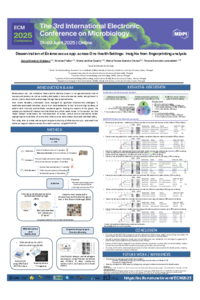
Enterococcus spp. are ubiquitous Gram-positive bacteria present in the gastrointestinal tract of humans and animals, as well as in various environmental niches. Over recent decades, Enterococcus spp. have emerged as significant opportunistic pathogens in healthcare-associated infections, with vancomycin-resistant E. faecium identified as a critical health threat. In this context, the One Health concept underscores the interconnection of human, animal, and environmental health, highlighting the importance of intervention fields such as antimicrobial resistance and food safety.
This study aimed to isolate and analyse the genetic diversity of enterococci from a diverse range of samples across One Health domains: sick (n=18) and healthy (n=17) humans, sick (n=13) and healthy (n=14) animals, canteen food (n=11), public transportation surfaces (n=8), and surface water (n=8). Samples were cultured on enterococci-selective media, with and without vancomycin supplementation. Approximately 20% of characteristic colonies were selected and confirmed at the genus level, followed by DNA extraction and RAPD-PCR using primers OPC15 and GTG5 in independent reactions. Amplification analysis and dendrogram construction were performed using the BioNumerics software to obtain relationship patterns within and across One Health sectors.
A total of 148 isolates were obtained from selective media, comprising 81 environmental, 27 animal-, and 35 human-derived isolates, including 24 from vancomycin-supplemented media. Overall, no distinct clustering by sample type or One Health sector was observed, suggesting the widespread dissemination of genetically diverse enterococci across these settings. However, isolates from surface water and clinical samples showed high genetic similarity (≥80–95%), with some clinical clusters also containing isolates from healthy humans.
These findings confirm the widespread dissemination of enterococci across One Health sectors, including presumptive vancomycin-resistant enterococci, and underscore the need for further biosurveillance studies.
Keywords
Enterococcus
fingerprinting
One Health
dissemination
Poster
Poster_ECM_2025_vf.pdf
The role of personalized nutrition to modulate gut microbiota for disease prevention
Surge in Dengue Cases in Rio Grande do Sul in 2024: Epidemiological Trends and Contributing Factors