Event submissions
Published
This submission belongs to the session S3. Antimicrobial Agents and Resistance of the event The 3rd International Electronic Conference on Microbiology
Published date
31 Mar, 2025
Academic Editor
'%3e%3cpath%20d='M12.6657%2010.9104C12.4185%2010.325%2012.0599%209.79327%2011.6097%209.34482C11.1609%208.89508%2010.6293%208.5365%2010.0442%208.28888C10.0389%208.28626%2010.0337%208.28495%2010.0285%208.28233C10.8446%207.69279%2011.3752%206.73249%2011.3752%205.64904C11.3752%203.8542%209.92103%202.39999%208.1262%202.39999C6.33136%202.39999%204.87715%203.8542%204.87715%205.64904C4.87715%206.73249%205.40774%207.69279%206.22393%208.28364C6.21869%208.28626%206.21345%208.28757%206.20821%208.29019C5.62129%208.5378%205.09463%208.89284%204.64265%209.34613C4.1929%209.79493%203.83432%2010.3266%203.58671%2010.9117C3.34345%2011.4845%203.21226%2012.0987%203.20023%2012.7209C3.19988%2012.7349%203.20233%2012.7488%203.20744%2012.7619C3.21255%2012.7749%203.22022%2012.7867%203.22998%2012.7968C3.23975%2012.8068%203.25142%2012.8147%203.26431%2012.8202C3.2772%2012.8256%203.29105%2012.8284%203.30504%2012.8284H4.09109C4.14874%2012.8284%204.19459%2012.7825%204.1959%2012.7262C4.2221%2011.7148%204.62823%2010.7676%205.34617%2010.0497C6.08899%209.30683%207.0755%208.89808%208.1262%208.89808C9.17689%208.89808%2010.1634%209.30683%2010.9062%2010.0497C11.6242%2010.7676%2012.0303%2011.7148%2012.0565%2012.7262C12.0578%2012.7838%2012.1037%2012.8284%2012.1613%2012.8284H12.9474C12.9613%2012.8284%2012.9752%2012.8256%2012.9881%2012.8202C13.001%2012.8147%2013.0126%2012.8068%2013.0224%2012.7968C13.0322%2012.7867%2013.0398%2012.7749%2013.0449%2012.7619C13.0501%2012.7488%2013.0525%2012.7349%2013.0522%2012.7209C13.0391%2012.0947%2012.9094%2011.4855%2012.6657%2010.9104ZM8.1262%207.9024C7.52486%207.9024%206.9589%207.6679%206.53312%207.24211C6.10733%206.81633%205.87283%206.25037%205.87283%205.64904C5.87283%205.0477%206.10733%204.48174%206.53312%204.05596C6.9589%203.63018%207.52486%203.39567%208.1262%203.39567C8.72753%203.39567%209.29349%203.63018%209.71927%204.05596C10.1451%204.48174%2010.3796%205.0477%2010.3796%205.64904C10.3796%206.25037%2010.1451%206.81633%209.71927%207.24211C9.29349%207.6679%208.72753%207.9024%208.1262%207.9024Z'%20fill='%235D1EE1'/%3e%3c/g%3e%3c/svg%3e) Nico Jehmlich
Nico JehmlichCitation
Elkadaoui Soukaina, Study of the antimicrobial activity of chitosan from insects against Gram-positive and Gram-negative bacteria, in Proceedings of The 3rd International Electronic Conference on Microbiology, 1 April–3 April 2025, MDPI: Basel, Switzerland
Share
Email
Facebook
Twitter
LinkedIn
Study of the antimicrobial activity of chitosan from insects against Gram-positive and Gram-negative bacteria

Elkadaoui Soukaina 1,2
1. Interdisciplinary Research Laboratory in Bioresources Environment and Materials (LIRBEM), ENS, Cadi Ayyad University, Hay Hassani, 40000 Marrakech, Morocco
2. Bioresource and Food Safety Laboratory, Faculty of Sciences and Technologies, Cadi Ayyad University, 112 Boulevard Abdelkrim Al Khattabi, 40000 Marrakech, Morocco
Abstract
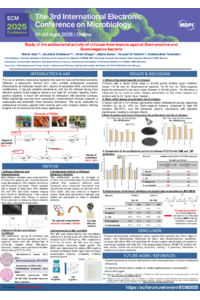
This work studies the antibacterial activity of chitosans prepared with controlled physicochemical characteristics against Gram-positive and Gram-negative reference bacteria. The optimal conditions in acetic acid and chitosan concentration were determined, and the disk diffusion method was used to evaluate the antimicrobial activity. All prepared chitosans, P CHTs, show an inhibition zone that varies between 14mm and 18mm depending on the strain and the physicochemical characteristics of the chitosan (degree of acetylation, DA; molar mass, Mv; and surface structure). These chitosans demonstrate enhanced antibacterial activity compared to the tested commercial chitosans, C CHTs. The effect of DA is particularly interesting. P CHTs exhibit significantly better antibacterial activity than C CHTs, especially against Gram-negative bacteria, where the improvement can reach 100%. Totally deacetylated chitosan (DA=0%) provided the highest inhibition diameter and the lowest MIC/MBC values. Also, PCHTs with Mv>80000 g/mol showed relatively high antimicrobial activity compared to Mv< 20000 g/mol. Interference of the surface structure with the effects of other parameters (Mv, DA, and strain) was observed. The antibacterial activity of the prepared chitosan (DA=0%) against E. faecalis was improved by 21% and 6% compared to Gentamicin and Ciprofloxacin. For the other bacteria, this chitosan provides 68 to 86% of the activity of Gentamicin and 49 to 80% of that of Ciprofloxacin.
Keywords
chitosan
bacteria
antibacterial activity
Degree of acetylation DA
Molar mass Mv,surface structure
Poster
poster conference.pdf
Surge in Dengue Cases in Rio Grande do Sul in 2024: Epidemiological Trends and Contributing Factors
Proteomic Insights into Bacterial Endophyte Responses to Chickpea Root Exudates Highlight the Role of GacS