Event submissions
Published
This submission belongs to the session S3. Antimicrobial Agents and Resistance of the event The 3rd International Electronic Conference on Microbiology
Published date
31 Mar, 2025
Academic Editor
'%3e%3cpath%20d='M12.6657%2010.9104C12.4185%2010.325%2012.0599%209.79327%2011.6097%209.34482C11.1609%208.89508%2010.6293%208.5365%2010.0442%208.28888C10.0389%208.28626%2010.0337%208.28495%2010.0285%208.28233C10.8446%207.69279%2011.3752%206.73249%2011.3752%205.64904C11.3752%203.8542%209.92103%202.39999%208.1262%202.39999C6.33136%202.39999%204.87715%203.8542%204.87715%205.64904C4.87715%206.73249%205.40774%207.69279%206.22393%208.28364C6.21869%208.28626%206.21345%208.28757%206.20821%208.29019C5.62129%208.5378%205.09463%208.89284%204.64265%209.34613C4.1929%209.79493%203.83432%2010.3266%203.58671%2010.9117C3.34345%2011.4845%203.21226%2012.0987%203.20023%2012.7209C3.19988%2012.7349%203.20233%2012.7488%203.20744%2012.7619C3.21255%2012.7749%203.22022%2012.7867%203.22998%2012.7968C3.23975%2012.8068%203.25142%2012.8147%203.26431%2012.8202C3.2772%2012.8256%203.29105%2012.8284%203.30504%2012.8284H4.09109C4.14874%2012.8284%204.19459%2012.7825%204.1959%2012.7262C4.2221%2011.7148%204.62823%2010.7676%205.34617%2010.0497C6.08899%209.30683%207.0755%208.89808%208.1262%208.89808C9.17689%208.89808%2010.1634%209.30683%2010.9062%2010.0497C11.6242%2010.7676%2012.0303%2011.7148%2012.0565%2012.7262C12.0578%2012.7838%2012.1037%2012.8284%2012.1613%2012.8284H12.9474C12.9613%2012.8284%2012.9752%2012.8256%2012.9881%2012.8202C13.001%2012.8147%2013.0126%2012.8068%2013.0224%2012.7968C13.0322%2012.7867%2013.0398%2012.7749%2013.0449%2012.7619C13.0501%2012.7488%2013.0525%2012.7349%2013.0522%2012.7209C13.0391%2012.0947%2012.9094%2011.4855%2012.6657%2010.9104ZM8.1262%207.9024C7.52486%207.9024%206.9589%207.6679%206.53312%207.24211C6.10733%206.81633%205.87283%206.25037%205.87283%205.64904C5.87283%205.0477%206.10733%204.48174%206.53312%204.05596C6.9589%203.63018%207.52486%203.39567%208.1262%203.39567C8.72753%203.39567%209.29349%203.63018%209.71927%204.05596C10.1451%204.48174%2010.3796%205.0477%2010.3796%205.64904C10.3796%206.25037%2010.1451%206.81633%209.71927%207.24211C9.29349%207.6679%208.72753%207.9024%208.1262%207.9024Z'%20fill='%235D1EE1'/%3e%3c/g%3e%3c/svg%3e) Nico Jehmlich
Nico JehmlichCitation
Maruping Hoffman Frost, Khumiso Dithebe, Elbert Jansen Van Rensburg, Raymond Makola, Isolation of fungal endophytes from Monsonia angustifolia and screening for their antimicrobial and extracellular enzymatic activities, in Proceedings of The 3rd International Electronic Conference on Microbiology, 1 April–3 April 2025, MDPI: Basel, Switzerland
Share
Email
Facebook
Twitter
LinkedIn
Isolation of fungal endophytes from Monsonia angustifolia and screening for their antimicrobial and extracellular enzymatic activities
'%3e%3cpath%20d='M12.6647%2010.9104C12.4176%2010.325%2012.0589%209.7933%2011.6088%209.34485C11.16%208.89511%2010.6283%208.53653%2010.0432%208.28891C10.038%208.28629%2010.0327%208.28498%2010.0275%208.28236C10.8437%207.69282%2011.3743%206.73252%2011.3743%205.64907C11.3743%203.85423%209.92005%202.40002%208.12522%202.40002C6.33038%202.40002%204.87618%203.85423%204.87618%205.64907C4.87618%206.73252%205.40677%207.69282%206.22296%208.28367C6.21772%208.28629%206.21248%208.2876%206.20724%208.29022C5.62031%208.53783%205.09365%208.89287%204.64167%209.34616C4.19192%209.79496%203.83334%2010.3266%203.58573%2010.9117C3.34247%2011.4846%203.21128%2012.0987%203.19925%2012.721C3.1989%2012.735%203.20135%2012.7489%203.20646%2012.7619C3.21157%2012.7749%203.21924%2012.7868%203.22901%2012.7968C3.23877%2012.8068%203.25045%2012.8148%203.26334%2012.8202C3.27623%2012.8256%203.29007%2012.8284%203.30406%2012.8284H4.09012C4.14776%2012.8284%204.19362%2012.7825%204.19493%2012.7262C4.22113%2011.7148%204.62726%2010.7676%205.34519%2010.0497C6.08802%209.30686%207.07452%208.89811%208.12522%208.89811C9.17592%208.89811%2010.1624%209.30686%2010.9052%2010.0497C11.6232%2010.7676%2012.0293%2011.7148%2012.0555%2012.7262C12.0568%2012.7839%2012.1027%2012.8284%2012.1603%2012.8284H12.9464C12.9604%2012.8284%2012.9742%2012.8256%2012.9871%2012.8202C13%2012.8148%2013.0117%2012.8068%2013.0214%2012.7968C13.0312%2012.7868%2013.0389%2012.7749%2013.044%2012.7619C13.0491%2012.7489%2013.0515%2012.735%2013.0512%2012.721C13.0381%2012.0947%2012.9084%2011.4856%2012.6647%2010.9104ZM8.12522%207.90243C7.52388%207.90243%206.95792%207.66793%206.53214%207.24215C6.10636%206.81636%205.87185%206.2504%205.87185%205.64907C5.87185%205.04773%206.10636%204.48177%206.53214%204.05599C6.95792%203.63021%207.52388%203.3957%208.12522%203.3957C8.72655%203.3957%209.29252%203.63021%209.7183%204.05599C10.1441%204.48177%2010.3786%205.04773%2010.3786%205.64907C10.3786%206.2504%2010.1441%206.81636%209.7183%207.24215C9.29252%207.66793%208.72655%207.90243%208.12522%207.90243Z'%20fill='%235D1EE1'/%3e%3c/g%3e%3c/svg%3e)
Maruping Hoffman Frost 1
Khumiso Dithebe 1
Elbert Jansen Van Rensburg 1
Raymond Makola 1
1. Department of Biochemistry Microbiology and Biotechnology, University of Limpopo, Private Bag X1106, Sovenga, 0727, South Africa
Abstract
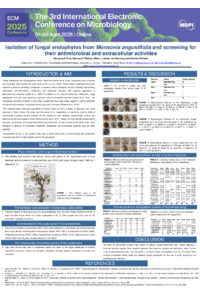
Endophytes reside in healthy plant tissue without causing visible harm. Fungal endophytes produce structurally and chemically diverse secondary metabolites, including those similar to the host plant, with antimicrobial and anti-inflammatory activities. Fungal endophytes also produce various extracellular enzymes with applications in various industries including the pharmaceutical industry. Despite this knowledge, the diversity and bioactivities of fungal endophytes of South African medicinal plants are relatively underexplored. Thus, the aim of this study was to isolate fungal endophytes from the medicinal plant Monsonia angustifolia and evaluate their antimicrobial and extracellular enzymatic activities. A total of 29 morphologically distinct fungal endophytes with 21 isolates related to filamentous fungi and 8 to yeasts were isolated from the surface-sterilised leaves, stems and spikes. The majority of the isolates (59%) were obtained from the stems. The sequencing of the internal transcribed spacer region revealed that all the filamentous fungi and four yeast isolates belonged to the Phylum Ascomycota, while the other four yeast isolates reside with Basidiomycota. The broth micro-dilution assay revealed that the ethyl acetate crude extracts of the endophytes possessed varying inhibitory activity, with minimum inhibitory concentrations ranging from 0.02 to 2.50 mg/mL against six clinically significant pathogens. Agar-plate screening for amylase, cellulase, laccase, lipase, pectinase, protease and xylanase enzymes revealed that the isolates had the ability to produce at least one of the tested enzymes, with four filamentous fungi exhibiting the ability to produce all the screened enzymes. This study highlights the significance of fungal endophytes as sources of antimicrobial secondary metabolites and industrially significant enzymes.
Keywords
Fungal endophytes
yeast endophytes
antimicrobial activity
extracellular enzymes
Monsonia angustifolia
Poster
Frost MH-Isolation of fungal endophytes from Monsonia angustifolia and screening for their antimicrobial and extracellular activities .pdf
Targeting the Resistant F533L Mutant in PBP3 of Pseudomonas aeruginosa: A Computational Approach Using ZnO and CuO Nanoparticles.
The use of metal ions as potential inhibitors of ferrochelatase