Event submissions
Published
This submission belongs to the session S4. Emerging Infectious Diseases of the event The 3rd International Electronic Conference on Microbiology
Published date
31 Mar, 2025
Academic Editor
'%3e%3cpath%20d='M12.6657%2010.9104C12.4185%2010.325%2012.0599%209.79327%2011.6097%209.34482C11.1609%208.89508%2010.6293%208.5365%2010.0442%208.28888C10.0389%208.28626%2010.0337%208.28495%2010.0285%208.28233C10.8446%207.69279%2011.3752%206.73249%2011.3752%205.64904C11.3752%203.8542%209.92103%202.39999%208.1262%202.39999C6.33136%202.39999%204.87715%203.8542%204.87715%205.64904C4.87715%206.73249%205.40774%207.69279%206.22393%208.28364C6.21869%208.28626%206.21345%208.28757%206.20821%208.29019C5.62129%208.5378%205.09463%208.89284%204.64265%209.34613C4.1929%209.79493%203.83432%2010.3266%203.58671%2010.9117C3.34345%2011.4845%203.21226%2012.0987%203.20023%2012.7209C3.19988%2012.7349%203.20233%2012.7488%203.20744%2012.7619C3.21255%2012.7749%203.22022%2012.7867%203.22998%2012.7968C3.23975%2012.8068%203.25142%2012.8147%203.26431%2012.8202C3.2772%2012.8256%203.29105%2012.8284%203.30504%2012.8284H4.09109C4.14874%2012.8284%204.19459%2012.7825%204.1959%2012.7262C4.2221%2011.7148%204.62823%2010.7676%205.34617%2010.0497C6.08899%209.30683%207.0755%208.89808%208.1262%208.89808C9.17689%208.89808%2010.1634%209.30683%2010.9062%2010.0497C11.6242%2010.7676%2012.0303%2011.7148%2012.0565%2012.7262C12.0578%2012.7838%2012.1037%2012.8284%2012.1613%2012.8284H12.9474C12.9613%2012.8284%2012.9752%2012.8256%2012.9881%2012.8202C13.001%2012.8147%2013.0126%2012.8068%2013.0224%2012.7968C13.0322%2012.7867%2013.0398%2012.7749%2013.0449%2012.7619C13.0501%2012.7488%2013.0525%2012.7349%2013.0522%2012.7209C13.0391%2012.0947%2012.9094%2011.4855%2012.6657%2010.9104ZM8.1262%207.9024C7.52486%207.9024%206.9589%207.6679%206.53312%207.24211C6.10733%206.81633%205.87283%206.25037%205.87283%205.64904C5.87283%205.0477%206.10733%204.48174%206.53312%204.05596C6.9589%203.63018%207.52486%203.39567%208.1262%203.39567C8.72753%203.39567%209.29349%203.63018%209.71927%204.05596C10.1451%204.48174%2010.3796%205.0477%2010.3796%205.64904C10.3796%206.25037%2010.1451%206.81633%209.71927%207.24211C9.29349%207.6679%208.72753%207.9024%208.1262%207.9024Z'%20fill='%235D1EE1'/%3e%3c/g%3e%3c/svg%3e) Nico Jehmlich
Nico JehmlichCitation
Maria Fernanda Valentim De Paula, Pedro Henrique Paesi Dutra, Gabriela Gerevini Dal Alba, Camilly Vitória Cansan Loss, “Influence of Non-Treatment of Partners on the Rate of Congenital Syphilis: A Comparative Analysis between Demographic Regions of Brazil (2014-2024)”, in Proceedings of The 3rd International Electronic Conference on Microbiology, 1 April–3 April 2025, MDPI: Basel, Switzerland
Share
Email
Facebook
Twitter
LinkedIn
“Influence of Non-Treatment of Partners on the Rate of Congenital Syphilis: A Comparative Analysis between Demographic Regions of Brazil (2014-2024)”
'%3e%3cpath%20d='M12.6647%2010.9104C12.4176%2010.325%2012.0589%209.7933%2011.6088%209.34485C11.16%208.89511%2010.6283%208.53653%2010.0432%208.28891C10.038%208.28629%2010.0327%208.28498%2010.0275%208.28236C10.8437%207.69282%2011.3743%206.73252%2011.3743%205.64907C11.3743%203.85423%209.92005%202.40002%208.12522%202.40002C6.33038%202.40002%204.87618%203.85423%204.87618%205.64907C4.87618%206.73252%205.40677%207.69282%206.22296%208.28367C6.21772%208.28629%206.21248%208.2876%206.20724%208.29022C5.62031%208.53783%205.09365%208.89287%204.64167%209.34616C4.19192%209.79496%203.83334%2010.3266%203.58573%2010.9117C3.34247%2011.4846%203.21128%2012.0987%203.19925%2012.721C3.1989%2012.735%203.20135%2012.7489%203.20646%2012.7619C3.21157%2012.7749%203.21924%2012.7868%203.22901%2012.7968C3.23877%2012.8068%203.25045%2012.8148%203.26334%2012.8202C3.27623%2012.8256%203.29007%2012.8284%203.30406%2012.8284H4.09012C4.14776%2012.8284%204.19362%2012.7825%204.19493%2012.7262C4.22113%2011.7148%204.62726%2010.7676%205.34519%2010.0497C6.08802%209.30686%207.07452%208.89811%208.12522%208.89811C9.17592%208.89811%2010.1624%209.30686%2010.9052%2010.0497C11.6232%2010.7676%2012.0293%2011.7148%2012.0555%2012.7262C12.0568%2012.7839%2012.1027%2012.8284%2012.1603%2012.8284H12.9464C12.9604%2012.8284%2012.9742%2012.8256%2012.9871%2012.8202C13%2012.8148%2013.0117%2012.8068%2013.0214%2012.7968C13.0312%2012.7868%2013.0389%2012.7749%2013.044%2012.7619C13.0491%2012.7489%2013.0515%2012.735%2013.0512%2012.721C13.0381%2012.0947%2012.9084%2011.4856%2012.6647%2010.9104ZM8.12522%207.90243C7.52388%207.90243%206.95792%207.66793%206.53214%207.24215C6.10636%206.81636%205.87185%206.2504%205.87185%205.64907C5.87185%205.04773%206.10636%204.48177%206.53214%204.05599C6.95792%203.63021%207.52388%203.3957%208.12522%203.3957C8.72655%203.3957%209.29252%203.63021%209.7183%204.05599C10.1441%204.48177%2010.3786%205.04773%2010.3786%205.64907C10.3786%206.2504%2010.1441%206.81636%209.7183%207.24215C9.29252%207.66793%208.72655%207.90243%208.12522%207.90243Z'%20fill='%235D1EE1'/%3e%3c/g%3e%3c/svg%3e)
Maria Fernanda Valentim De Paula 1
Pedro Henrique Paesi Dutra 1
Gabriela Gerevini Dal Alba 1
Camilly Vitória Cansan Loss 1
1. Academic of Medicine, School of Medicine Federal University of Health Sciences of Porto Alegre (UFCSPA), Porto Alegre, 90050-170, Brazil
Abstract
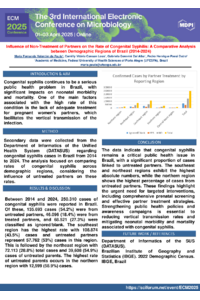
Introduction: Congenital syphilis continues to be a serious public health problem in Brazil, with significant impacts on neonatal morbidity and mortality. One of the main factors associated with the high rate of this condition is the lack of adequate treatment for pregnant women's partners, which facilitates the vertical transmission of the infection.
Methods: Secondary data were collected from the Department of Informatics of the Unified Health System (DATASUS) regarding congenital syphilis cases in Brazil from 2014 to 2024. The analysis focused on comparing rates of congenital syphilis across demographic regions, considering the influence of untreated partners on these rates.
Results: Between 2014 and 2024, 250.310 cases of congenital syphilis were reported in Brazil. Of these, 135.693 cases (54.2%) were from untreated partners, 46.096 (18.4%) were from treated partners, and 68.521 (27.3%) were classified as ignored/blank. The southeast region has the highest rate with 108.874 (43.5%) cases and untreated partners represent 57.762 (53%) cases in this region. This is followed by the northeast region with 72.113 (28.8%) total cases and 39,608 (54.9%) cases of untreated parents. The highest rate of untreated parents occurs in the northern region with 12,599 (58.9%) cases.
Conclusions: The data indicate that congenital syphilis remains a critical public health issue in Brazil, with a significant proportion of cases linked to untreated partners. The southeast and northeast regions exhibit the highest absolute numbers, while the northern region shows the highest percentage of cases from untreated partners. These findings highlight the urgent need for targeted interventions, including comprehensive prenatal screening and effective partner treatment strategies. Strengthening public health policies and awareness campaigns is essential to reducing vertical transmission rates and mitigating neonatal morbidity and mortality associated with congenital syphilis.
Keywords
Congenital syphilis
Vertical transmission
Public health interventions
Poster
E-POSTER MICROBIO.pdf
Celery (Apium graveolens) seed extracts: A natural and effective strategy against Helicobacter pylori infection.
Epidemiological Profile of Gestational Syphilis Cases in Brazil Between 2020 and 2023: Insights for Public Health Improvement