Event submissions
Published
This submission belongs to the session S4. Emerging Infectious Diseases of the event The 3rd International Electronic Conference on Microbiology
Published date
31 Mar, 2025
Academic Editor
'%3e%3cpath%20d='M12.6657%2010.9104C12.4185%2010.325%2012.0599%209.79327%2011.6097%209.34482C11.1609%208.89508%2010.6293%208.5365%2010.0442%208.28888C10.0389%208.28626%2010.0337%208.28495%2010.0285%208.28233C10.8446%207.69279%2011.3752%206.73249%2011.3752%205.64904C11.3752%203.8542%209.92103%202.39999%208.1262%202.39999C6.33136%202.39999%204.87715%203.8542%204.87715%205.64904C4.87715%206.73249%205.40774%207.69279%206.22393%208.28364C6.21869%208.28626%206.21345%208.28757%206.20821%208.29019C5.62129%208.5378%205.09463%208.89284%204.64265%209.34613C4.1929%209.79493%203.83432%2010.3266%203.58671%2010.9117C3.34345%2011.4845%203.21226%2012.0987%203.20023%2012.7209C3.19988%2012.7349%203.20233%2012.7488%203.20744%2012.7619C3.21255%2012.7749%203.22022%2012.7867%203.22998%2012.7968C3.23975%2012.8068%203.25142%2012.8147%203.26431%2012.8202C3.2772%2012.8256%203.29105%2012.8284%203.30504%2012.8284H4.09109C4.14874%2012.8284%204.19459%2012.7825%204.1959%2012.7262C4.2221%2011.7148%204.62823%2010.7676%205.34617%2010.0497C6.08899%209.30683%207.0755%208.89808%208.1262%208.89808C9.17689%208.89808%2010.1634%209.30683%2010.9062%2010.0497C11.6242%2010.7676%2012.0303%2011.7148%2012.0565%2012.7262C12.0578%2012.7838%2012.1037%2012.8284%2012.1613%2012.8284H12.9474C12.9613%2012.8284%2012.9752%2012.8256%2012.9881%2012.8202C13.001%2012.8147%2013.0126%2012.8068%2013.0224%2012.7968C13.0322%2012.7867%2013.0398%2012.7749%2013.0449%2012.7619C13.0501%2012.7488%2013.0525%2012.7349%2013.0522%2012.7209C13.0391%2012.0947%2012.9094%2011.4855%2012.6657%2010.9104ZM8.1262%207.9024C7.52486%207.9024%206.9589%207.6679%206.53312%207.24211C6.10733%206.81633%205.87283%206.25037%205.87283%205.64904C5.87283%205.0477%206.10733%204.48174%206.53312%204.05596C6.9589%203.63018%207.52486%203.39567%208.1262%203.39567C8.72753%203.39567%209.29349%203.63018%209.71927%204.05596C10.1451%204.48174%2010.3796%205.0477%2010.3796%205.64904C10.3796%206.25037%2010.1451%206.81633%209.71927%207.24211C9.29349%207.6679%208.72753%207.9024%208.1262%207.9024Z'%20fill='%235D1EE1'/%3e%3c/g%3e%3c/svg%3e) Nico Jehmlich
Nico JehmlichCitation
Enrico Lázaro Guidugli, Letícia De Paula e Souza, Theodora Garcia Furtado, Pedro Henrique Paesi Dutra, Demographic analysis of Zika virus cases in Brazil from 2020 to 2024, in Proceedings of The 3rd International Electronic Conference on Microbiology, 1 April–3 April 2025, MDPI: Basel, Switzerland
Share
Email
Facebook
Twitter
LinkedIn
Demographic analysis of Zika virus cases in Brazil from 2020 to 2024
'%3e%3cpath%20d='M12.6647%2010.9104C12.4176%2010.325%2012.0589%209.7933%2011.6088%209.34485C11.16%208.89511%2010.6283%208.53653%2010.0432%208.28891C10.038%208.28629%2010.0327%208.28498%2010.0275%208.28236C10.8437%207.69282%2011.3743%206.73252%2011.3743%205.64907C11.3743%203.85423%209.92005%202.40002%208.12522%202.40002C6.33038%202.40002%204.87618%203.85423%204.87618%205.64907C4.87618%206.73252%205.40677%207.69282%206.22296%208.28367C6.21772%208.28629%206.21248%208.2876%206.20724%208.29022C5.62031%208.53783%205.09365%208.89287%204.64167%209.34616C4.19192%209.79496%203.83334%2010.3266%203.58573%2010.9117C3.34247%2011.4846%203.21128%2012.0987%203.19925%2012.721C3.1989%2012.735%203.20135%2012.7489%203.20646%2012.7619C3.21157%2012.7749%203.21924%2012.7868%203.22901%2012.7968C3.23877%2012.8068%203.25045%2012.8148%203.26334%2012.8202C3.27623%2012.8256%203.29007%2012.8284%203.30406%2012.8284H4.09012C4.14776%2012.8284%204.19362%2012.7825%204.19493%2012.7262C4.22113%2011.7148%204.62726%2010.7676%205.34519%2010.0497C6.08802%209.30686%207.07452%208.89811%208.12522%208.89811C9.17592%208.89811%2010.1624%209.30686%2010.9052%2010.0497C11.6232%2010.7676%2012.0293%2011.7148%2012.0555%2012.7262C12.0568%2012.7839%2012.1027%2012.8284%2012.1603%2012.8284H12.9464C12.9604%2012.8284%2012.9742%2012.8256%2012.9871%2012.8202C13%2012.8148%2013.0117%2012.8068%2013.0214%2012.7968C13.0312%2012.7868%2013.0389%2012.7749%2013.044%2012.7619C13.0491%2012.7489%2013.0515%2012.735%2013.0512%2012.721C13.0381%2012.0947%2012.9084%2011.4856%2012.6647%2010.9104ZM8.12522%207.90243C7.52388%207.90243%206.95792%207.66793%206.53214%207.24215C6.10636%206.81636%205.87185%206.2504%205.87185%205.64907C5.87185%205.04773%206.10636%204.48177%206.53214%204.05599C6.95792%203.63021%207.52388%203.3957%208.12522%203.3957C8.72655%203.3957%209.29252%203.63021%209.7183%204.05599C10.1441%204.48177%2010.3786%205.04773%2010.3786%205.64907C10.3786%206.2504%2010.1441%206.81636%209.7183%207.24215C9.29252%207.66793%208.72655%207.90243%208.12522%207.90243Z'%20fill='%235D1EE1'/%3e%3c/g%3e%3c/svg%3e)
Enrico Lázaro Guidugli 1
Letícia De Paula e Souza 2
Theodora Garcia Furtado 1
Pedro Henrique Paesi Dutra 1
1. Academic of Medicine, School of Medicine, Federal University of Health Sciences of Porto Alegre (UFCSPA), Porto Alegre, 90050-170, Brazil
2. Academic of Medicine, School of Medicine, Federal University of Rio Grande do Sul (UFRGS), Porto Alegre, 90035-003, Brazil
Abstract
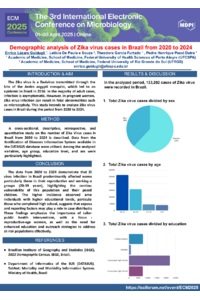
Introduction: The Zika virus is a flavivirus transmitted through the bite of the Aedes aegypti mosquito, which led to an epidemic in Brazil in 2016. In the majority of adult cases, infection is asymptomatic. However, in pregnant women, Zika virus infection can result in fetal abnormalities such as microcephaly. This study intends to analyze Zika virus cases in Brazil during the period from 2020 to 2024. Methods: A cross-sectional, descriptive, retrospective, and quantitative study on the number of Zika Virus cases in Brazil from 2020 to 2024 is described. Data from the Notification of Diseases Information System available in the DATASUS database were utilized. Among the analyzed variables, age group, education level, and sex were particularly highlighted. Results: In the analyzed period, 133,202 cases were recorded, with women being the most affected, accounting for 62% of the cases. Regarding age, the highest number of registered cases (52,423) was in the 20-39 years age group, followed by the 40-59 age group, computing 31,412 cases. Furthermore, illiterate people recorded the lowest incidence of Zika (1,077), as the highest incidence was recorded in the group that completed high school (22,030). Conclusions: The data from 2020 to 2024 demonstrate that Zika virus infection in Brazil predominantly affected women, particularly those in their reproductive and working-age groups (20-39 years), highlighting the continued vulnerability of this population and their possible children. The higher incidence observed among individuals with higher educational levels, particularly those who completed high school, suggests that exposure and reporting factors may play a role in case distribution. These findings emphasize the importance of tailored public health interventions, with a focus on reproductive-age women, as well as the need for enhanced education and outreach strategies to address at-risk populations effectively.
Keywords
Zika
Brazil
pregnancy
Poster
Poster.pdf
Epidemiological Profile of Gestational Syphilis Cases in Brazil Between 2020 and 2023: Insights for Public Health Improvement
Impact of the 2024 Floods on the Increase in Leptospirosis Cases in the City of Canoas, Southern Brazil: A Comparison with 2023