Event submissions
Published
This submission belongs to the session S3. Antimicrobial Agents and Resistance of the event The 3rd International Electronic Conference on Microbiology
Published date
31 Mar, 2025
Academic Editor
'%3e%3cpath%20d='M12.6657%2010.9104C12.4185%2010.325%2012.0599%209.79327%2011.6097%209.34482C11.1609%208.89508%2010.6293%208.5365%2010.0442%208.28888C10.0389%208.28626%2010.0337%208.28495%2010.0285%208.28233C10.8446%207.69279%2011.3752%206.73249%2011.3752%205.64904C11.3752%203.8542%209.92103%202.39999%208.1262%202.39999C6.33136%202.39999%204.87715%203.8542%204.87715%205.64904C4.87715%206.73249%205.40774%207.69279%206.22393%208.28364C6.21869%208.28626%206.21345%208.28757%206.20821%208.29019C5.62129%208.5378%205.09463%208.89284%204.64265%209.34613C4.1929%209.79493%203.83432%2010.3266%203.58671%2010.9117C3.34345%2011.4845%203.21226%2012.0987%203.20023%2012.7209C3.19988%2012.7349%203.20233%2012.7488%203.20744%2012.7619C3.21255%2012.7749%203.22022%2012.7867%203.22998%2012.7968C3.23975%2012.8068%203.25142%2012.8147%203.26431%2012.8202C3.2772%2012.8256%203.29105%2012.8284%203.30504%2012.8284H4.09109C4.14874%2012.8284%204.19459%2012.7825%204.1959%2012.7262C4.2221%2011.7148%204.62823%2010.7676%205.34617%2010.0497C6.08899%209.30683%207.0755%208.89808%208.1262%208.89808C9.17689%208.89808%2010.1634%209.30683%2010.9062%2010.0497C11.6242%2010.7676%2012.0303%2011.7148%2012.0565%2012.7262C12.0578%2012.7838%2012.1037%2012.8284%2012.1613%2012.8284H12.9474C12.9613%2012.8284%2012.9752%2012.8256%2012.9881%2012.8202C13.001%2012.8147%2013.0126%2012.8068%2013.0224%2012.7968C13.0322%2012.7867%2013.0398%2012.7749%2013.0449%2012.7619C13.0501%2012.7488%2013.0525%2012.7349%2013.0522%2012.7209C13.0391%2012.0947%2012.9094%2011.4855%2012.6657%2010.9104ZM8.1262%207.9024C7.52486%207.9024%206.9589%207.6679%206.53312%207.24211C6.10733%206.81633%205.87283%206.25037%205.87283%205.64904C5.87283%205.0477%206.10733%204.48174%206.53312%204.05596C6.9589%203.63018%207.52486%203.39567%208.1262%203.39567C8.72753%203.39567%209.29349%203.63018%209.71927%204.05596C10.1451%204.48174%2010.3796%205.0477%2010.3796%205.64904C10.3796%206.25037%2010.1451%206.81633%209.71927%207.24211C9.29349%207.6679%208.72753%207.9024%208.1262%207.9024Z'%20fill='%235D1EE1'/%3e%3c/g%3e%3c/svg%3e) Nico Jehmlich
Nico JehmlichCitation
Amina RESSMI, Habiba RAQRAQ, RAFIQ ANIBA, ASMAA DIHMANE, NABILA SORAA, Abouddihaj BARGUIGUA, From Desert to Lab: Evaluating Camel Urine’s Antibacterial Efficacy Against Carbapenem-Resistant Gram-Negative Bacilli, in Proceedings of The 3rd International Electronic Conference on Microbiology, 1 April–3 April 2025, MDPI: Basel, Switzerland
Share
Email
Facebook
Twitter
LinkedIn
From Desert to Lab: Evaluating Camel Urine’s Antibacterial Efficacy Against Carbapenem-Resistant Gram-Negative Bacilli
'%3e%3cpath%20d='M12.6647%2010.9104C12.4176%2010.325%2012.0589%209.7933%2011.6088%209.34485C11.16%208.89511%2010.6283%208.53653%2010.0432%208.28891C10.038%208.28629%2010.0327%208.28498%2010.0275%208.28236C10.8437%207.69282%2011.3743%206.73252%2011.3743%205.64907C11.3743%203.85423%209.92005%202.40002%208.12522%202.40002C6.33038%202.40002%204.87618%203.85423%204.87618%205.64907C4.87618%206.73252%205.40677%207.69282%206.22296%208.28367C6.21772%208.28629%206.21248%208.2876%206.20724%208.29022C5.62031%208.53783%205.09365%208.89287%204.64167%209.34616C4.19192%209.79496%203.83334%2010.3266%203.58573%2010.9117C3.34247%2011.4846%203.21128%2012.0987%203.19925%2012.721C3.1989%2012.735%203.20135%2012.7489%203.20646%2012.7619C3.21157%2012.7749%203.21924%2012.7868%203.22901%2012.7968C3.23877%2012.8068%203.25045%2012.8148%203.26334%2012.8202C3.27623%2012.8256%203.29007%2012.8284%203.30406%2012.8284H4.09012C4.14776%2012.8284%204.19362%2012.7825%204.19493%2012.7262C4.22113%2011.7148%204.62726%2010.7676%205.34519%2010.0497C6.08802%209.30686%207.07452%208.89811%208.12522%208.89811C9.17592%208.89811%2010.1624%209.30686%2010.9052%2010.0497C11.6232%2010.7676%2012.0293%2011.7148%2012.0555%2012.7262C12.0568%2012.7839%2012.1027%2012.8284%2012.1603%2012.8284H12.9464C12.9604%2012.8284%2012.9742%2012.8256%2012.9871%2012.8202C13%2012.8148%2013.0117%2012.8068%2013.0214%2012.7968C13.0312%2012.7868%2013.0389%2012.7749%2013.044%2012.7619C13.0491%2012.7489%2013.0515%2012.735%2013.0512%2012.721C13.0381%2012.0947%2012.9084%2011.4856%2012.6647%2010.9104ZM8.12522%207.90243C7.52388%207.90243%206.95792%207.66793%206.53214%207.24215C6.10636%206.81636%205.87185%206.2504%205.87185%205.64907C5.87185%205.04773%206.10636%204.48177%206.53214%204.05599C6.95792%203.63021%207.52388%203.3957%208.12522%203.3957C8.72655%203.3957%209.29252%203.63021%209.7183%204.05599C10.1441%204.48177%2010.3786%205.04773%2010.3786%205.64907C10.3786%206.2504%2010.1441%206.81636%209.7183%207.24215C9.29252%207.66793%208.72655%207.90243%208.12522%207.90243Z'%20fill='%235D1EE1'/%3e%3c/g%3e%3c/svg%3e)
Amina RESSMI 1
Habiba RAQRAQ 1
RAFIQ ANIBA 1
ASMAA DIHMANE 1
NABILA SORAA 2
Abouddihaj BARGUIGUA 1
1. Team of Biotechnology and Sustainable Development of Natural Resources, Biology-Geology Department, Polydisciplinary Faculty, Sultan Moulay Slimane University, Beni Mellal 23023, Morocco
2. Faculty of Medicine and Pharmacy of Marrakech Cadi Ayyad University, Microbiology Department, Mohamed VI University Hospital Center, Marrakech, 40000, Morocco
Abstract
Antimicrobial resistance currently contributes to over seven million deaths annually worldwide, and that number is projected to rise to ten million by 2050. The increasing prevalence of multidrug-resistant (MDR) bacteria, compounded by the widespread misuse of antibiotics, underscores the urgent need for alternative treatment strategies. Natural products, including camel urine, are emerging as promising candidates to combat this growing public health crisis. By exploring these alternative agents, we may be able to effectively address multidrug resistance and improve global health outcomes.
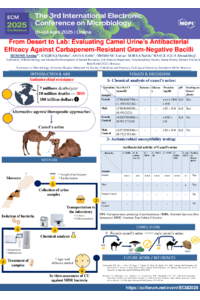
Using the well diffusion method, sterilized camel urine from male and female camels was tested against eight multidrug-resistant bacterial strains isolated from clinical samples. The strains were first identified through phenotypic characterization on selective media, followed by confirmation using MALDI-TOF mass spectrometry and the BD Phoenix system.
Our findings revealed that female camel urine exhibited a stronger antibacterial effect than male camel urine. Specifically, the largest inhibition zones were observed on Mueller–Hinton agar, with diameters of 32 mm for NDM-1-producing Enterobacter cloacae, 30 mm for NDM-1-producing Klebsiella oxytoca, 29 mm for VIM-producing Acinetobacter baumannii and Citrobacter freundii, 25 mm for OXA-48-producing Pseudomonas aeruginosa and Escherichia coli, and 22 mm for NDM-1-producing Klebsiella pneumoniae. The minimal inhibitory concentration (MIC) and minimum bactericidal concentration (MBC) values were ranging from 0.08 to 12.5mg/l and from 0.8 to 25 mg/l, respectively.
This investigation demonstrated that sterilized female camel urine exhibits significant in vitro antibacterial activity against various carbapenem-resistant bacteria isolated from clinical samples which may serve as a promising source of new compounds to combat bacterial infections.
Keywords
Camel urine
antibacterials
Carbapenem-Resistant bacteria
antibiotic resistance
Poster
RESSMI Amina Poster the 3rd international electronic conference of microbiology MDPI.pdf
Increase in Dengue Cases in Rio Grande do Sul in 2024 and Its Relation to Floods
Development of new tools for sustainable management olive trees crop