Event submissions
Published
This submission belongs to the session S1. Microbial Characterization and Bioprocess of the event The 3rd International Electronic Conference on Microbiology
Published date
31 Mar, 2025
Academic Editor
'%3e%3cpath%20d='M12.6657%2010.9104C12.4185%2010.325%2012.0599%209.79327%2011.6097%209.34482C11.1609%208.89508%2010.6293%208.5365%2010.0442%208.28888C10.0389%208.28626%2010.0337%208.28495%2010.0285%208.28233C10.8446%207.69279%2011.3752%206.73249%2011.3752%205.64904C11.3752%203.8542%209.92103%202.39999%208.1262%202.39999C6.33136%202.39999%204.87715%203.8542%204.87715%205.64904C4.87715%206.73249%205.40774%207.69279%206.22393%208.28364C6.21869%208.28626%206.21345%208.28757%206.20821%208.29019C5.62129%208.5378%205.09463%208.89284%204.64265%209.34613C4.1929%209.79493%203.83432%2010.3266%203.58671%2010.9117C3.34345%2011.4845%203.21226%2012.0987%203.20023%2012.7209C3.19988%2012.7349%203.20233%2012.7488%203.20744%2012.7619C3.21255%2012.7749%203.22022%2012.7867%203.22998%2012.7968C3.23975%2012.8068%203.25142%2012.8147%203.26431%2012.8202C3.2772%2012.8256%203.29105%2012.8284%203.30504%2012.8284H4.09109C4.14874%2012.8284%204.19459%2012.7825%204.1959%2012.7262C4.2221%2011.7148%204.62823%2010.7676%205.34617%2010.0497C6.08899%209.30683%207.0755%208.89808%208.1262%208.89808C9.17689%208.89808%2010.1634%209.30683%2010.9062%2010.0497C11.6242%2010.7676%2012.0303%2011.7148%2012.0565%2012.7262C12.0578%2012.7838%2012.1037%2012.8284%2012.1613%2012.8284H12.9474C12.9613%2012.8284%2012.9752%2012.8256%2012.9881%2012.8202C13.001%2012.8147%2013.0126%2012.8068%2013.0224%2012.7968C13.0322%2012.7867%2013.0398%2012.7749%2013.0449%2012.7619C13.0501%2012.7488%2013.0525%2012.7349%2013.0522%2012.7209C13.0391%2012.0947%2012.9094%2011.4855%2012.6657%2010.9104ZM8.1262%207.9024C7.52486%207.9024%206.9589%207.6679%206.53312%207.24211C6.10733%206.81633%205.87283%206.25037%205.87283%205.64904C5.87283%205.0477%206.10733%204.48174%206.53312%204.05596C6.9589%203.63018%207.52486%203.39567%208.1262%203.39567C8.72753%203.39567%209.29349%203.63018%209.71927%204.05596C10.1451%204.48174%2010.3796%205.0477%2010.3796%205.64904C10.3796%206.25037%2010.1451%206.81633%209.71927%207.24211C9.29349%207.6679%208.72753%207.9024%208.1262%207.9024Z'%20fill='%235D1EE1'/%3e%3c/g%3e%3c/svg%3e) Laurent Dufossé
Laurent DufosséCitation
Clara Izquierdo Jiménez, Cecilia Recuero García, Sergi Maicas Prieto, Inmaculada del Castillo Madrigal, Development of new tools for sustainable management olive trees crop, in Proceedings of The 3rd International Electronic Conference on Microbiology, 1 April–3 April 2025, MDPI: Basel, Switzerland
Share
Email
Facebook
Twitter
LinkedIn
Development of new tools for sustainable management olive trees crop

Clara Izquierdo Jiménez 1
'%3e%3cpath%20d='M12.6647%2010.9104C12.4176%2010.325%2012.0589%209.7933%2011.6088%209.34485C11.16%208.89511%2010.6283%208.53653%2010.0432%208.28891C10.038%208.28629%2010.0327%208.28498%2010.0275%208.28236C10.8437%207.69282%2011.3743%206.73252%2011.3743%205.64907C11.3743%203.85423%209.92005%202.40002%208.12522%202.40002C6.33038%202.40002%204.87618%203.85423%204.87618%205.64907C4.87618%206.73252%205.40677%207.69282%206.22296%208.28367C6.21772%208.28629%206.21248%208.2876%206.20724%208.29022C5.62031%208.53783%205.09365%208.89287%204.64167%209.34616C4.19192%209.79496%203.83334%2010.3266%203.58573%2010.9117C3.34247%2011.4846%203.21128%2012.0987%203.19925%2012.721C3.1989%2012.735%203.20135%2012.7489%203.20646%2012.7619C3.21157%2012.7749%203.21924%2012.7868%203.22901%2012.7968C3.23877%2012.8068%203.25045%2012.8148%203.26334%2012.8202C3.27623%2012.8256%203.29007%2012.8284%203.30406%2012.8284H4.09012C4.14776%2012.8284%204.19362%2012.7825%204.19493%2012.7262C4.22113%2011.7148%204.62726%2010.7676%205.34519%2010.0497C6.08802%209.30686%207.07452%208.89811%208.12522%208.89811C9.17592%208.89811%2010.1624%209.30686%2010.9052%2010.0497C11.6232%2010.7676%2012.0293%2011.7148%2012.0555%2012.7262C12.0568%2012.7839%2012.1027%2012.8284%2012.1603%2012.8284H12.9464C12.9604%2012.8284%2012.9742%2012.8256%2012.9871%2012.8202C13%2012.8148%2013.0117%2012.8068%2013.0214%2012.7968C13.0312%2012.7868%2013.0389%2012.7749%2013.044%2012.7619C13.0491%2012.7489%2013.0515%2012.735%2013.0512%2012.721C13.0381%2012.0947%2012.9084%2011.4856%2012.6647%2010.9104ZM8.12522%207.90243C7.52388%207.90243%206.95792%207.66793%206.53214%207.24215C6.10636%206.81636%205.87185%206.2504%205.87185%205.64907C5.87185%205.04773%206.10636%204.48177%206.53214%204.05599C6.95792%203.63021%207.52388%203.3957%208.12522%203.3957C8.72655%203.3957%209.29252%203.63021%209.7183%204.05599C10.1441%204.48177%2010.3786%205.04773%2010.3786%205.64907C10.3786%206.2504%2010.1441%206.81636%209.7183%207.24215C9.29252%207.66793%208.72655%207.90243%208.12522%207.90243Z'%20fill='%235D1EE1'/%3e%3c/g%3e%3c/svg%3e)
Cecilia Recuero García 1

Sergi Maicas Prieto 2
Inmaculada del Castillo Madrigal 1
1. R&B Department; Microbiology Area; SEIPASA. L’Alcúdia (Valencia). 46250. Spain
2. Department of Microbiology and Ecology; Faculty of Biological Sciences, Universitat de València
Abstract
1. Introduction
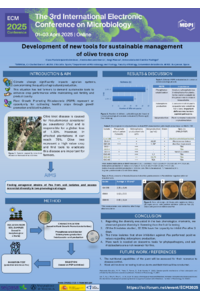
Climate change significantly impacts agrarian systems, compromising the quality of agricultural production. This situation has led farmers to demand sustainable tools to enhance crop performance while maintaining soil fertility and product quality. Microorganisms capable of interact with plants represent an opportunity for cultivating healthy crops through growth promotion and biostimulation. Numerous studies point to native microbiomes in agricultural soils as a primary source of well-adapted microorganisms to develop new tools for crop treatment. This study was focused on the olive tree, a high-value Mediterranean crop. Microbial diversity was analyzed at two different phenological stages of the crop and both, the growth promotion and inhibitory capability against phytopathogens of isolated microorganisms were also evaluated.
2. Material and methods
A metagenomic analysis was performed using high-throughput sequencing. Additionally, culturable microorganisms were selected based on morphological criteria. Diversity data, combining molecular analysis and variability on isolated microorganisms, were studied to determine the effect of the crop stage on the soil microbiome structure.
The isolated strains were characterized for their plant growth-promoting properties (PGPR), such as nitrogen fixation, phosphate solubilization, siderophores, and phytohormones production, to identify and select candidates to be used for the development of biotechnological tools.
3. Results
The number of morphotypes isolated during the fruit development stage was twice that obtained during the flowering stage. This increment is associated with greater root activity and the presence of exudates richer in organic compounds. Furthermore, microorganisms with remarkable PGPR characteristics were found, granting their strong potential as biocontrol and biofertilization agents.
4. Conclusions
This study demonstrates that soil is a valuable reservoir of microorganisms, that can be used to create bio-tools fos sustainable agriculture.
Keywords
Soil Science
Sustinable agriculture
PGPR characterization
Microbial Diversity
Poster
sciforum-115135.pdf
From Desert to Lab: Evaluating Camel Urine’s Antibacterial Efficacy Against Carbapenem-Resistant Gram-Negative Bacilli
Effect of atmospheric pollution on the taxonomic composition, diversity, and antibiotic resistance of the culturable bacterial community of the aerobiome in the Región Metropolitana of Chile.