Event submissions
Published
This submission belongs to the session S1. Microbial Characterization and Bioprocess of the event The 3rd International Electronic Conference on Microbiology
Published date
31 Mar, 2025
Academic Editor
'%3e%3cpath%20d='M12.6657%2010.9104C12.4185%2010.325%2012.0599%209.79327%2011.6097%209.34482C11.1609%208.89508%2010.6293%208.5365%2010.0442%208.28888C10.0389%208.28626%2010.0337%208.28495%2010.0285%208.28233C10.8446%207.69279%2011.3752%206.73249%2011.3752%205.64904C11.3752%203.8542%209.92103%202.39999%208.1262%202.39999C6.33136%202.39999%204.87715%203.8542%204.87715%205.64904C4.87715%206.73249%205.40774%207.69279%206.22393%208.28364C6.21869%208.28626%206.21345%208.28757%206.20821%208.29019C5.62129%208.5378%205.09463%208.89284%204.64265%209.34613C4.1929%209.79493%203.83432%2010.3266%203.58671%2010.9117C3.34345%2011.4845%203.21226%2012.0987%203.20023%2012.7209C3.19988%2012.7349%203.20233%2012.7488%203.20744%2012.7619C3.21255%2012.7749%203.22022%2012.7867%203.22998%2012.7968C3.23975%2012.8068%203.25142%2012.8147%203.26431%2012.8202C3.2772%2012.8256%203.29105%2012.8284%203.30504%2012.8284H4.09109C4.14874%2012.8284%204.19459%2012.7825%204.1959%2012.7262C4.2221%2011.7148%204.62823%2010.7676%205.34617%2010.0497C6.08899%209.30683%207.0755%208.89808%208.1262%208.89808C9.17689%208.89808%2010.1634%209.30683%2010.9062%2010.0497C11.6242%2010.7676%2012.0303%2011.7148%2012.0565%2012.7262C12.0578%2012.7838%2012.1037%2012.8284%2012.1613%2012.8284H12.9474C12.9613%2012.8284%2012.9752%2012.8256%2012.9881%2012.8202C13.001%2012.8147%2013.0126%2012.8068%2013.0224%2012.7968C13.0322%2012.7867%2013.0398%2012.7749%2013.0449%2012.7619C13.0501%2012.7488%2013.0525%2012.7349%2013.0522%2012.7209C13.0391%2012.0947%2012.9094%2011.4855%2012.6657%2010.9104ZM8.1262%207.9024C7.52486%207.9024%206.9589%207.6679%206.53312%207.24211C6.10733%206.81633%205.87283%206.25037%205.87283%205.64904C5.87283%205.0477%206.10733%204.48174%206.53312%204.05596C6.9589%203.63018%207.52486%203.39567%208.1262%203.39567C8.72753%203.39567%209.29349%203.63018%209.71927%204.05596C10.1451%204.48174%2010.3796%205.0477%2010.3796%205.64904C10.3796%206.25037%2010.1451%206.81633%209.71927%207.24211C9.29349%207.6679%208.72753%207.9024%208.1262%207.9024Z'%20fill='%235D1EE1'/%3e%3c/g%3e%3c/svg%3e) Thomas Brueck
Thomas BrueckCitation
Andressa Sbano S. Ferreira, Maria Luiza Souza Galvão Dacio, Maria Giovanna de Araújo Ferreira, Pamella de Sousa Silva, Talita Bernardo Valadão, Rebeca Vitória da Silva Lage de Miranda, Joyce Modesto de Andrade, Marcelo Luiz Lima Brandão, Luciana Veloso da Costa, Identification of a strain of the genus Janibacter isolated in a pharmaceutical industry using molecular and proteomic techniques., in Proceedings of The 3rd International Electronic Conference on Microbiology, 1 April–3 April 2025, MDPI: Basel, Switzerland
Share
Email
Facebook
Twitter
LinkedIn
Identification of a strain of the genus Janibacter isolated in a pharmaceutical industry using molecular and proteomic techniques.
'%3e%3cpath%20d='M12.6647%2010.9104C12.4176%2010.325%2012.0589%209.7933%2011.6088%209.34485C11.16%208.89511%2010.6283%208.53653%2010.0432%208.28891C10.038%208.28629%2010.0327%208.28498%2010.0275%208.28236C10.8437%207.69282%2011.3743%206.73252%2011.3743%205.64907C11.3743%203.85423%209.92005%202.40002%208.12522%202.40002C6.33038%202.40002%204.87618%203.85423%204.87618%205.64907C4.87618%206.73252%205.40677%207.69282%206.22296%208.28367C6.21772%208.28629%206.21248%208.2876%206.20724%208.29022C5.62031%208.53783%205.09365%208.89287%204.64167%209.34616C4.19192%209.79496%203.83334%2010.3266%203.58573%2010.9117C3.34247%2011.4846%203.21128%2012.0987%203.19925%2012.721C3.1989%2012.735%203.20135%2012.7489%203.20646%2012.7619C3.21157%2012.7749%203.21924%2012.7868%203.22901%2012.7968C3.23877%2012.8068%203.25045%2012.8148%203.26334%2012.8202C3.27623%2012.8256%203.29007%2012.8284%203.30406%2012.8284H4.09012C4.14776%2012.8284%204.19362%2012.7825%204.19493%2012.7262C4.22113%2011.7148%204.62726%2010.7676%205.34519%2010.0497C6.08802%209.30686%207.07452%208.89811%208.12522%208.89811C9.17592%208.89811%2010.1624%209.30686%2010.9052%2010.0497C11.6232%2010.7676%2012.0293%2011.7148%2012.0555%2012.7262C12.0568%2012.7839%2012.1027%2012.8284%2012.1603%2012.8284H12.9464C12.9604%2012.8284%2012.9742%2012.8256%2012.9871%2012.8202C13%2012.8148%2013.0117%2012.8068%2013.0214%2012.7968C13.0312%2012.7868%2013.0389%2012.7749%2013.044%2012.7619C13.0491%2012.7489%2013.0515%2012.735%2013.0512%2012.721C13.0381%2012.0947%2012.9084%2011.4856%2012.6647%2010.9104ZM8.12522%207.90243C7.52388%207.90243%206.95792%207.66793%206.53214%207.24215C6.10636%206.81636%205.87185%206.2504%205.87185%205.64907C5.87185%205.04773%206.10636%204.48177%206.53214%204.05599C6.95792%203.63021%207.52388%203.3957%208.12522%203.3957C8.72655%203.3957%209.29252%203.63021%209.7183%204.05599C10.1441%204.48177%2010.3786%205.04773%2010.3786%205.64907C10.3786%206.2504%2010.1441%206.81636%209.7183%207.24215C9.29252%207.66793%208.72655%207.90243%208.12522%207.90243Z'%20fill='%235D1EE1'/%3e%3c/g%3e%3c/svg%3e)
Andressa Sbano S. Ferreira 1
Maria Luiza Souza Galvão Dacio 1
Maria Giovanna de Araújo Ferreira 1
Pamella de Sousa Silva 1
Talita Bernardo Valadão 1
Rebeca Vitória da Silva Lage de Miranda 1
Joyce Modesto de Andrade 1
Marcelo Luiz Lima Brandão 1
Luciana Veloso da Costa 1
1. DEQUA, Bio-Manguinhos, Rio de Janeiro, 21040-900, Brazil
Abstract
The production of medicines and vaccines must comply with strict Good Manufacturing Practice standards to ensure the safety of the manufactured products. Consequently, environmental monitoring of pharmaceutical production areas is essential to ensure compliance with recommended limits for microbiological contamination, and identifying microorganisms isolated from these areas supports preventive and corrective actions. This study aimed to identify at the species level strain B1373/24, which was isolated during air monitoring in a viral vaccine production area of a pharmaceutical industry in Rio de Janeiro. The strain was initially analyzed using matrix-assisted laser desorption ionization time-of-flight mass spectrometry (MALDI-TOF MS) with the MALDI Biotyper® (Bruker); however, it could not be identified. Therefore, the 16S rRNA gene of B1373/24 was sequenced, and the resulting data were compared with the EzBioCloud database, using the ≥98.7% threshold for species-level identification. The following species were proposed: Janibacter anophelis (100.0%), Janibacter hoylei (98.82%), and Janibacter cremeus (98.75%).The species was confirmed as Janibacter anophelis through phylogenetic analysis using the following software: MegaX, jModelTest, Mafft-online, and FigTree. This confirmation allowed the spectrum of strain B1373/24 to be incorporated into the MALDI Biotyper® system, contributing to the expansion of its database (DB). A subsequent reanalysis of B1373/24 using MALDI-TOF MS successfully identified it as Janibacter anophelis, confirming the validity of the newly added spectrum within the system's DB. The identification of B1373/24 as Janibacter anophelis highlights the importance of combining molecular tools to expand the MALDI-TOF MS database, thereby improving its capacity to identify environmental microorganisms. This study underscores its significant technological and scientific value for the pharmaceutical industry.
Keywords
16S rRNA
MALDI-TOF MS
bacterial identification
quality control.
Poster
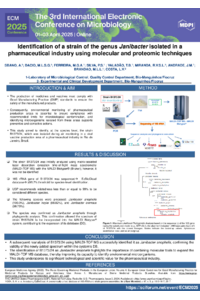
Pôster 3ºIECM- Andressa Sbano FINAL (1).pdf
Effect of atmospheric pollution on the taxonomic composition, diversity, and antibiotic resistance of the culturable bacterial community of the aerobiome in the Región Metropolitana of Chile.
Evaluation of Molecular Hydrogen in the Treatment of Intestinal Inflammation in a Murine Model