Event submissions
Published
This submission belongs to the session S1. Microbial Characterization and Bioprocess of the event The 3rd International Electronic Conference on Microbiology
Published date
31 Mar, 2025
Academic Editor
'%3e%3cpath%20d='M12.6657%2010.9104C12.4185%2010.325%2012.0599%209.79327%2011.6097%209.34482C11.1609%208.89508%2010.6293%208.5365%2010.0442%208.28888C10.0389%208.28626%2010.0337%208.28495%2010.0285%208.28233C10.8446%207.69279%2011.3752%206.73249%2011.3752%205.64904C11.3752%203.8542%209.92103%202.39999%208.1262%202.39999C6.33136%202.39999%204.87715%203.8542%204.87715%205.64904C4.87715%206.73249%205.40774%207.69279%206.22393%208.28364C6.21869%208.28626%206.21345%208.28757%206.20821%208.29019C5.62129%208.5378%205.09463%208.89284%204.64265%209.34613C4.1929%209.79493%203.83432%2010.3266%203.58671%2010.9117C3.34345%2011.4845%203.21226%2012.0987%203.20023%2012.7209C3.19988%2012.7349%203.20233%2012.7488%203.20744%2012.7619C3.21255%2012.7749%203.22022%2012.7867%203.22998%2012.7968C3.23975%2012.8068%203.25142%2012.8147%203.26431%2012.8202C3.2772%2012.8256%203.29105%2012.8284%203.30504%2012.8284H4.09109C4.14874%2012.8284%204.19459%2012.7825%204.1959%2012.7262C4.2221%2011.7148%204.62823%2010.7676%205.34617%2010.0497C6.08899%209.30683%207.0755%208.89808%208.1262%208.89808C9.17689%208.89808%2010.1634%209.30683%2010.9062%2010.0497C11.6242%2010.7676%2012.0303%2011.7148%2012.0565%2012.7262C12.0578%2012.7838%2012.1037%2012.8284%2012.1613%2012.8284H12.9474C12.9613%2012.8284%2012.9752%2012.8256%2012.9881%2012.8202C13.001%2012.8147%2013.0126%2012.8068%2013.0224%2012.7968C13.0322%2012.7867%2013.0398%2012.7749%2013.0449%2012.7619C13.0501%2012.7488%2013.0525%2012.7349%2013.0522%2012.7209C13.0391%2012.0947%2012.9094%2011.4855%2012.6657%2010.9104ZM8.1262%207.9024C7.52486%207.9024%206.9589%207.6679%206.53312%207.24211C6.10733%206.81633%205.87283%206.25037%205.87283%205.64904C5.87283%205.0477%206.10733%204.48174%206.53312%204.05596C6.9589%203.63018%207.52486%203.39567%208.1262%203.39567C8.72753%203.39567%209.29349%203.63018%209.71927%204.05596C10.1451%204.48174%2010.3796%205.0477%2010.3796%205.64904C10.3796%206.25037%2010.1451%206.81633%209.71927%207.24211C9.29349%207.6679%208.72753%207.9024%208.1262%207.9024Z'%20fill='%235D1EE1'/%3e%3c/g%3e%3c/svg%3e) Laurent Dufossé
Laurent DufosséCitation
Claudia Alejandra Conte, Máximo Rivarola, Sergio Gonzalez, María Romina Russo, Alejandra Scannapieco, Juan Pedro Wulff, Alfred M. Handler, Ioannis Ragoussis, Konstantinos Bourtzis, Silvia Beatriz Lanzavecchia, Preliminary genome assembly of the Wolbachia endosymbiont of the South American fruit fly Anastrepha fraterculus sp. 1., in Proceedings of The 3rd International Electronic Conference on Microbiology, 1 April–3 April 2025, MDPI: Basel, Switzerland
Share
Email
Facebook
Twitter
LinkedIn
Preliminary genome assembly of the Wolbachia endosymbiont of the South American fruit fly Anastrepha fraterculus sp. 1.
'%3e%3cpath%20d='M12.6647%2010.9104C12.4176%2010.325%2012.0589%209.7933%2011.6088%209.34485C11.16%208.89511%2010.6283%208.53653%2010.0432%208.28891C10.038%208.28629%2010.0327%208.28498%2010.0275%208.28236C10.8437%207.69282%2011.3743%206.73252%2011.3743%205.64907C11.3743%203.85423%209.92005%202.40002%208.12522%202.40002C6.33038%202.40002%204.87618%203.85423%204.87618%205.64907C4.87618%206.73252%205.40677%207.69282%206.22296%208.28367C6.21772%208.28629%206.21248%208.2876%206.20724%208.29022C5.62031%208.53783%205.09365%208.89287%204.64167%209.34616C4.19192%209.79496%203.83334%2010.3266%203.58573%2010.9117C3.34247%2011.4846%203.21128%2012.0987%203.19925%2012.721C3.1989%2012.735%203.20135%2012.7489%203.20646%2012.7619C3.21157%2012.7749%203.21924%2012.7868%203.22901%2012.7968C3.23877%2012.8068%203.25045%2012.8148%203.26334%2012.8202C3.27623%2012.8256%203.29007%2012.8284%203.30406%2012.8284H4.09012C4.14776%2012.8284%204.19362%2012.7825%204.19493%2012.7262C4.22113%2011.7148%204.62726%2010.7676%205.34519%2010.0497C6.08802%209.30686%207.07452%208.89811%208.12522%208.89811C9.17592%208.89811%2010.1624%209.30686%2010.9052%2010.0497C11.6232%2010.7676%2012.0293%2011.7148%2012.0555%2012.7262C12.0568%2012.7839%2012.1027%2012.8284%2012.1603%2012.8284H12.9464C12.9604%2012.8284%2012.9742%2012.8256%2012.9871%2012.8202C13%2012.8148%2013.0117%2012.8068%2013.0214%2012.7968C13.0312%2012.7868%2013.0389%2012.7749%2013.044%2012.7619C13.0491%2012.7489%2013.0515%2012.735%2013.0512%2012.721C13.0381%2012.0947%2012.9084%2011.4856%2012.6647%2010.9104ZM8.12522%207.90243C7.52388%207.90243%206.95792%207.66793%206.53214%207.24215C6.10636%206.81636%205.87185%206.2504%205.87185%205.64907C5.87185%205.04773%206.10636%204.48177%206.53214%204.05599C6.95792%203.63021%207.52388%203.3957%208.12522%203.3957C8.72655%203.3957%209.29252%203.63021%209.7183%204.05599C10.1441%204.48177%2010.3786%205.04773%2010.3786%205.64907C10.3786%206.2504%2010.1441%206.81636%209.7183%207.24215C9.29252%207.66793%208.72655%207.90243%208.12522%207.90243Z'%20fill='%235D1EE1'/%3e%3c/g%3e%3c/svg%3e)
Claudia Alejandra Conte 1

Máximo Rivarola 2
Sergio Gonzalez 2
María Romina Russo 1
Alejandra Scannapieco 1
Juan Pedro Wulff 3
Alfred M. Handler 4
Ioannis Ragoussis 5
Konstantinos Bourtzis 6
Silvia Beatriz Lanzavecchia 1
1. Instituto de Genética “E. A. Favret”, Instituto Nacional de Tecnología Agropecuaria (INTA) – Grupo vinculado al Instituto de Agrobiotecnología y Biología Molecular (IABIMO), Hurlingham, Buenos Aires, Argentina.
2. Instituto de Biotecnología IABIMO-CONICET, Instituto Nacional de Tecnología Agropecuaria (INTA), Hurlingham, Buenos Aires, Argentina.
3. North Carolina State University. NCSU, USA.
4. U.S. Department of Agriculture, Agricultural Research Service, Center for Medical, Agricultural, and Veterinary Entomology, Gainesville, FL 32608, USA.
5. McGill Centre, Montreal, Canada.
6. Insect Pest Control Laboratory, Joint FAO/IAEA Centre of Nuclear Techniques in Food and Agriculture, Seibersdorf, Austria.
Abstract
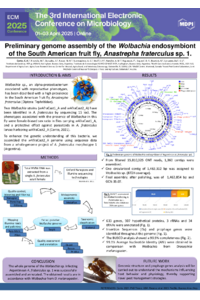
Wolbachia sp., an alphaproteobacterium associated with reproductive phenotypes, has previously been characterized in the fruit fly pest Anastrepha fraterculus (Diptera: Tephritidae). Two Wolbachia strains (wAfraCast1_A and wAfraCast2_A) have been identified using MLST and HVR as molecular markers. Mating assays have revealed a female-biased sex ratio in flies carrying wAfraCast1_A, while behavioral tests have suggested a protective effect against parasitoids in A. fraterculus larvae harboring wAfraCast2_A. Here, we assembled the wAfraCast2_A genome from a whole-genome project of A. fraterculus morphotype 1 (Argentina).
High-molecular-weight DNA was extracted from a single adult female, and Oxford Nanopore high-throughput genome sequencing was performed. After quality control and filtering of raw reads, a metagenomic approach was followed to obtain de novo assemblies of A. fraterculus and Wolbachia sp. genomes, and a Wolbachia-assigned contig was further analyzed. Quast and BUSCO were used to check the integrity and completeness of a preliminary Wolbachia genome assembly. Annotation was carried out with Prokka and compared to the reference genome of the Wolbachia endosymbiont of Drosophila melanogaster (wMel).
A total of 15,810,325 reads were obtained after adapter removal and quality filtering (10% of the reads were discarded). From these, a total of 1,360 contigs were generated de novo, and 1 contig was assigned to the Wolbachia sp. taxon. A preliminary assembly of the wAfraCast2_A genome revealed a circularized contig of 1,463,312 bp with 93.1% completeness, 0% duplicated genes, and 6.9% missing genes (rickettsiales_odb10 database, n:364). A genome comparison with wMel showed an Average Nucleotide Identity of 99.1% and structural annotation identified 1,701 CDSs, including 633 genes, 907 hypothetical proteins, 3 rRNAs, and 34 tRNAs. These results will enhance our understanding of the Wolbachia–A. fraterculus interaction, including mechanisms influencing host behavior, physiology, and ecological functions, thereby supporting novel pest management strategies.
Keywords
Wolbachia
endosymbiont
fruit fly
host-endosymbiont interaction
Poster
ECM2025-conte-final.pdf
Photobioreactors for Atmospheric Carbon Dioxide Fixation (Liquid trees): A Conceptual Approach Using Chlorella vulgaris Cultivation
Fungi and wildlife: the case of avian aspergillosis