Event submissions
Published
This submission belongs to the session S4. Emerging Infectious Diseases of the event The 3rd International Electronic Conference on Microbiology
Published date
31 Mar, 2025
Academic Editor
'%3e%3cpath%20d='M12.6657%2010.9104C12.4185%2010.325%2012.0599%209.79327%2011.6097%209.34482C11.1609%208.89508%2010.6293%208.5365%2010.0442%208.28888C10.0389%208.28626%2010.0337%208.28495%2010.0285%208.28233C10.8446%207.69279%2011.3752%206.73249%2011.3752%205.64904C11.3752%203.8542%209.92103%202.39999%208.1262%202.39999C6.33136%202.39999%204.87715%203.8542%204.87715%205.64904C4.87715%206.73249%205.40774%207.69279%206.22393%208.28364C6.21869%208.28626%206.21345%208.28757%206.20821%208.29019C5.62129%208.5378%205.09463%208.89284%204.64265%209.34613C4.1929%209.79493%203.83432%2010.3266%203.58671%2010.9117C3.34345%2011.4845%203.21226%2012.0987%203.20023%2012.7209C3.19988%2012.7349%203.20233%2012.7488%203.20744%2012.7619C3.21255%2012.7749%203.22022%2012.7867%203.22998%2012.7968C3.23975%2012.8068%203.25142%2012.8147%203.26431%2012.8202C3.2772%2012.8256%203.29105%2012.8284%203.30504%2012.8284H4.09109C4.14874%2012.8284%204.19459%2012.7825%204.1959%2012.7262C4.2221%2011.7148%204.62823%2010.7676%205.34617%2010.0497C6.08899%209.30683%207.0755%208.89808%208.1262%208.89808C9.17689%208.89808%2010.1634%209.30683%2010.9062%2010.0497C11.6242%2010.7676%2012.0303%2011.7148%2012.0565%2012.7262C12.0578%2012.7838%2012.1037%2012.8284%2012.1613%2012.8284H12.9474C12.9613%2012.8284%2012.9752%2012.8256%2012.9881%2012.8202C13.001%2012.8147%2013.0126%2012.8068%2013.0224%2012.7968C13.0322%2012.7867%2013.0398%2012.7749%2013.0449%2012.7619C13.0501%2012.7488%2013.0525%2012.7349%2013.0522%2012.7209C13.0391%2012.0947%2012.9094%2011.4855%2012.6657%2010.9104ZM8.1262%207.9024C7.52486%207.9024%206.9589%207.6679%206.53312%207.24211C6.10733%206.81633%205.87283%206.25037%205.87283%205.64904C5.87283%205.0477%206.10733%204.48174%206.53312%204.05596C6.9589%203.63018%207.52486%203.39567%208.1262%203.39567C8.72753%203.39567%209.29349%203.63018%209.71927%204.05596C10.1451%204.48174%2010.3796%205.0477%2010.3796%205.64904C10.3796%206.25037%2010.1451%206.81633%209.71927%207.24211C9.29349%207.6679%208.72753%207.9024%208.1262%207.9024Z'%20fill='%235D1EE1'/%3e%3c/g%3e%3c/svg%3e) Nico Jehmlich
Nico JehmlichCitation
Andreia Manuela Vieira Garces, Isabel Pires, Fungi and wildlife: the case of avian aspergillosis, in Proceedings of The 3rd International Electronic Conference on Microbiology, 1 April–3 April 2025, MDPI: Basel, Switzerland
Share
Email
Facebook
Twitter
LinkedIn
Fungi and wildlife: the case of avian aspergillosis

Andreia Manuela Vieira Garces 1

Isabel Pires 1,2
1. Animal and Veterinary Research Centre (CECAV), Associate Laboratory for Animal and Veterinary Sciences (AL4AnimalS), University of Trás-os-Montes e Alto Douro (UTAD), 5000-801 Vila Real, Portugal
2. Universidade de Trás os Montes e Alto Douro
Abstract
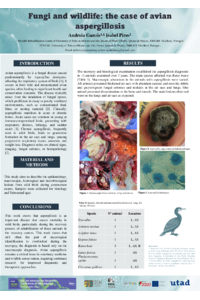
Avian aspergillosis is a fungal disease caused predominantly by Aspergillus fumigatus, affecting the respiratory system of birds. It occurs in both wild and domesticated avian species, often leading to significant health and conservation concerns. The disease typically arises from the inhalation of fungal spores, which proliferate in damp or poorly ventilated environments, such as contaminated feed, litter, or nesting material. Clinically, aspergillosis manifests in acute or chronic forms. Acute cases are common in young or immunocompromised birds, presenting with respiratory distress, lethargy, and sudden death. Chronic aspergillosis, frequently seen in adult birds, leads to granuloma formation in the air sacs and lungs, causing progressive respiratory issues, anorexia, and weight loss. Diagnosis relies on clinical signs, imaging, fungal cultures, or histopathology. This study aims to describe the epidemiology and the macroscopic, histological, and microbiological lesions from wild birds during postmortem exams. Samples were collected for histology and Sabouraud agar. The necropsy and histological examination established the aspergillosis diagnosis in 10 animals examined over 7 years. The main species affected was Buteo buteo. Macroscopic alterations in the animals with aspergillosis were varied. All animals presented thickened air sacs with abundant caseous and necrotic debris and greyish-green fungal colonies and nodules in the air sacs and lungs. One animal presented dissemination to the bone and muscle. The main lesions observed were on the lungs and air sacs as expected. This work shows that aspergillosis is an important disease that causes mortality in wild birds, particularly during the recovery process of rehabilitation of these animals in the recovery centres. This work shows that the part of mycological identification is still often overlooked during the necropsy, and the diagnosis is based only on the macroscopic diagnosis. Avian aspergillosis remains a critical issue in veterinary medicine and wildlife conservation, requiring continued research for improved diagnostic and therapeutic approaches.
Keywords
Aspergillus
fingi
birds
wildlife
One Health
zoonose
Poster
poster_aspergilose birds.pdf
Preliminary genome assembly of the Wolbachia endosymbiont of the South American fruit fly Anastrepha fraterculus sp. 1.
Harnessing the Intrinsic Disorder in Human Metapneumovirus for Therapeutic Development