Event submissions
Published
This submission belongs to the session S3. Antimicrobial Agents and Resistance of the event The 3rd International Electronic Conference on Microbiology
Published date
31 Mar, 2025
Academic Editor
'%3e%3cpath%20d='M12.6657%2010.9104C12.4185%2010.325%2012.0599%209.79327%2011.6097%209.34482C11.1609%208.89508%2010.6293%208.5365%2010.0442%208.28888C10.0389%208.28626%2010.0337%208.28495%2010.0285%208.28233C10.8446%207.69279%2011.3752%206.73249%2011.3752%205.64904C11.3752%203.8542%209.92103%202.39999%208.1262%202.39999C6.33136%202.39999%204.87715%203.8542%204.87715%205.64904C4.87715%206.73249%205.40774%207.69279%206.22393%208.28364C6.21869%208.28626%206.21345%208.28757%206.20821%208.29019C5.62129%208.5378%205.09463%208.89284%204.64265%209.34613C4.1929%209.79493%203.83432%2010.3266%203.58671%2010.9117C3.34345%2011.4845%203.21226%2012.0987%203.20023%2012.7209C3.19988%2012.7349%203.20233%2012.7488%203.20744%2012.7619C3.21255%2012.7749%203.22022%2012.7867%203.22998%2012.7968C3.23975%2012.8068%203.25142%2012.8147%203.26431%2012.8202C3.2772%2012.8256%203.29105%2012.8284%203.30504%2012.8284H4.09109C4.14874%2012.8284%204.19459%2012.7825%204.1959%2012.7262C4.2221%2011.7148%204.62823%2010.7676%205.34617%2010.0497C6.08899%209.30683%207.0755%208.89808%208.1262%208.89808C9.17689%208.89808%2010.1634%209.30683%2010.9062%2010.0497C11.6242%2010.7676%2012.0303%2011.7148%2012.0565%2012.7262C12.0578%2012.7838%2012.1037%2012.8284%2012.1613%2012.8284H12.9474C12.9613%2012.8284%2012.9752%2012.8256%2012.9881%2012.8202C13.001%2012.8147%2013.0126%2012.8068%2013.0224%2012.7968C13.0322%2012.7867%2013.0398%2012.7749%2013.0449%2012.7619C13.0501%2012.7488%2013.0525%2012.7349%2013.0522%2012.7209C13.0391%2012.0947%2012.9094%2011.4855%2012.6657%2010.9104ZM8.1262%207.9024C7.52486%207.9024%206.9589%207.6679%206.53312%207.24211C6.10733%206.81633%205.87283%206.25037%205.87283%205.64904C5.87283%205.0477%206.10733%204.48174%206.53312%204.05596C6.9589%203.63018%207.52486%203.39567%208.1262%203.39567C8.72753%203.39567%209.29349%203.63018%209.71927%204.05596C10.1451%204.48174%2010.3796%205.0477%2010.3796%205.64904C10.3796%206.25037%2010.1451%206.81633%209.71927%207.24211C9.29349%207.6679%208.72753%207.9024%208.1262%207.9024Z'%20fill='%235D1EE1'/%3e%3c/g%3e%3c/svg%3e) Nico Jehmlich
Nico JehmlichCitation
Jiewen Guan, Mingsong Kang, Calvin Lau, Catherine Carrillo, Edward Topp, Gut dysbiosis promotes dissemination of antimicrobial resistance genes, in Proceedings of The 3rd International Electronic Conference on Microbiology, 1 April–3 April 2025, MDPI: Basel, Switzerland
Share
Email
Facebook
Twitter
LinkedIn
Gut dysbiosis promotes dissemination of antimicrobial resistance genes
'%3e%3cpath%20d='M12.6647%2010.9104C12.4176%2010.325%2012.0589%209.7933%2011.6088%209.34485C11.16%208.89511%2010.6283%208.53653%2010.0432%208.28891C10.038%208.28629%2010.0327%208.28498%2010.0275%208.28236C10.8437%207.69282%2011.3743%206.73252%2011.3743%205.64907C11.3743%203.85423%209.92005%202.40002%208.12522%202.40002C6.33038%202.40002%204.87618%203.85423%204.87618%205.64907C4.87618%206.73252%205.40677%207.69282%206.22296%208.28367C6.21772%208.28629%206.21248%208.2876%206.20724%208.29022C5.62031%208.53783%205.09365%208.89287%204.64167%209.34616C4.19192%209.79496%203.83334%2010.3266%203.58573%2010.9117C3.34247%2011.4846%203.21128%2012.0987%203.19925%2012.721C3.1989%2012.735%203.20135%2012.7489%203.20646%2012.7619C3.21157%2012.7749%203.21924%2012.7868%203.22901%2012.7968C3.23877%2012.8068%203.25045%2012.8148%203.26334%2012.8202C3.27623%2012.8256%203.29007%2012.8284%203.30406%2012.8284H4.09012C4.14776%2012.8284%204.19362%2012.7825%204.19493%2012.7262C4.22113%2011.7148%204.62726%2010.7676%205.34519%2010.0497C6.08802%209.30686%207.07452%208.89811%208.12522%208.89811C9.17592%208.89811%2010.1624%209.30686%2010.9052%2010.0497C11.6232%2010.7676%2012.0293%2011.7148%2012.0555%2012.7262C12.0568%2012.7839%2012.1027%2012.8284%2012.1603%2012.8284H12.9464C12.9604%2012.8284%2012.9742%2012.8256%2012.9871%2012.8202C13%2012.8148%2013.0117%2012.8068%2013.0214%2012.7968C13.0312%2012.7868%2013.0389%2012.7749%2013.044%2012.7619C13.0491%2012.7489%2013.0515%2012.735%2013.0512%2012.721C13.0381%2012.0947%2012.9084%2011.4856%2012.6647%2010.9104ZM8.12522%207.90243C7.52388%207.90243%206.95792%207.66793%206.53214%207.24215C6.10636%206.81636%205.87185%206.2504%205.87185%205.64907C5.87185%205.04773%206.10636%204.48177%206.53214%204.05599C6.95792%203.63021%207.52388%203.3957%208.12522%203.3957C8.72655%203.3957%209.29252%203.63021%209.7183%204.05599C10.1441%204.48177%2010.3786%205.04773%2010.3786%205.64907C10.3786%206.2504%2010.1441%206.81636%209.7183%207.24215C9.29252%207.66793%208.72655%207.90243%208.12522%207.90243Z'%20fill='%235D1EE1'/%3e%3c/g%3e%3c/svg%3e)
Jiewen Guan 1
Mingsong Kang 1
Calvin Lau 2
Catherine Carrillo 2
Edward Topp 3
1. Ottawa Laboratory (Fallowfield), Canadian Food Inspection Agency, Ottawa, Ontario, Canada
2. Ottawa Laboratory (Carling), Canadian Food Inspection Agency, Ottawa, Ontario, Canada
3. Agroecology research unit, INRAE, University of Burgundy, Dijon, France
Abstract
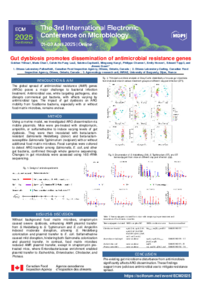
Introduction: The global spread of antimicrobial resistance (AMR) genes (ARGs) poses a major challenge to bacterial infection treatment. Antibiotic use, while targeting pathogens, also disrupts commensal gut bacteria, with effects varying by antibiotic type. The impact of gut dysbiosis on ARG mobility from foodborne bacteria, especially with or without food matrix microbes, remains unclear.
Methods: Using a murine model, we investigated ARG dissemination via mobile AMR plasmids. Mice were pre-treated with streptomycin, ampicillin, or sulfamethazine to induce varying levels of gut dysbiosis. They were then inoculated with beta-lactam-resistant Salmonella Heidelberg (donor) and beta-lactam-susceptible Salmonella Typhimurium (recipient) with or without additional food matrix microbes. Fecal samples were cultured to detect ARG transfer among Salmonella, E. coli, and other gut bacteria, which were confirmed using whole-genome sequencing. Changes in gut microbiota were assessed using 16S rRNA sequencing.
Results: Without background food matrix microbes, streptomycin caused severe gut dysbiosis, enhancing AMR plasmid transfer from S. Heidelberg to S. Typhimurium and E. coli. Ampicillin induced moderate dysbiosis, allowing S. Heidelberg colonization and plasmid transfer to E. coli. Sulfamethazine caused mild dysbiosis, hindering both Salmonella colonization and plasmid transfer. In contrast, food matrix microbes reduced AMR plasmid transfer, except in streptomycin pre-treated mice, where Enterobacteriaceae enrichment enabled AMR plasmid transfer to Escherichia, Enterobacter, Citrobacter, and Proteus.
Conclusions: Pre-existing gut microbiome disturbances from antibiotics significantly affect ARG dissemination. These findings support more judicious antibiotic use to mitigate resistance spread.
Keywords
Antimicrobial resistance
gut dysbiosis
horizontal gene transfer
Salmonella
Poster
Guan poster MDPI2025.pdf
Zika Virus Surveillance in Brazil (2010–2024): Epidemiological Insights
Plant–microbial interactions in the phytosphere of thyme (Thymus vulgaris L.)