Event submissions
Published
This submission belongs to the session S4. Emerging Infectious Diseases of the event The 3rd International Electronic Conference on Microbiology
Published date
31 Mar, 2025
Academic Editor
'%3e%3cpath%20d='M12.6657%2010.9104C12.4185%2010.325%2012.0599%209.79327%2011.6097%209.34482C11.1609%208.89508%2010.6293%208.5365%2010.0442%208.28888C10.0389%208.28626%2010.0337%208.28495%2010.0285%208.28233C10.8446%207.69279%2011.3752%206.73249%2011.3752%205.64904C11.3752%203.8542%209.92103%202.39999%208.1262%202.39999C6.33136%202.39999%204.87715%203.8542%204.87715%205.64904C4.87715%206.73249%205.40774%207.69279%206.22393%208.28364C6.21869%208.28626%206.21345%208.28757%206.20821%208.29019C5.62129%208.5378%205.09463%208.89284%204.64265%209.34613C4.1929%209.79493%203.83432%2010.3266%203.58671%2010.9117C3.34345%2011.4845%203.21226%2012.0987%203.20023%2012.7209C3.19988%2012.7349%203.20233%2012.7488%203.20744%2012.7619C3.21255%2012.7749%203.22022%2012.7867%203.22998%2012.7968C3.23975%2012.8068%203.25142%2012.8147%203.26431%2012.8202C3.2772%2012.8256%203.29105%2012.8284%203.30504%2012.8284H4.09109C4.14874%2012.8284%204.19459%2012.7825%204.1959%2012.7262C4.2221%2011.7148%204.62823%2010.7676%205.34617%2010.0497C6.08899%209.30683%207.0755%208.89808%208.1262%208.89808C9.17689%208.89808%2010.1634%209.30683%2010.9062%2010.0497C11.6242%2010.7676%2012.0303%2011.7148%2012.0565%2012.7262C12.0578%2012.7838%2012.1037%2012.8284%2012.1613%2012.8284H12.9474C12.9613%2012.8284%2012.9752%2012.8256%2012.9881%2012.8202C13.001%2012.8147%2013.0126%2012.8068%2013.0224%2012.7968C13.0322%2012.7867%2013.0398%2012.7749%2013.0449%2012.7619C13.0501%2012.7488%2013.0525%2012.7349%2013.0522%2012.7209C13.0391%2012.0947%2012.9094%2011.4855%2012.6657%2010.9104ZM8.1262%207.9024C7.52486%207.9024%206.9589%207.6679%206.53312%207.24211C6.10733%206.81633%205.87283%206.25037%205.87283%205.64904C5.87283%205.0477%206.10733%204.48174%206.53312%204.05596C6.9589%203.63018%207.52486%203.39567%208.1262%203.39567C8.72753%203.39567%209.29349%203.63018%209.71927%204.05596C10.1451%204.48174%2010.3796%205.0477%2010.3796%205.64904C10.3796%206.25037%2010.1451%206.81633%209.71927%207.24211C9.29349%207.6679%208.72753%207.9024%208.1262%207.9024Z'%20fill='%235D1EE1'/%3e%3c/g%3e%3c/svg%3e) Nico Jehmlich
Nico JehmlichCitation
Anda Upane, Simons Svirskis, Sandra Skuja, HHV-6 in Liver Damage: Innocent Presence or Active Player in Alcohol-Induced Injury?, in Proceedings of The 3rd International Electronic Conference on Microbiology, 1 April–3 April 2025, MDPI: Basel, Switzerland
Share
Email
Facebook
Twitter
LinkedIn
HHV-6 in Liver Damage: Innocent Presence or Active Player in Alcohol-Induced Injury?
'%3e%3cpath%20d='M12.6647%2010.9104C12.4176%2010.325%2012.0589%209.7933%2011.6088%209.34485C11.16%208.89511%2010.6283%208.53653%2010.0432%208.28891C10.038%208.28629%2010.0327%208.28498%2010.0275%208.28236C10.8437%207.69282%2011.3743%206.73252%2011.3743%205.64907C11.3743%203.85423%209.92005%202.40002%208.12522%202.40002C6.33038%202.40002%204.87618%203.85423%204.87618%205.64907C4.87618%206.73252%205.40677%207.69282%206.22296%208.28367C6.21772%208.28629%206.21248%208.2876%206.20724%208.29022C5.62031%208.53783%205.09365%208.89287%204.64167%209.34616C4.19192%209.79496%203.83334%2010.3266%203.58573%2010.9117C3.34247%2011.4846%203.21128%2012.0987%203.19925%2012.721C3.1989%2012.735%203.20135%2012.7489%203.20646%2012.7619C3.21157%2012.7749%203.21924%2012.7868%203.22901%2012.7968C3.23877%2012.8068%203.25045%2012.8148%203.26334%2012.8202C3.27623%2012.8256%203.29007%2012.8284%203.30406%2012.8284H4.09012C4.14776%2012.8284%204.19362%2012.7825%204.19493%2012.7262C4.22113%2011.7148%204.62726%2010.7676%205.34519%2010.0497C6.08802%209.30686%207.07452%208.89811%208.12522%208.89811C9.17592%208.89811%2010.1624%209.30686%2010.9052%2010.0497C11.6232%2010.7676%2012.0293%2011.7148%2012.0555%2012.7262C12.0568%2012.7839%2012.1027%2012.8284%2012.1603%2012.8284H12.9464C12.9604%2012.8284%2012.9742%2012.8256%2012.9871%2012.8202C13%2012.8148%2013.0117%2012.8068%2013.0214%2012.7968C13.0312%2012.7868%2013.0389%2012.7749%2013.044%2012.7619C13.0491%2012.7489%2013.0515%2012.735%2013.0512%2012.721C13.0381%2012.0947%2012.9084%2011.4856%2012.6647%2010.9104ZM8.12522%207.90243C7.52388%207.90243%206.95792%207.66793%206.53214%207.24215C6.10636%206.81636%205.87185%206.2504%205.87185%205.64907C5.87185%205.04773%206.10636%204.48177%206.53214%204.05599C6.95792%203.63021%207.52388%203.3957%208.12522%203.3957C8.72655%203.3957%209.29252%203.63021%209.7183%204.05599C10.1441%204.48177%2010.3786%205.04773%2010.3786%205.64907C10.3786%206.2504%2010.1441%206.81636%209.7183%207.24215C9.29252%207.66793%208.72655%207.90243%208.12522%207.90243Z'%20fill='%235D1EE1'/%3e%3c/g%3e%3c/svg%3e)
Anda Upane 1
Simons Svirskis 2
Sandra Skuja 1
1. Joint Laboratory of Electron Microscopy, Institute of Anatomy and Anthropology, Rīga Stradiņš University, Riga, Latvia
2. Institute of Microbiology and Virology, Rīga Stradiņš University, Latvia
Abstract
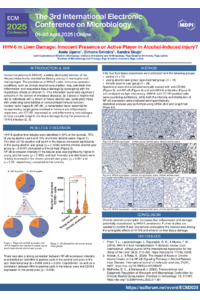
Human herpesvirus 6 (HHV-6), a widely distributed member of the Herpesviridae family, establishes lifelong latency in monocytes and macrophages. The persistence of HHV-6 under immunosuppressive conditions, such as chronic alcohol consumption, may potentiate liver inflammation and exacerbate tissue damage by synergising with the hepatotoxic effects of ethanol. This interaction could raise significant concerns in the context of infectious diseases, as it poses a heightened risk to individuals with a history of heavy alcohol use, particularly those with underlying comorbidities or compromised immune function. The transcription factor NF-κB, essential for transactivating target genes involved in immune and inflammatory responses and CD163, expressed on anti-inflammatory macrophages, provides valuable insights into tissue damage during the presence of HHV- 6 infection.
Fifty-four liver tissue specimens were collected from the following groups: control (n=11), young alcohol users (n=15), and chronic alcohol users (n=28). Specimens were immunohistochemically stained with anti-CD163, anti-NF-κB, and anti-HHV-6 antibodies and analysed via light microscopy. HHV-6- and CD163-positive cells were counted quantitatively, while both the intensity and distribution of NF-κB expression were analysed semi-quantitatively. Statistical analysis was performed using SPSS 28.0.
HHV-6-positive liver lobules were identified in 48.75% of the controls, 63.89% of young alcohol users, and 72.04% of chronic alcohol users. The mean CD163-positive cell count in the lobular area increased significantly in young alcohol users (mean=135 ± 43 SEM) and chronic alcohol users (mean=226 ± 38 SEM) compared to the controls (mean=59 ± 14 SEM). NF-κB expression intensity in the lobular area was significantly higher in young alcohol users (p<0.005), and both intensity and distribution were notably increased in chronic alcoholics (p<0.001, p=0.02) compared to the controls.
Chronic alcohol consumption increases liver inflammation and damage, potentially exacerbated by HHV‑6 persistence. Further studies are needed to confirm these interactions and explore the mechanisms driving the synergistic effects of HHV-6 and ethanol on liver tissue damage.
Keywords
Liver
Chronic alcoholism
HHV-6 infection
Inflammation.
Poster
ECM 2025 poster Anda Upane.pdf
Shifts in Aerobic Granular Sludge Bacteriome Driven by Seawater Intrusion in Wastewater
Microbial Signatures in High- and Low-Blood-Glucose Participants of the Generation 100 Study