Event submissions
Published
This submission belongs to the session S5. Foodborne Pathogens and Food Safety of the event The 3rd International Electronic Conference on Microbiology
Published date
31 Mar, 2025
Academic Editor
'%3e%3cpath%20d='M12.6657%2010.9104C12.4185%2010.325%2012.0599%209.79327%2011.6097%209.34482C11.1609%208.89508%2010.6293%208.5365%2010.0442%208.28888C10.0389%208.28626%2010.0337%208.28495%2010.0285%208.28233C10.8446%207.69279%2011.3752%206.73249%2011.3752%205.64904C11.3752%203.8542%209.92103%202.39999%208.1262%202.39999C6.33136%202.39999%204.87715%203.8542%204.87715%205.64904C4.87715%206.73249%205.40774%207.69279%206.22393%208.28364C6.21869%208.28626%206.21345%208.28757%206.20821%208.29019C5.62129%208.5378%205.09463%208.89284%204.64265%209.34613C4.1929%209.79493%203.83432%2010.3266%203.58671%2010.9117C3.34345%2011.4845%203.21226%2012.0987%203.20023%2012.7209C3.19988%2012.7349%203.20233%2012.7488%203.20744%2012.7619C3.21255%2012.7749%203.22022%2012.7867%203.22998%2012.7968C3.23975%2012.8068%203.25142%2012.8147%203.26431%2012.8202C3.2772%2012.8256%203.29105%2012.8284%203.30504%2012.8284H4.09109C4.14874%2012.8284%204.19459%2012.7825%204.1959%2012.7262C4.2221%2011.7148%204.62823%2010.7676%205.34617%2010.0497C6.08899%209.30683%207.0755%208.89808%208.1262%208.89808C9.17689%208.89808%2010.1634%209.30683%2010.9062%2010.0497C11.6242%2010.7676%2012.0303%2011.7148%2012.0565%2012.7262C12.0578%2012.7838%2012.1037%2012.8284%2012.1613%2012.8284H12.9474C12.9613%2012.8284%2012.9752%2012.8256%2012.9881%2012.8202C13.001%2012.8147%2013.0126%2012.8068%2013.0224%2012.7968C13.0322%2012.7867%2013.0398%2012.7749%2013.0449%2012.7619C13.0501%2012.7488%2013.0525%2012.7349%2013.0522%2012.7209C13.0391%2012.0947%2012.9094%2011.4855%2012.6657%2010.9104ZM8.1262%207.9024C7.52486%207.9024%206.9589%207.6679%206.53312%207.24211C6.10733%206.81633%205.87283%206.25037%205.87283%205.64904C5.87283%205.0477%206.10733%204.48174%206.53312%204.05596C6.9589%203.63018%207.52486%203.39567%208.1262%203.39567C8.72753%203.39567%209.29349%203.63018%209.71927%204.05596C10.1451%204.48174%2010.3796%205.0477%2010.3796%205.64904C10.3796%206.25037%2010.1451%206.81633%209.71927%207.24211C9.29349%207.6679%208.72753%207.9024%208.1262%207.9024Z'%20fill='%235D1EE1'/%3e%3c/g%3e%3c/svg%3e) Ute Römling
Ute RömlingCitation
Joana Paiva, Cristina Saraiva, Microbiological assessment and acceptability of minced meat from hypermarkets: pathogenic and spoilage microorganisms, in Proceedings of The 3rd International Electronic Conference on Microbiology, 1 April–3 April 2025, MDPI: Basel, Switzerland
Share
Email
Facebook
Twitter
LinkedIn
Microbiological assessment and acceptability of minced meat from hypermarkets: pathogenic and spoilage microorganisms

Joana Paiva 1,2,3

Cristina Saraiva 2,3,4
1. University of Trás-os-Montes e Alto Douro
2. Department of Veterinary Sciences, University of Trás-os-Montes and Alto Douro (UTAD), 5001-801 Vila Real, Portugal
3. Centro de Ciência Animal e Veterinária (CECAV), University of Trás-os-Montes and Alto Douro (UTAD), 5001-801 Vila Real, Portugal
4. Veterinary and Animal Research Centre, Associate Laboratory for Animal and Veterinary Science (AL4AnimalS), University of Trás-os-Montes and Alto Douro (UTAD), 5000-801 Vila Real, Portugal
Abstract
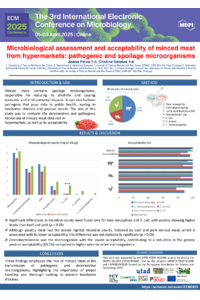
Minced meat contains spoilage microorganisms, reducing shelf-life and causing economic and environmental impacts. It can also harbour pathogens that pose risks to public health, leading to foodborne illnesses and product recalls. The aim of this study was to evaluate the deteriorative and pathogenic microbiota of minced meat obtained in hypermarkets. Thirty samples of minced meat from bovine (n=15), swine (n=6), and poultry (n=9), produced from hypermarkets in Vila Real, were analysed for the presence of three important foodborne pathogenic bacteria, i.e., L. monocytogenes, S. aureus, and E. coli. In parallel, total aerobic microorganisms at 30ºC (mesophiles), Enterobacteriaceae, Lactic Acid Bacteria (LAB), and Pseudomonas spp., were also enumerated as hygiene / safety indicator organisms. Microbial concentrations (log10 cfu/g) of 6,01 ± 0,19 (total mesophiles), 3,79 ± 1,27 (Enterobacteriaceae), 4,14 ± 0,96 (LAB), 1,35 ± 1,31 (Pseudomonas spp.), 0,07 ± 0,29 (L. monocytogenes); 0,21 ± 0,66 (S. aureus), and 0,52 ± 0,81 (E. coli) were found. Significant differences in microbial counts were found only for total mesophiles and E. coli, with poultry showing higher levels than beef and pork (p < 0.05). Although poultry meat had the overall highest microbial counts, which is assocaited with its lower acceptability, followed by beef and pork minced meat,this difference was not statistically significant (p > 0.05). Enterobacteriaceae was the microorganism with the lowest acceptability, contributing to a reduction in the general product acceptability (83.3%) compared to the higher rates for other microorganisms. These findings emphasize the role of minced meat in the transmission of pathogenic and deteriorative microorganisms, highlighting the importance of proper handling and thorough cooking to prevent foodborne diseases.
Keywords
Minced meat
food microbiology
pathogenic
spoilage
acceptability
Poster
Poster Joana Paiva.pdf
Microbial Signatures in High- and Low-Blood-Glucose Participants of the Generation 100 Study
Impact of Co-Inoculating Bradyrhizobium japonicum with Bacillus subtilis or Priestia megaterium on Nitrate Inhibition of Symbiotic Nitrogen Fixation in Soybean