Event submissions
Published
This submission belongs to the session S1. Microbial Characterization and Bioprocess of the event The 3rd International Electronic Conference on Microbiology
Published date
31 Mar, 2025
Academic Editor
'%3e%3cpath%20d='M12.6657%2010.9104C12.4185%2010.325%2012.0599%209.79327%2011.6097%209.34482C11.1609%208.89508%2010.6293%208.5365%2010.0442%208.28888C10.0389%208.28626%2010.0337%208.28495%2010.0285%208.28233C10.8446%207.69279%2011.3752%206.73249%2011.3752%205.64904C11.3752%203.8542%209.92103%202.39999%208.1262%202.39999C6.33136%202.39999%204.87715%203.8542%204.87715%205.64904C4.87715%206.73249%205.40774%207.69279%206.22393%208.28364C6.21869%208.28626%206.21345%208.28757%206.20821%208.29019C5.62129%208.5378%205.09463%208.89284%204.64265%209.34613C4.1929%209.79493%203.83432%2010.3266%203.58671%2010.9117C3.34345%2011.4845%203.21226%2012.0987%203.20023%2012.7209C3.19988%2012.7349%203.20233%2012.7488%203.20744%2012.7619C3.21255%2012.7749%203.22022%2012.7867%203.22998%2012.7968C3.23975%2012.8068%203.25142%2012.8147%203.26431%2012.8202C3.2772%2012.8256%203.29105%2012.8284%203.30504%2012.8284H4.09109C4.14874%2012.8284%204.19459%2012.7825%204.1959%2012.7262C4.2221%2011.7148%204.62823%2010.7676%205.34617%2010.0497C6.08899%209.30683%207.0755%208.89808%208.1262%208.89808C9.17689%208.89808%2010.1634%209.30683%2010.9062%2010.0497C11.6242%2010.7676%2012.0303%2011.7148%2012.0565%2012.7262C12.0578%2012.7838%2012.1037%2012.8284%2012.1613%2012.8284H12.9474C12.9613%2012.8284%2012.9752%2012.8256%2012.9881%2012.8202C13.001%2012.8147%2013.0126%2012.8068%2013.0224%2012.7968C13.0322%2012.7867%2013.0398%2012.7749%2013.0449%2012.7619C13.0501%2012.7488%2013.0525%2012.7349%2013.0522%2012.7209C13.0391%2012.0947%2012.9094%2011.4855%2012.6657%2010.9104ZM8.1262%207.9024C7.52486%207.9024%206.9589%207.6679%206.53312%207.24211C6.10733%206.81633%205.87283%206.25037%205.87283%205.64904C5.87283%205.0477%206.10733%204.48174%206.53312%204.05596C6.9589%203.63018%207.52486%203.39567%208.1262%203.39567C8.72753%203.39567%209.29349%203.63018%209.71927%204.05596C10.1451%204.48174%2010.3796%205.0477%2010.3796%205.64904C10.3796%206.25037%2010.1451%206.81633%209.71927%207.24211C9.29349%207.6679%208.72753%207.9024%208.1262%207.9024Z'%20fill='%235D1EE1'/%3e%3c/g%3e%3c/svg%3e) Laurent Dufossé
Laurent DufosséCitation
Beatrice Farda, Amedeo Mignini, Fabrizia Pasquarelli, Luz de-Bashan, Iris Beatriz Vega Erramuspe, Rihab Djebaili, Marika Pellegrini, Exploring Cellulose Fibers as Support for a Microbial Inoculant Immobilization, in Proceedings of The 3rd International Electronic Conference on Microbiology, 1 April–3 April 2025, MDPI: Basel, Switzerland
Share
Email
Facebook
Twitter
LinkedIn
Exploring Cellulose Fibers as Support for a Microbial Inoculant Immobilization

Beatrice Farda 1
'%3e%3cpath%20d='M12.6647%2010.9104C12.4176%2010.325%2012.0589%209.7933%2011.6088%209.34485C11.16%208.89511%2010.6283%208.53653%2010.0432%208.28891C10.038%208.28629%2010.0327%208.28498%2010.0275%208.28236C10.8437%207.69282%2011.3743%206.73252%2011.3743%205.64907C11.3743%203.85423%209.92005%202.40002%208.12522%202.40002C6.33038%202.40002%204.87618%203.85423%204.87618%205.64907C4.87618%206.73252%205.40677%207.69282%206.22296%208.28367C6.21772%208.28629%206.21248%208.2876%206.20724%208.29022C5.62031%208.53783%205.09365%208.89287%204.64167%209.34616C4.19192%209.79496%203.83334%2010.3266%203.58573%2010.9117C3.34247%2011.4846%203.21128%2012.0987%203.19925%2012.721C3.1989%2012.735%203.20135%2012.7489%203.20646%2012.7619C3.21157%2012.7749%203.21924%2012.7868%203.22901%2012.7968C3.23877%2012.8068%203.25045%2012.8148%203.26334%2012.8202C3.27623%2012.8256%203.29007%2012.8284%203.30406%2012.8284H4.09012C4.14776%2012.8284%204.19362%2012.7825%204.19493%2012.7262C4.22113%2011.7148%204.62726%2010.7676%205.34519%2010.0497C6.08802%209.30686%207.07452%208.89811%208.12522%208.89811C9.17592%208.89811%2010.1624%209.30686%2010.9052%2010.0497C11.6232%2010.7676%2012.0293%2011.7148%2012.0555%2012.7262C12.0568%2012.7839%2012.1027%2012.8284%2012.1603%2012.8284H12.9464C12.9604%2012.8284%2012.9742%2012.8256%2012.9871%2012.8202C13%2012.8148%2013.0117%2012.8068%2013.0214%2012.7968C13.0312%2012.7868%2013.0389%2012.7749%2013.044%2012.7619C13.0491%2012.7489%2013.0515%2012.735%2013.0512%2012.721C13.0381%2012.0947%2012.9084%2011.4856%2012.6647%2010.9104ZM8.12522%207.90243C7.52388%207.90243%206.95792%207.66793%206.53214%207.24215C6.10636%206.81636%205.87185%206.2504%205.87185%205.64907C5.87185%205.04773%206.10636%204.48177%206.53214%204.05599C6.95792%203.63021%207.52388%203.3957%208.12522%203.3957C8.72655%203.3957%209.29252%203.63021%209.7183%204.05599C10.1441%204.48177%2010.3786%205.04773%2010.3786%205.64907C10.3786%206.2504%2010.1441%206.81636%209.7183%207.24215C9.29252%207.66793%208.72655%207.90243%208.12522%207.90243Z'%20fill='%235D1EE1'/%3e%3c/g%3e%3c/svg%3e)
Amedeo Mignini 2
Fabrizia Pasquarelli 3

Luz de-Bashan 4
Iris Beatriz Vega Erramuspe 5

Rihab Djebaili 1

Marika Pellegrini 1,2
1. Department of Life, Health and Environmental Sciences, University of L'Aquila, L'Aquila, 67100, Italy
2. Agroqualis Srl, Academic Spin off of University of L’Aquila, L’Aquila, Italy
3. SPAA s.r.l., Via delle Industrie 11-13, Città Sant’Angelo, 65013 PE, Italy
4. The Bashan Institute of Science, 1730 Post Oak Court, Auburn, 36830 AL, USA
5. Department of Biosystems Engineering , College of Agriculture, Auburn University, Auburn (AL), USA
Abstract
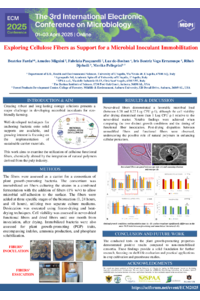
Creating robust and long-lasting storage solutions presents a major challenge in developing microbial inoculants for eco-friendly farming. Well-developed techniques for anchoring bacteria onto solid supports are available, and growing interest is focusing on the implementation of sustainable carrier materials. This work aims to examine the utilization of cellulose functional fibers, chemically altered by the integration of natural polymers derived from the pulp industry. The fibers were assessed as a carrier for a consortium of plant growth-promoting bacteria. The consortium was immobilized on fibers culturing the strains in a combined fermentation with the addition of fibers (1% w/v) to allow for microbial self-adhesion to the surface. The fibers were added at three specific stages of the bioreaction (0, 24 hours, and 48 hours), utilizing two separate culture mediums. Desiccation was executed using freeze-drying and heat-drying techniques. Cell viability was assessed in never-dried functional fibers and dried fibers until one month from inoculation, after drying. Immobilized bacteria were also assessed for plant growth-promoting (PGP) traits, encompassing indoles, ammonia production, and phosphate solubilization. Never-dried fibers demonstrated a favorable microbial load (between 6.78 and 8.22 Log CFU g-1), although the cell viability after drying diminished more than 1 Log CFU g-1 relative to the never-dried matter. Notable findings were achieved when comparing the two distinct growth conditions and the timing of functional fiber inoculation. Post-drying disparities between unmodified fibers and functional fibers were observed, underscoring the possible role of natural polymers in enhancing cellular protection. Plant growth-promoting testing exhibited advantageous results relative to the non-immobilized consortia. These results establish a foundation for additional research, concentrating on shelf-life assessments and suitable applications in plant and greenhouse investigations.
Keywords
microbial formulation
solid support
cellulose functional fibers
microbial immobilization
Poster
Poster ECM 2025_BF.pdf
Decreased levels of aromatic microbial metabolites as a reflection of microbiota dysfunction in cancer patients
Assessing the potential association between pigeons and the presence of Acanthamoeba spp. in the River Soar and public parks in Leicester, England