Event submissions
Published
This submission belongs to the session S6. Microbiome and Soil Science of the event The 3rd International Electronic Conference on Microbiology
Published date
31 Mar, 2025
Academic Editor
'%3e%3cpath%20d='M12.6657%2010.9104C12.4185%2010.325%2012.0599%209.79327%2011.6097%209.34482C11.1609%208.89508%2010.6293%208.5365%2010.0442%208.28888C10.0389%208.28626%2010.0337%208.28495%2010.0285%208.28233C10.8446%207.69279%2011.3752%206.73249%2011.3752%205.64904C11.3752%203.8542%209.92103%202.39999%208.1262%202.39999C6.33136%202.39999%204.87715%203.8542%204.87715%205.64904C4.87715%206.73249%205.40774%207.69279%206.22393%208.28364C6.21869%208.28626%206.21345%208.28757%206.20821%208.29019C5.62129%208.5378%205.09463%208.89284%204.64265%209.34613C4.1929%209.79493%203.83432%2010.3266%203.58671%2010.9117C3.34345%2011.4845%203.21226%2012.0987%203.20023%2012.7209C3.19988%2012.7349%203.20233%2012.7488%203.20744%2012.7619C3.21255%2012.7749%203.22022%2012.7867%203.22998%2012.7968C3.23975%2012.8068%203.25142%2012.8147%203.26431%2012.8202C3.2772%2012.8256%203.29105%2012.8284%203.30504%2012.8284H4.09109C4.14874%2012.8284%204.19459%2012.7825%204.1959%2012.7262C4.2221%2011.7148%204.62823%2010.7676%205.34617%2010.0497C6.08899%209.30683%207.0755%208.89808%208.1262%208.89808C9.17689%208.89808%2010.1634%209.30683%2010.9062%2010.0497C11.6242%2010.7676%2012.0303%2011.7148%2012.0565%2012.7262C12.0578%2012.7838%2012.1037%2012.8284%2012.1613%2012.8284H12.9474C12.9613%2012.8284%2012.9752%2012.8256%2012.9881%2012.8202C13.001%2012.8147%2013.0126%2012.8068%2013.0224%2012.7968C13.0322%2012.7867%2013.0398%2012.7749%2013.0449%2012.7619C13.0501%2012.7488%2013.0525%2012.7349%2013.0522%2012.7209C13.0391%2012.0947%2012.9094%2011.4855%2012.6657%2010.9104ZM8.1262%207.9024C7.52486%207.9024%206.9589%207.6679%206.53312%207.24211C6.10733%206.81633%205.87283%206.25037%205.87283%205.64904C5.87283%205.0477%206.10733%204.48174%206.53312%204.05596C6.9589%203.63018%207.52486%203.39567%208.1262%203.39567C8.72753%203.39567%209.29349%203.63018%209.71927%204.05596C10.1451%204.48174%2010.3796%205.0477%2010.3796%205.64904C10.3796%206.25037%2010.1451%206.81633%209.71927%207.24211C9.29349%207.6679%208.72753%207.9024%208.1262%207.9024Z'%20fill='%235D1EE1'/%3e%3c/g%3e%3c/svg%3e) Ute Römling
Ute RömlingCitation
Romain Kouakou FOSSOU, Comparative evaluation of 16S rRNA and housekeeping gene-specific primer pairs for rhizobia and agrobacteria community metagenomics, in Proceedings of The 3rd International Electronic Conference on Microbiology, 1 April–3 April 2025, MDPI: Basel, Switzerland
Share
Email
Facebook
Twitter
LinkedIn
Comparative evaluation of 16S rRNA and housekeeping gene-specific primer pairs for rhizobia and agrobacteria community metagenomics

Romain Kouakou FOSSOU 1
1. Laboratoire de Microbiologie, Biotechnologie et Bio-Informatique ; Unité Mixte de Recherche et d’Innovation en Sciences Agronomiques et des Procédés de Transformation ; Institut National Polytechnique Félix HOUPHOUËT-BOIGNY ; Yamoussoukro ; BP 1093 ; Côte
Abstract
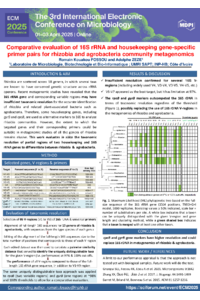
Rhizobia are scattered across 18 genera, in which several taxa are known to have conserved genetic structure across rRNA operons. Recent metagenomic studies have revealed that the 16S rRNA gene and corresponding variable regions may have insufficient taxonomic resolution for the accurate identification of rhizobia and related plant-associated bacteria such as agrobacteria. Therefore, some housekeeping genes, including gyrB and rpoB, are used as alternative markers to 16S to analyze rhizobia communities. However, the extent to which the targeted genes and their corresponding primers could be suitable in metagenomic studies of all the genera of rhizobia remains elusive. This work evaluates in silico the taxonomic resolution of partial regions of two housekeeping and 16S rRNA genes to differentiate between rhizobia and agrobacteria communities. For the evaluation, nine V-regions (V1 to V9) spanning the entire 16S rRNA gene and commonly targeted in bacterial metagenomic-based studies were selected. The full-length 16S rRNA gene sequences retrieved from genome data archived in GenBank were first aligned for 19 rhizobia and agrobacteria genera, and the alignment was adjusted to the total number of positions that correspond to those of each V-region. The number of positions in each edited dataset was used to calculate pairwise similarity distances, which were used to identify uniquely distinguishable taxa for a given V-region, mainly at 97% (OTU) and 100% (ASV) cut-offs. The same uniquely distinguishable taxa approach was applied to rpoB (two regions) and gyrB (one region) at ~98% and 100% thresholds to allow for a comparative evaluation. This study suggested V5-V7 as the best 16S rDNA v-region for differentiating all genera at a 100% threshold. However, the rpoB and gyrB markers outcompeted the 16S rDNA in terms of taxonomic resolution regardless of the threshold, possibly replacing the use of 16S rDNA V-regions in the metagenomics of rhizobia and agrobacteria.
Keywords
rhizobia
metagenomic
16S rDNA variable regions
housekeeping gene
amplicon sequencing
Poster
Romain FOSSOU K. ECM 2025 POSTER_v2OK.pdf
Bark extract of Melia azedarach inhibits motility and viability of Ralstonia solanacearum growing in humid substrate
Interplay of symbiotic bacteria in Wolbachia density modulation among Naupactini weevils (Coleoptera, Curculionidae)