Event submissions
Published
This submission belongs to the session S1. Microbial Characterization and Bioprocess of the event The 3rd International Electronic Conference on Microbiology
Published date
31 Mar, 2025
Academic Editor
'%3e%3cpath%20d='M12.6657%2010.9104C12.4185%2010.325%2012.0599%209.79327%2011.6097%209.34482C11.1609%208.89508%2010.6293%208.5365%2010.0442%208.28888C10.0389%208.28626%2010.0337%208.28495%2010.0285%208.28233C10.8446%207.69279%2011.3752%206.73249%2011.3752%205.64904C11.3752%203.8542%209.92103%202.39999%208.1262%202.39999C6.33136%202.39999%204.87715%203.8542%204.87715%205.64904C4.87715%206.73249%205.40774%207.69279%206.22393%208.28364C6.21869%208.28626%206.21345%208.28757%206.20821%208.29019C5.62129%208.5378%205.09463%208.89284%204.64265%209.34613C4.1929%209.79493%203.83432%2010.3266%203.58671%2010.9117C3.34345%2011.4845%203.21226%2012.0987%203.20023%2012.7209C3.19988%2012.7349%203.20233%2012.7488%203.20744%2012.7619C3.21255%2012.7749%203.22022%2012.7867%203.22998%2012.7968C3.23975%2012.8068%203.25142%2012.8147%203.26431%2012.8202C3.2772%2012.8256%203.29105%2012.8284%203.30504%2012.8284H4.09109C4.14874%2012.8284%204.19459%2012.7825%204.1959%2012.7262C4.2221%2011.7148%204.62823%2010.7676%205.34617%2010.0497C6.08899%209.30683%207.0755%208.89808%208.1262%208.89808C9.17689%208.89808%2010.1634%209.30683%2010.9062%2010.0497C11.6242%2010.7676%2012.0303%2011.7148%2012.0565%2012.7262C12.0578%2012.7838%2012.1037%2012.8284%2012.1613%2012.8284H12.9474C12.9613%2012.8284%2012.9752%2012.8256%2012.9881%2012.8202C13.001%2012.8147%2013.0126%2012.8068%2013.0224%2012.7968C13.0322%2012.7867%2013.0398%2012.7749%2013.0449%2012.7619C13.0501%2012.7488%2013.0525%2012.7349%2013.0522%2012.7209C13.0391%2012.0947%2012.9094%2011.4855%2012.6657%2010.9104ZM8.1262%207.9024C7.52486%207.9024%206.9589%207.6679%206.53312%207.24211C6.10733%206.81633%205.87283%206.25037%205.87283%205.64904C5.87283%205.0477%206.10733%204.48174%206.53312%204.05596C6.9589%203.63018%207.52486%203.39567%208.1262%203.39567C8.72753%203.39567%209.29349%203.63018%209.71927%204.05596C10.1451%204.48174%2010.3796%205.0477%2010.3796%205.64904C10.3796%206.25037%2010.1451%206.81633%209.71927%207.24211C9.29349%207.6679%208.72753%207.9024%208.1262%207.9024Z'%20fill='%235D1EE1'/%3e%3c/g%3e%3c/svg%3e) Thomas Brueck
Thomas BrueckCitation
Lizbeth Rosas-Ordoñez, Oscar Jiménez-González, Taisa S.S. Pereira, Evaluation of antioxidant stability of jinicuil (Inga paterno) probiotic beverages fermented by Lactobocillus delbrueckii ssp bulgaricus and Streptococus thermophilus during refrigeration storage, in Proceedings of The 3rd International Electronic Conference on Microbiology, 1 April–3 April 2025, MDPI: Basel, Switzerland
Share
Email
Facebook
Twitter
LinkedIn
Evaluation of antioxidant stability of jinicuil (Inga paterno) probiotic beverages fermented by Lactobocillus delbrueckii ssp bulgaricus and Streptococus thermophilus during refrigeration storage

Lizbeth Rosas-Ordoñez 1
'%3e%3cpath%20d='M12.6647%2010.9104C12.4176%2010.325%2012.0589%209.7933%2011.6088%209.34485C11.16%208.89511%2010.6283%208.53653%2010.0432%208.28891C10.038%208.28629%2010.0327%208.28498%2010.0275%208.28236C10.8437%207.69282%2011.3743%206.73252%2011.3743%205.64907C11.3743%203.85423%209.92005%202.40002%208.12522%202.40002C6.33038%202.40002%204.87618%203.85423%204.87618%205.64907C4.87618%206.73252%205.40677%207.69282%206.22296%208.28367C6.21772%208.28629%206.21248%208.2876%206.20724%208.29022C5.62031%208.53783%205.09365%208.89287%204.64167%209.34616C4.19192%209.79496%203.83334%2010.3266%203.58573%2010.9117C3.34247%2011.4846%203.21128%2012.0987%203.19925%2012.721C3.1989%2012.735%203.20135%2012.7489%203.20646%2012.7619C3.21157%2012.7749%203.21924%2012.7868%203.22901%2012.7968C3.23877%2012.8068%203.25045%2012.8148%203.26334%2012.8202C3.27623%2012.8256%203.29007%2012.8284%203.30406%2012.8284H4.09012C4.14776%2012.8284%204.19362%2012.7825%204.19493%2012.7262C4.22113%2011.7148%204.62726%2010.7676%205.34519%2010.0497C6.08802%209.30686%207.07452%208.89811%208.12522%208.89811C9.17592%208.89811%2010.1624%209.30686%2010.9052%2010.0497C11.6232%2010.7676%2012.0293%2011.7148%2012.0555%2012.7262C12.0568%2012.7839%2012.1027%2012.8284%2012.1603%2012.8284H12.9464C12.9604%2012.8284%2012.9742%2012.8256%2012.9871%2012.8202C13%2012.8148%2013.0117%2012.8068%2013.0214%2012.7968C13.0312%2012.7868%2013.0389%2012.7749%2013.044%2012.7619C13.0491%2012.7489%2013.0515%2012.735%2013.0512%2012.721C13.0381%2012.0947%2012.9084%2011.4856%2012.6647%2010.9104ZM8.12522%207.90243C7.52388%207.90243%206.95792%207.66793%206.53214%207.24215C6.10636%206.81636%205.87185%206.2504%205.87185%205.64907C5.87185%205.04773%206.10636%204.48177%206.53214%204.05599C6.95792%203.63021%207.52388%203.3957%208.12522%203.3957C8.72655%203.3957%209.29252%203.63021%209.7183%204.05599C10.1441%204.48177%2010.3786%205.04773%2010.3786%205.64907C10.3786%206.2504%2010.1441%206.81636%209.7183%207.24215C9.29252%207.66793%208.72655%207.90243%208.12522%207.90243Z'%20fill='%235D1EE1'/%3e%3c/g%3e%3c/svg%3e)
Oscar Jiménez-González 1
Taisa S.S. Pereira 2
1. Department of Chemical, Food and Environmental Engineering, Universidad de las Américas Puebla, Puebla, 72810, Mexico
2. Department of Health Sciences, Universidad de las Américas Puebla, Puebla, 72810, Mexico
Abstract
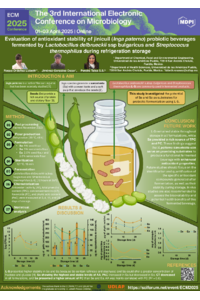
Inga paterno produces seeds (Se) covered by a sarcotesta (Sa), both of which remain understudied. Meanwhile, Lactobacillus delbrueckii subsp. bulgaricus and Streptococcus thermophilus (L-S) are commonly used in fermented products. This study investigated the potential of Se and Sa as substrates for probiotic fermentation using L-S.
Three formulations were prepared: 5%(w/v) Sa, 5%(w/v) Se, and a 1:1 mixture (Ae). These were sterilized, inoculated with L-S (7.67×10⁶ CFU/ml), fermented (72 hours at 35°C), and stored at refrigeration temperature (5°C). Antioxidant activity (AA), total phenolic content (TPC), condensed tannins (CT), flavonoids (FC), and phytic acid content (PAC) were measured at 0, 4, 11, and 25 days of storage. One-way ANOVA and Tukey's test (p < 0.05) were used to analyze the data.
L-S counts ranged from 6.69 to 9.41 log CFU/ml, with higher stability in Se (8.39 to 7.62 log CFU/ml) and Sa (8.44 to 8.01 log CFU/ml). AA ranged from 27.50 to 115.92 μg Trolox equivalents/ml, with Sa showing the highest and stable levels (84.07 to 113.46 log CFU/ml). PAC increased in Sa (from 34.22 to 42.54 μg of phytic acid /ml) but decreased in Se (from 40.13 to 37.73 μg of phytic acid /ml). CT decreased in all formulations (ranging from 1.53 to 0.70 mg of catechin equivalents/ml), and Sa presented a higher amount of FC (from 0.53 to 1.04 mg of quercetin equivalents/ml) than Se (from 0.03 to 0.08 mg of quercetin equivalents/ml) and Ea (from 0.09 to 0.21 mg of quercetin equivalents/ml). AA was mainly correlated with FC (R² = 0.6). L-S remained viable throughout storage in all formulations, while Sa provided a rich source of TPC and FC. These findings suggest that I. paterno sarcotesta can serve as promising substrates to produce a functional fermented beverage with enhanced antioxidant properties.
Keywords
phenols
flavonoids
condensed tannins
probiotic
antioxidant activity
novel legume
jinicuil
Poster
sciforum-111350 poster.pdf
Staphylococcus aureus biofilm gene analysis: risks for patients with chronic lymphocytic leukemia (CLL)
Exploring Beer By-products as Novel Antibacterial Ingredients for Health Care Products